
Peptides in Health and Fitness Research
Literacy guide to peptide research in wellness, recovery, and performance talk, with clear limits on evidence, anti-doping context, and what studies can support.

Health and fitness media often mentions peptides alongside recovery, body composition, sleep, inflammation, and athletic performance. Those topics are real research areas in biology and medicine, but popular summaries frequently blur study models, endpoints, and regulatory categories. This guide is about research literacy for readers who want to understand those conversations without treating headlines as training plans or medical instructions. It explains claim patterns, evidence limits, anti-doping context for athletes who follow tested sport, and better questions to ask before trusting a wellness peptide story.
Key takeaways
- Fitness and wellness discussions often cite peptide research out of context. Study model, population, and measured endpoint matter more than marketing labels.
- Recovery, performance, and body composition language in media is often broader than the specific outcomes reported in papers.
- Approved peptide medicines, investigational candidates, and informal research chemicals are different educational categories and should not be blended casually.
- WADA publishes a Prohibited List that is part of the real-world context for competitive athletes. Status on that list is a rules question, not a scientific proof of effect.
- Sleep, stress, and inflammation claims are especially prone to vague wording. Ask what was measured and in whom.
- This page is educational only. It is not medical advice, coaching advice, or a recommendation to use any substance.
Educational disclaimer
This guide is for research literacy and education only. It is not medical advice. Read our disclaimer.
What this Health and Fitness guide covers
This guide covers how peptide research is discussed in wellness, recovery, body composition, sleep, stress, inflammation, and performance contexts. It is written for readers who encounter peptide talk in podcasts, social feeds, gym culture, and sports media and want a clearer map of what those claims usually rest on.
Literacy focus, not lifestyle prescription
The focus is literacy, not lifestyle prescription. You will see how everyday words like recovery and performance map poorly onto specific study endpoints, why regulatory and anti-doping categories matter for context, and how to compare a media claim with a paper abstract without overreaching.
What this page is not, and where to go next
It is not a workout plan, nutrition protocol, substance-use guide, or coaching program. Viral Peptides does not promote personal use of research peptides. Use related Health and Fitness articles for narrower educational topics, Research and Science for study-design depth, Safety and Guides for responsibility framing, and Peptide Basics when vocabulary still feels fuzzy.
Why peptides appear so often in fitness media

Peptides are short amino-acid chains. Educational biochemistry sources such as StatPearls describe them as relatively short sequences linked by peptide bonds, often contrasted with longer proteins. In biology teaching they frequently appear as messengers: molecules that carry signals between cells or within pathways. That messenger framing travels easily into wellness media, where audiences look for explanations of recovery, body composition, aging biology, or training adaptation.
A real biomedical field collapsed into a trend story
Therapeutic-peptide reviews by Lau and Dunn, and later landscape reviews such as Wang and colleagues, show that peptide science is a genuine biomedical field. Some peptides are approved medicines for labeled indications. Many others are investigational candidates. Still others remain research tools studied mainly in chemistry, cell, or animal models. Fitness media often collapses that landscape into a single trend story in which every peptide sounds equally established.
Adjacent laboratory endpoints are not gym guarantees
There is also a cultural reason these stories spread. Fitness audiences already care about measurable change: strength, body composition, sleep quality, soreness, and return-to-training timelines. Peptide research papers sometimes report biomarkers, tissue readouts, or metabolic outcomes that sound adjacent to those goals. Adjacent is not identical. A controlled laboratory endpoint is not a gym guarantee, and a clinical indication is not a general lifestyle claim.
Which story are you actually reading?
A useful reader habit is to ask which story you are reading. Is the claim about an approved medicine for a labeled indication? A registered clinical research question? A preclinical finding rewritten for lifestyle certainty? Or informal marketing language that borrows scientific words without matching scientific categories? Keeping those lanes separate is the core skill this pillar teaches.
Familiarity is not scientific consensus
Search interest and social repetition also amplify the topic. When enough creators use the same vocabulary, audiences can mistake familiarity for consensus. Familiarity is a media effect. Consensus in science is slower, narrower, and usually tied to specific indications and study designs. Educational readers benefit from treating repetition as a cue to verify sources, not as a substitute for evidence.
Recovery language versus what studies can support

Recovery is a broad everyday word. In training culture it can mean feeling less sore, sleeping better, returning to practice sooner, or simply believing that adaptation is on track. In research, recovery may mean a specific tissue endpoint, a biomarker, a functional test, imaging finding, or a patient-reported outcome. Those measurements answer different questions and should not be treated as interchangeable.
Check study type before accepting recovery claims
When fitness content says a peptide helps recovery, check the original study type. Animal injury models, cell assays, and human trials answer different questions. Moving from one level to the next without saying so is a common overreach. A rodent soft-tissue model may be scientifically interesting and still leave human training outcomes unproven.
Tie recovery talk to the actual endpoint
Educational coverage should keep recovery talk tied to the actual endpoint. Otherwise the word becomes a slogan. Ask: recovered according to what measure, in which population, over what time window, compared with what control? If the source cannot answer those points, the claim is weaker than the headline suggests.
Stability and delivery constraints in the literature
Therapeutic-peptide literature also repeatedly notes practical constraints such as metabolic fragility and delivery challenges. Reviews discussing protease sensitivity and stability engineering, including work summarized in Lucana and colleagues on protease-resistant peptide concepts, remind readers that biology in a paper is not the same as a ready wellness product story. Stability and delivery constraints are research themes, not instructions for personal use.
Optional literacy table: recovery language versus measurable research endpoints
| Everyday recovery language | Example measurable endpoint in research | Why the gap matters |
|---|---|---|
| I recovered faster | Time to a defined functional milestone in a protocol | Feeling better is not the same as a pre-specified endpoint |
| Less inflammation | Named biomarker or imaging readout under defined conditions | Inflammation is many pathways, not one casual label |
| Better recovery sleep | Sleep architecture or validated sleep questionnaire scores | Anecdote and measured sleep are different evidence types |
| Back to training sooner | Return-to-activity criteria in a clinical or sports medicine study | Gym timelines often omit controls and diagnosis |
Body composition claim literacy
Body composition and metabolic claims are among the most persuasive and most misread topics in health and fitness peptide talk. Readers care about fat mass, lean mass, waist measures, and scale weight. Research papers may report related outcomes, but methods dominate interpretation. Diet control, training status, measurement tool, hydration, study duration, and adherence can dwarf the effect a headline attributes to a single molecule.
Measurement tools are not interchangeable
DEXA, bioimpedance, skinfolds, MRI, and simple scale weight are not equivalent tools. A small change on one method may not appear on another. Short studies can capture water shifts or temporary dietary change rather than durable composition change. Open-label designs and uncontrolled before-after anecdotes are especially weak for physique claims.
Halo borrowing from approved metabolic medicines
Peptide-related discussions in this area are prone to halo borrowing: an approved metabolic medicine with a labeled indication is used rhetorically to make unrelated research chemicals sound equally settled. That leap is not valid. Landscape reviews of therapeutic peptides carefully distinguish approved products, clinical candidates, and earlier-stage research. Educational readers should demand the same distinctions.
Population match and time scale
If a claim sounds like a guaranteed physique result, it is probably leaving out the hard parts: controls, adherence, measurement error, and external validity. Look for transparent methods and avoid treating influencer summaries as primary sources. Ask whether the population studied matches the audience being sold the story. Metabolic research in clinical populations does not automatically generalize to recreational athletes or healthy adults seeking aesthetic change.
Another literacy check is time scale. Many composition studies are weeks to months long under supervised conditions. Media often implies rapid transformation without stating diet control or training standardization. If a summary skips those constraints, you are reading a sales story built beside research language, not a careful translation of a methods section.
Performance talk and anti-doping reality

Performance is another word that expands in media and contracts in research. Media performance can mean any perceived edge: energy, recovery, motivation, or competition results. Research performance usually means defined tests under protocol conditions. Those are not the same claim.
Anti-doping rules as part of the evidence landscape
Competitive athletes must treat anti-doping rules as part of the evidence landscape, not a footnote. The World Anti-Doping Agency publishes a Prohibited List that athletes and support staff are expected to consult. That list includes categories such as non-approved substances and other classes relevant to pharmacological agents discussed in sport. Educational explanations of the list have discussed examples such as BPC-157 in the context of non-approved substances. National organizations such as USADA also publish athlete-facing prohibited list resources.
Prohibition status is not a scientific efficacy score
Anti-doping status does not by itself answer every scientific question about a compound. A substance can be prohibited and still have thin human evidence, or be permitted in a category while still lacking fitness-marketing support. The list answers a practical sport rules question: many substances discussed in wellness culture are prohibited in sport regardless of internet popularity.
Literacy only for tested sport readers
If you follow tested sport, rely on official anti-doping resources and your sport organization. This page is literacy only. It does not advise use, avoidance protocols, therapeutic use exemptions, or any personal strategy. It only explains why rules literacy belongs in the same conversation as media literacy when performance peptides are discussed.
WADA-relevant context for athletes reading fitness peptide media
| Topic | Why it matters for athletes | Where to verify (WADA prohibited list) |
|---|---|---|
| Non-approved pharmacological substances | Many wellness-discussed compounds fall under sport rules even when marketed as research chemicals | Consult the current WADA Prohibited List and your sport body guidance |
| Annual list updates | Status can change; relying on old social posts is a rules risk | Check the live WADA list page rather than secondary summaries |
| Supplement and informal market confusion | Labeling and online claims do not determine anti-doping status | Verify substance categories on the official list, not seller copy |
| Team and federation policy | National and sport-specific rules may add obligations beyond headlines | Cross-check WADA with USADA or your national anti-doping organization |
Wellness marketing patterns to watch
Pattern one: preclinical findings rewritten as lifestyle certainty. A cell or animal result becomes a confident human promise without stating the model. Pattern two: approved peptide medicines used as halo evidence for unrelated research chemicals. Pattern three: personal anecdotes treated as equivalent to controlled studies.
Urgency, research-use labels, and stacked soft claims
Pattern four: urgency and scarcity language that discourages careful reading. Pattern five: research-use-only labels placed next to human-use implications. Pattern six: stacking many soft claims (sleep, recovery, inflammation, body composition) so no single claim can be checked against a single endpoint.
Selective citation that drops development limits
Pattern seven: selective citation. A review of therapeutic peptides is quoted for excitement while the same review's discussion of development failure rates, delivery limits, or indication specificity is ignored. Lau and Dunn, Wang and colleagues, and related landscape papers are useful precisely because they hold both promise and constraint in view.
Pause when one claim bundles many outcomes
When you notice these patterns, slow down and return to study-design basics from the Research and Science guide. Marketing fluency is not evidence strength. A polished video can still rest on a weak abstract match. A useful personal rule is to pause whenever a claim bundles several outcomes at once. Multi-benefit language is harder to falsify and easier to sell, which is exactly why careful readers unpack it claim by claim.
Claim type, typical evidence, and reader caution
| Claim type | Typical evidence behind it | Reader caution |
|---|---|---|
| Mechanism or pathway story | Binding assays, cell signaling readouts, narrative reviews | Mechanism hypotheses are not proven lifestyle outcomes |
| Tissue recovery story | Often animal injury models or early exploratory human work | Model and endpoint may not match training recovery language |
| Body composition story | Metabolic trials, observational data, or uncontrolled anecdotes | Diet, training, and measurement method can dominate results |
| Performance edge story | Mixed: sometimes lab tests, often testimonials | Sport rules and study validity are separate checks |
| Sleep or stress story | Indirect biomarkers, small samples, or vague surveys | Ask for validated measures and clear populations |
Approved medicines versus trend compounds

Some peptide drugs are approved for specific medical indications after formal development, quality controls, and regulatory review. That history is sometimes used rhetorically to make every peptide sound established. That leap is not valid. Approval is use-specific and jurisdiction-specific.
Investigational candidates and trial-phase vocabulary
Investigational peptides may appear in registries, early-phase trials, or development pipelines. NIH educational materials describe clinical research phases in plain language: early phases focus more on safety exploration in small groups; later phases test effectiveness in larger groups; post-approval research continues to learn about real-world use. Not every compound discussed in fitness media has entered that pathway.
Informal research chemicals are not an evidence class
Informal research chemicals and trend compounds discussed in gyms or on social platforms are not a scientific category. Popularity, forum consensus, and seller language do not create an evidence class. FDA educational communications about certain bulk drug substances used in compounding have also highlighted significant safety-information gaps and quality concerns for some peptide-related substances in compounding contexts. Those communications are context about risk information gaps, not a finished judgment on every setting, and they are not a how-to guide.
Keep categories visible in fitness content
Educational fitness content should keep categories visible. A compound being widely discussed is not the same as being approved, and being studied is not the same as being settled for wellness goals.
For incretin-specific status literacy outside this fitness hub, see GLP-1 peptide medicines explained and tirzepatide research status in Research & Science, plus compounded vs approved peptide medicines in Safety & Guides.
Educational categories: approved medicine, investigational, and informal research chemical
| Category | What it usually means in education | Common media mistake |
|---|---|---|
| Approved medicine | Regulated product for labeled indications after formal review | Treating any related peptide as equally settled |
| Investigational candidate | Studied in registered research with unanswered questions remaining | Reading early-phase interest as finished proof |
| Informal research chemical / trend compound | Discussed outside a clear approved or late-stage clinical pathway | Equating online popularity with evidence quality |
Sleep and stress claim caution
Sleep and stress sit at the center of wellness marketing because everyone recognizes them as felt experiences. That familiarity makes vague claims easy to accept. Research literacy asks for harder detail: which sleep measure, which stress construct, which instrument, which population, and which time frame.
Anecdote versus validated sleep and stress measures
A claim that someone slept better after hearing about a peptide is anecdote. A study using a validated questionnaire, actigraphy, or polysomnography is a different kind of statement. Cortisol snapshots, heart-rate variability snippets, and mood adjectives are also not interchangeable. Mixing them into one recovery narrative hides uncertainty.
Pathway storytelling is not outcome evidence
Peptide messenger language can sound especially persuasive here because sleep and stress biology already involve signaling systems. Educational readers should still separate pathway storytelling from outcome evidence. Reviews of therapeutic peptides describe real signaling roles for many endogenous peptides while also documenting how hard translation into medicines can be. That dual reality applies to wellness claims as well: biological plausibility is not the same as demonstrated benefit for a fitness audience.
Demand the endpoint or treat the claim as unfinished
If sleep or stress is the center of a peptide story you are reading, demand the endpoint. If the endpoint is missing, treat the claim as unfinished education rather than actionable certainty. The same caution applies when creators use laboratory pathway language to explain why an audience should feel restored overnight. Pathway talk can be interesting as biology education and still fail as outcome evidence for sleep quality or stress resilience in trained adults.
Inflammation language caution
Inflammation is one of the most overextended words in health and fitness media. In clinical and research settings it can refer to infection response, sterile tissue injury processes, autoimmune activity, or local cellular signaling. In lifestyle media it often becomes a single villain that every product claims to calm.
From cytokine changes to whole-body certainty
Peptide discussions inherit that problem. A paper may report a cytokine change in a model system. A post may translate that into whole-body recovery certainty. Those are different claims. Named biomarkers, histology scores, and clinical inflammation indices are measurable. Feeling less inflamed is not a standardized endpoint unless a study defines it carefully.
Training-related signaling is not a single villain
Training itself creates inflammatory signaling as part of adaptation. Reducing every training-related signal is not automatically desirable, and wellness copy rarely acknowledges that nuance. Educational reading should ask whether the inflammation claim is about pathology, acute exercise response, or a marketing mood.
Circular recovery wording to watch for
As with recovery language, keep the word tied to a measure. If no measure is offered, the claim is mostly rhetoric. Readers can also watch for circular wording: a product is said to support recovery because it supports healthy inflammation responses, while healthy inflammation responses are defined only as feeling recovered. That loop explains nothing measurable.
Comparing a media claim with a paper abstract
A practical literacy drill is to place a media sentence next to the abstract it supposedly rests on. Start with the media claim's subject, verb, and object. Then find the paper's population or model, intervention or exposure, comparator, and primary outcome. If those pieces do not match, the media claim is stretching.
- Does the abstract population match the audience in the post?
- Is the endpoint the same as the media outcome word?
- Is the study human, animal, or in vitro?
- Are limitations acknowledged in the paper but erased in the post?
- Is the citation a review being used as if it were a definitive trial?
Tense, population, and outcome shifts
Watch for tense and certainty shifts. Abstracts often say associated with, observed in, or may suggest. Media often says proves, transforms, or unlocks. Watch for population shifts: clinical patients become athletes; rodents become humans; cell assays become gym results. Watch for outcome shifts: molecular readouts become physique or podium claims.
Primary study, review, or definition page?
Also check whether the cited source is a primary study, a narrative review, a systematic review, or an opinion piece. Therapeutic-peptide reviews are excellent for landscape context and still may not support a specific fitness promise. StatPearls-style educational biochemistry pages define terms; they are not evidence that a trend compound works for recovery.
Downgrade confidence without retrievable sources
If you cannot locate a paper, registry entry, or official regulatory page behind a strong claim, downgrade your confidence. Citation theater without retrievable sources is a warning sign.
Athlete decision framework: rules literacy, not use advice
Athletes and support staff often need a decision framework that is about information quality and rules awareness, not about how to obtain or use substances. A responsible educational framework asks different questions from a coaching protocol.
- What category is being discussed: approved, investigational, or informal trend?
- What does the current WADA list say, verified on the official page?
- What exact outcome is being claimed, and what study supports it?
- Who studied that outcome, and does that population match yours?
- Are you reading education, marketing, or compliance information?
Category, anti-doping status, and scientific uncertainty
First, identify whether the conversation is about an approved medicine with a labeled indication, an investigational agent, or an informal trend compound. Second, check current anti-doping status using official sources such as the WADA Prohibited List and athlete-facing pages from organizations like USADA. Third, separate scientific uncertainty from rules certainty: a compound can be poorly evidenced and still prohibited, or widely discussed and still prohibited.
Sport-relevant endpoints and professional involvement
Fourth, evaluate the claim against endpoints that matter in your sport science context: validated performance tests, injury definitions, and medical diagnosis pathways are not the same as influencer recovery talk. Fifth, involve appropriate professionals for medical and compliance questions. This site does not replace team physicians, pharmacists, or anti-doping advisors.
A framework that is not a green light
The point of this framework is to reduce confusion. It is not a green light, red light, or dosing framework. Viral Peptides does not recommend use of any peptide for performance or recovery.
Women and men in research: generalizability caveats
Fitness media often speaks as if study findings apply equally to every adult who trains. Research populations are rarely that broad. Sex, age, hormonal status, training history, clinical diagnosis, and body composition baseline can all change how results should be read.
Underrepresentation and mismatched clinical cohorts
Some metabolic and body-composition literatures have historically underrepresented women or have not reported sex-specific analyses clearly. Other studies focus on clinical populations that do not resemble recreational athletes. Educational readers should notice who was enrolled before accepting a universal gym conclusion.
Generalizability problems cut both ways
Generalizability problems cut both ways. A finding in young male athletes does not automatically transfer to older adults or to women. A finding in a clinical female cohort does not automatically transfer to elite sport. Absence of subgroup data is a limitation, not a license to invent symmetry.
Population detail as evidence quality
When a peptide wellness claim ignores population detail, treat that as incomplete literacy. Ask for sex distribution, inclusion criteria, and whether authors discuss external validity. Those details are part of evidence quality, not pedantry.
Age and training status deserve the same scrutiny
Age and training status deserve the same scrutiny. A clinical cohort recovering from illness is not interchangeable with a collegiate team in-season, and neither is interchangeable with masters athletes managing different recovery baselines. Educational summaries that flatten those differences into one audience make the science look more portable than it is.
Safety signals in a fitness context

Fitness culture can normalize experimental substances faster than evidence can catch up. Quality, identity, and purity concerns are part of why informal markets are a poor substitute for regulated medicines. FDA communications about certain bulk drug substances that may present significant safety risks in compounding contexts are one public educational signal that popularity is not a safety certificate.
Unknowns are neither proof of harm nor proof of safety
Safety literacy also means noticing what is unknown. Missing long-term data, limited human studies, and unclear product quality are information gaps. Gaps are not proof of harm in every case, and they are not proof of safety either. They are reasons for caution in interpretation.
Where to continue for responsibility and methods
This guide does not inventory adverse events compound by compound, and it does not provide medical triage. For responsibility boundaries and disclaimer framing, continue in Safety and Guides. For method vocabulary that helps you read safety language in papers, use Research and Science.
Better questions checklist before trusting a fitness peptide claim
Good questions protect you from confusing education with coaching or medical direction. They also make media claims easier to audit. Use this checklist as a reading tool, not as a purchase or use protocol.
- What exact outcome was measured, and in what units or instrument?
- What study model was used: cell, animal, or human?
- Who was studied, and how well does that group match the claim's audience?
- Is the compound an approved medicine for that use, investigational, or something else?
- Does the media wording match the abstract, or stretch it?
- Would this conversation conflict with sport anti-doping rules for tested athletes?
- Is the source disclosing uncertainty, conflicts, and limitations?
- Is urgency or scarcity doing more work than methods?
- Can you verify citations on PubMed, PMC, NIH, FDA, WADA, or similar primary pages?
- Are sleep, stress, inflammation, or recovery words tied to defined endpoints?
Literacy is not cynicism
Those questions do not make you a cynic. They make you literate. If a source cannot tolerate them, the source is selling certainty more than evidence.
Where to go next
Read related Health and Fitness articles for topic-specific educational explainers when you need a narrower question. Use Research and Science when you need study-design depth, trial-phase vocabulary, or help reading methods sections. Use Safety and Guides for responsibility, limitation, and disclaimer framing.
Official pages and landscape reviews worth opening
Peptide Basics remains the vocabulary foundation if terms such as peptide bond, half-life, or messenger still feel fuzzy. Landscape reviews such as Lau and Dunn and Wang and colleagues are strong next reads for the therapeutic-peptide field as a whole. Official pages from WADA, USADA, NIH, and FDA are the right places for rules, glossary, and safety-context verification.
No training plan, medical plan, or substance-use guide
Remember: no article on this site is a training plan, medical plan, or substance-use guide. The goal of this pillar is clearer reading of peptides in health and fitness research conversations.
Frequently asked questions
Does this guide recommend peptides for fitness or recovery?
No. It explains how peptide research is discussed in health and fitness contexts. It does not recommend use of any substance, and it does not provide training or medical instructions.
Why mention WADA on an educational site?
Because many readers follow competitive or tested sport. Anti-doping status is part of the real-world context around substances discussed in fitness media. Verify details on the official WADA Prohibited List and related athlete resources such as USADA.
Are recovery peptides proven?
It depends on the compound, the study type, and the endpoint. Many popular claims outrun the available human evidence. Always check the original research design and whether recovery was a defined measure or a marketing word.
How should I read body composition claims in peptide media?
Look for measurement methods, diet and training controls, study duration, and population. Physique language in media is often broader than what a paper actually measured. Treat influencer summaries as secondary, not primary, sources.
What is the difference between an approved peptide medicine and a trend compound?
An approved medicine has a regulated pathway for labeled indications. An investigational candidate is still being studied with unanswered questions. Informal trend compounds discussed online are not an evidence category by popularity alone. Educational reading should keep those lanes separate.
Can sleep, stress, or inflammation claims be taken at face value?
Not without endpoints. Ask what was measured, with which tool, in whom, and compared with what. Vague wellness wording is common in these areas and often outruns the data.
Do findings in men automatically apply to women, or the reverse?
No. Generalizability depends on who was studied and whether sex-specific analyses were reported. Fitness media often over-extends results across populations. Check enrollment and limitations before accepting universal claims.
Is this medical or coaching advice?
No. Viral Peptides publishes educational research explainers only. For personal health decisions, speak with appropriate licensed professionals. For sport compliance questions, consult official anti-doping resources and your sport organization.
Sources & citations
Key definitions and research-literacy points in this guide are grounded in the publicly available educational and review sources below. Links open the original pages so you can verify context yourself.
- World Anti-Doping Agency. The Prohibited List.
- U.S. Anti-Doping Agency. Prohibited List overview.
- U.S. FDA. Certain Bulk Drug Substances for Use in Compounding that May Present Significant Safety Risks.
- Lau JL, Dunn MK. Therapeutic peptides: Historical perspectives, current development trends, and future directions. Bioorg Med Chem. 2018. PubMed PMID: 28720325.
- Wang L, et al. Therapeutic peptides: current applications and future directions. Signal Transduct Target Ther. 2022. PubMed PMID: 35165272.
- National Institutes of Health. Glossary of Common Terms (clinical research phases).
- Lucana MC, Arruga Y, Petrachi E, et al. Protease-Resistant Peptides for Targeting and Intracellular Delivery of Therapeutics. Pharmaceutics. 2021. PMC8708026.
- Forbes Kaprive J, Krishnamurthy K. Biochemistry, Peptide. StatPearls. NCBI Bookshelf.
Related articles
More specific explainers that go deeper on individual topics.
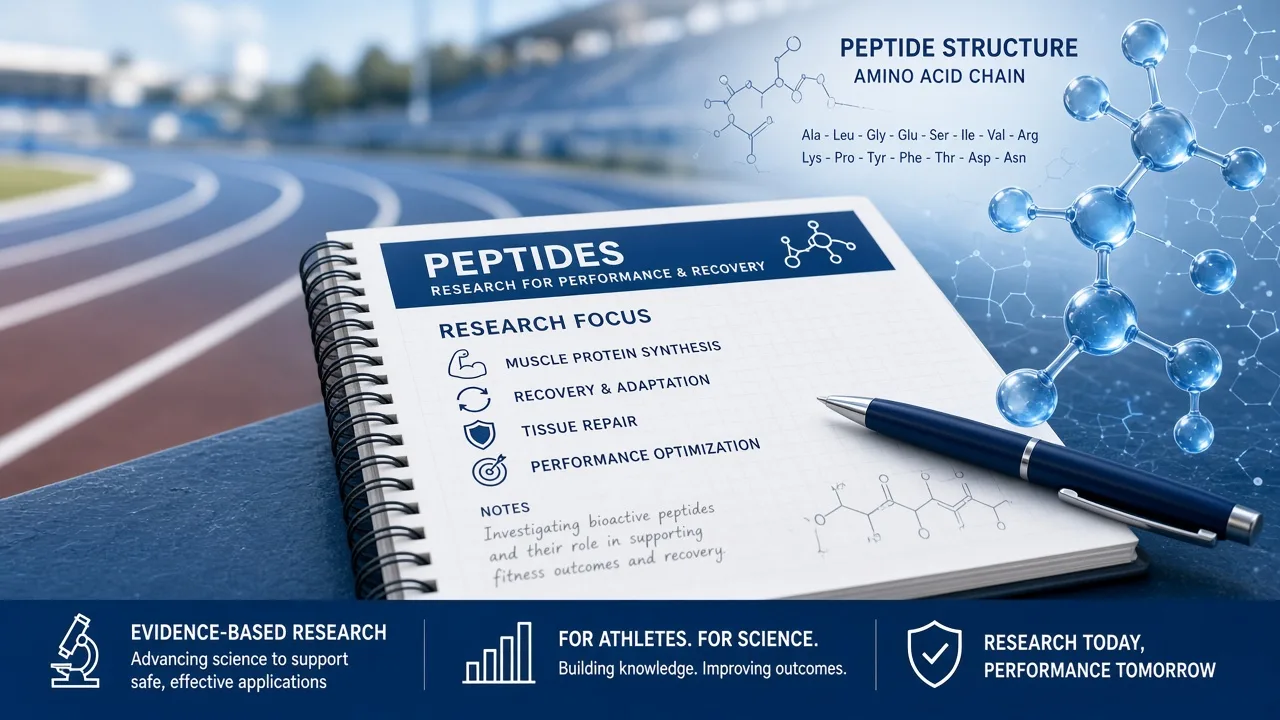
Peptides and Fitness Research Limits
How peptide science appears in wellness and recovery conversations, with focus on study limits, model systems, and sport-rule context for readers.

Peptides and Recovery Research
How recovery appears in exercise and peptide research: endpoints, study designs, and evidence limits explained for literacy, without use protocols.