
Peptide Research and Science Guide
Educational guide to peptide research literature: study designs, preclinical versus clinical evidence, half-life concepts, and how to spot overstated claims.

Peptide research is often discussed online as if every paper were a final answer. This guide explains how peptide science is actually produced and reported, from laboratory models to clinical trial phases, so you can read studies with clearer judgment and less hype. It is research literacy, not product advice.
Key takeaways
- Peptide research spans chemistry, cell models, animal studies, and human trials. Each level supports different kinds of conclusions, and those levels are not interchangeable.
- NIH educational materials describe clinical research in phases: early phases focus more on safety and dosing exploration in research settings; later phases test effectiveness in larger groups under formal protocols.
- Many native peptides are metabolically fragile. Reviews repeatedly highlight short half-life and protease sensitivity as core research constraints that shape study design.
- A strong-sounding abstract is not the same as regulatory approval, clinical consensus, or a finished human outcome claim.
- Reading tools such as CONSORT, trial registries, conflict disclosures, and endpoint definitions help you separate careful reporting from marketing rewrite.
- Use this guide to interpret literature, then open related articles for compound-specific or method-specific depth while keeping evidence limits visible.
Educational disclaimer
This guide is for research literacy and education only. It is not medical advice. Read our disclaimer.
What this Research & Science guide covers
This page is a map of peptide research literacy. It explains how scientists study peptides, how papers are structured, and how evidence strength changes as work moves from test tubes to animals to humans. The emphasis is on judgment: what a given study can support, what it cannot prove, and how online summaries often compress those differences.
What this page will not do
It does not tell you how to use any compound. It also does not treat research-use marketing language as proof of medical utility. The goal is orientation: enough method vocabulary to read related articles and primary papers without getting lost in confident headlines that outrun the data.
Recurring themes across sections
You will see recurring themes across sections: models, endpoints, stability, binding language, synthesis as a research concept, purity analytics, approval status, conflicts of interest, and reporting standards. Each theme appears because it repeatedly decides whether a claim is careful or overstated.
How to use related articles afterward
After this guide, use compound-focused articles for narrower questions, and return here when you need the broader evidence framework. If vocabulary itself is still fuzzy, Peptide Basics remains the better first stop before diving into literature critique.
Reading this as a syllabus
Think of this page as a syllabus. You can read it straight through, or jump to clinical phases, paper-reading checklists, or the glossary when a related post leaves a term unexplained. The through-line stays the same: evidence has tiers, and tiers are not interchangeable.
What peptide research usually means
In the scientific literature, peptide research can mean many different projects. Some papers are purely chemical: sequence design, purity, folding, or synthesis route. Others are biological: receptor binding, pathway activation, tissue readouts in a model system. Still others sit at the interface, connecting a chemical modification to a pharmacologic observation under controlled conditions.
Promise and constraint in therapeutic-peptide history
Therapeutic-peptide reviews describe a long history in which endogenous messengers inspired drug discovery, while also documenting practical limits such as instability and delivery challenges. That mix of promise and constraint is normal in the field, not a contradiction. Historical surveys such as Lau and Dunn place modern candidates inside a decades-long pipeline story, not a sudden consumer category.
Why landscape reviews show uneven progress
Landscape reviews, including Wang and colleagues, emphasize that therapeutic peptides occupy an active but selective development space. Candidates move, stall, or fail for scientific, commercial, and regulatory reasons. Expect uneven progress rather than a continuous upgrade of every named sequence discussed online.
Rewriting marketing sentences into research sentences
When a website says a peptide is researched, ask what kind of research. Binding assay? Cell culture? Rodent injury model? Human trial registry entry? Those are not interchangeable. Rewrite marketing sentences into research sentences: which model, which endpoint, which comparator, and whether any human data exist. That rewrite alone removes much of the fog around peptide research talk online.
Chemistry papers versus biology papers
Chemistry-facing peptide papers often prioritize sequence identity, purity, structural characterization, and synthetic strategy. They may report chromatographic traces, mass confirmation, or conformation studies. Those results can be rigorous and still say little about physiology in a living organism. Confusing a clean analytical profile with a clinical claim is a classic literacy error.
What biology-facing papers prioritize
Biology-facing papers prioritize functional readouts: receptor engagement, pathway markers, cell behavior, tissue histology, or organism-level outcomes in a model. They may cite chemistry only briefly. A strong biological signal in a narrow model still needs careful translation language, because model success does not automatically become human proof.
When modern papers blend both traditions
Many modern papers blend both traditions. A methods section may describe synthesis quality, then jump to a cell assay, then to an animal endpoint. Track which claims belong to which layer. A purity percentage supports identity and quality discussion. It does not by itself support a lifestyle outcome claim.
How reviews inherit the limits of cited work
Review articles help by surveying across layers, but reviews inherit the limits of the papers they cite. Zheng and colleagues discuss discovery, synthesis, and clinical translation as connected themes. That breadth is useful for orientation, yet each cited finding still rests on its own design and endpoint.
Keeping lanes distinct on related articles
When you open a related article on Viral Peptides, notice whether it mainly explains a chemical concept, a biological model, or a literature-reading habit. Keeping those lanes distinct makes peptide research easier to evaluate and harder to oversell.
An evidence ladder for peptide research claims

Evidence strength is not a personality trait of a molecule. It is a property of the study design, the endpoint, the population or model, and the transparency of reporting. A careful in vitro paper can be excellent science and still sit low on the ladder for human outcome claims. A large randomized trial can sit higher for a specific question and still leave other questions unanswered.
A simple ladder from chemistry to later trials
Educational readers benefit from a simple ladder: chemical characterization, biochemical or cell assays, animal models, early human studies, later confirmatory trials, and post-approval learning where applicable. Moving up the ladder usually means more relevance to human decisions, and also more cost, complexity, and attrition.
Publication bias and why the table is a reading aid
Publication bias and selective sharing can distort the ladder. Exciting positive models are more likely to be discussed. Negative or inconclusive work may remain quieter. That asymmetry is why replication language, registry checks, and limitation sections matter. The table below is a reading aid, not a ranking of scientific worth. Problems begin when communication pretends a lower rung already answered a higher-rung question.
Evidence ladder for reading peptide research claims carefully
| Study type | What it can support | What it cannot prove |
|---|---|---|
| Chemical characterization | Identity, purity context, structural description under stated methods | Biological effect, safety in people, or clinical usefulness |
| In vitro / cell assay | Mechanism hypotheses, binding or pathway signals in defined systems | Organism-level outcomes or real-world human benefit |
| Animal model study | Controlled physiologic signals in that species and model | Direct human equivalence or approved medical use |
| Early-phase human study | Preliminary safety and exploratory signals under a protocol | Broad effectiveness claims across populations |
| Later-phase confirmatory trial | Stronger evidence for specific endpoints in the studied population | Unlimited generalization beyond design, setting, and outcomes |
The preclinical ladder: chemistry, cells, and animal models
Most peptide stories begin far from clinical practice. Chemists characterize a sequence. Biologists may test it in vitro, in cell or biochemical systems. Later work may move into living animal models to explore physiology under controlled conditions. Each step answers a different question, and skipping the labels is how hype forms.
Why strong animal findings are not finished human conclusions
Preclinical evidence can be scientifically valuable and still leave major human questions unanswered. Species differences, dose translation problems in research settings, and publication bias all matter. Strong animal findings are a reason for careful further study, not a finished human conclusion.
Reading habits that beat confident titles
Educational reading habit: note the model organism, sample size, endpoints, and whether authors state limitations openly. Those details often matter more than a confident title. A paper that names its limits is usually easier to trust than a summary that erases them.
Cell systems as scaffolding, not miniature trials
Cell systems can be powerful for mechanism mapping and still be poor predictors of whole-organism behavior. Culture conditions and short observation windows shape results. Treat cell findings as scaffolding for hypotheses, not as miniature clinical trials. When related articles discuss a named research peptide, check whether the cited work is still on this preclinical ladder. Many popular names live almost entirely here.
Animal model caveats readers should keep visible
Animal models are tools for controlled questions. They are not miniature people. Strain, age, injury method, housing, and endpoint timing can all change what a study can claim. Two rodent papers with similar titles may answer different biologic questions.
Translation failure is common across biomedical research
Translation failure is common across biomedical research, not a special flaw of peptide work. A pathway that looks decisive in one species may be quieter, redundant, or differently regulated in humans. Educational summaries should preserve that uncertainty instead of converting every positive figure into a promise.
Endpoints matter as much as species
Endpoints matter as much as species. Histology, biomarker shifts, behavioral scores, and survival measures are not interchangeable. A model optimized to show one signal may be poorly suited to another. Ask what the authors measured before asking what the internet concludes.
Controls, blinding, and staying honest about the model
Control groups and blinding practices also deserve attention. Uncontrolled before-and-after designs in animals can inflate apparent effects. Papers that describe randomization, blinding, and pre-specified outcomes are easier to place on the evidence ladder. Animal research remains animal research, even when headlines try to delete that sentence.
Clinical trial phases in plain language
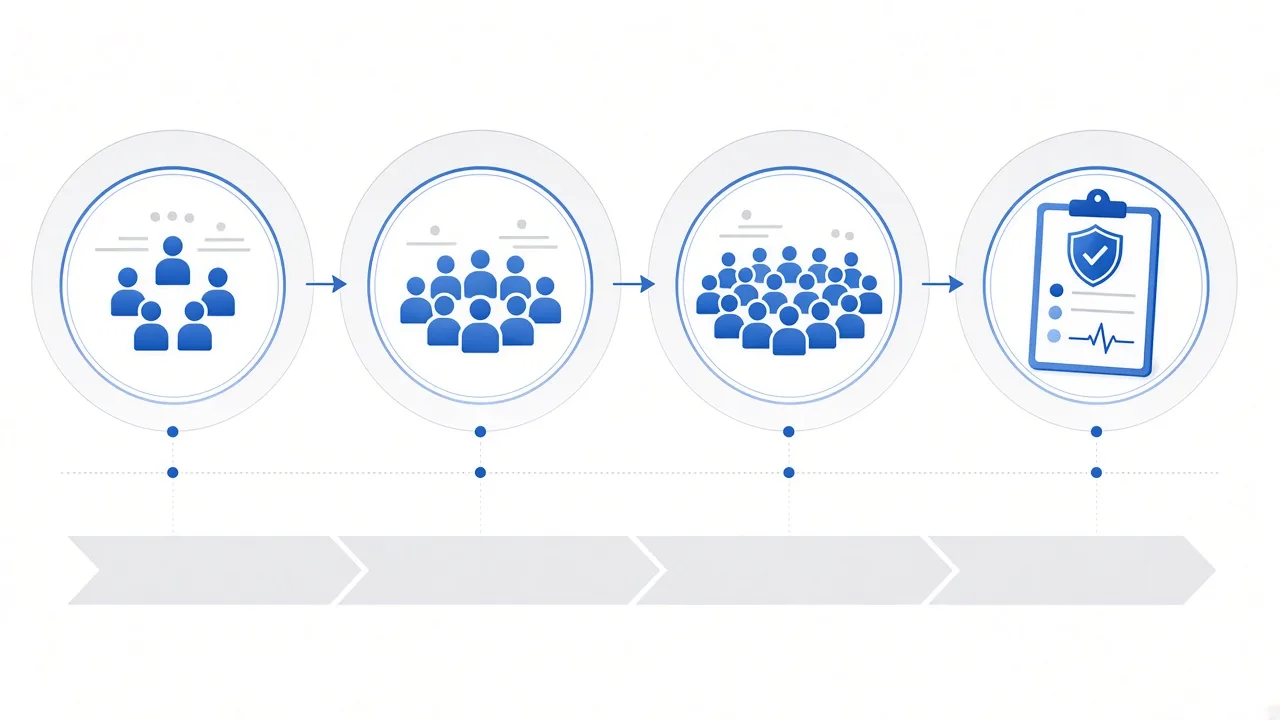
When human research begins, NIH educational materials describe common trial phases. Phase I typically involves a small group and focuses on safety and side effects. Phase II expands the group to explore effectiveness while continuing safety evaluation. Phase III uses larger groups to confirm effectiveness and compare with standard approaches. Phase IV follows after approval to learn more about real-world use.
Many online peptides never enter this pathway
Not every peptide discussed online has entered this pathway. Many remain preclinical. Some enter early human studies and later stop. Landscape reviews of peptide therapeutics show that clinical development is selective and often slow. Attrition is a feature of the process, not a secret failure unique to one molecule.
Registry identity versus completed, positive results
If a claim mentions a clinical trial, look for a registry identity such as a ClinicalTrials.gov entry, the phase, the primary outcome, and whether results are published or only announced. A registry listing proves a study was described for public tracking. It does not prove that results were positive, completed, or practice-changing.
Phase labels as educational shorthand
Phase labels are educational shorthand. Actual protocols vary by indication, product class, and regulatory context. Still, the NIH glossary framing remains a useful public map. The table below compresses typical phase focus and scale into a quick reference for decoding news posts that wave at a phase number.
NIH-style clinical phase overview for educational reading
| Phase | Typical focus | Rough scale |
|---|---|---|
| Phase I | Safety, side effects, and early pharmacology exploration in research settings | Usually a small group of participants |
| Phase II | Exploring effectiveness while continuing safety evaluation | Larger than Phase I, still limited |
| Phase III | Confirming effectiveness and comparing with standard approaches | Larger groups across more settings |
| Phase IV | Learning more after approval about real-world use and longer-term questions | Varies; often broader populations over time |
Endpoints, surrogates, and what papers actually measure
An endpoint is what a study counts as success or failure for its question. Clinical outcomes that matter to patients, such as events, function, or survival in a defined setting, sit in a different category from laboratory markers that only hint at a pathway. Educational readers should name the endpoint before celebrating the result.
Surrogate endpoints and what they cannot finish
Surrogate endpoints are substitutes that are easier or faster to measure. They can be scientifically useful and still fail to capture the outcome people care about. A biomarker shift may be real, precise, and biologically interesting while remaining a weak basis for broad human claims.
Preclinical mixes of molecular and organism readouts
Preclinical papers often mix molecular, cellular, and organism-level readouts. That mix is normal. Confusion starts when a summary elevates a convenient marker into a finished story about benefit. Ask whether the endpoint matches the claim language.
Primary versus secondary endpoints in human trials
Primary versus secondary endpoints also matter in human trials. The primary endpoint is the main question the study was designed to answer. Secondary findings can be informative and still require more caution. The table below compares endpoint types and common overread risks.
Endpoint types comparison for careful claim reading
| Endpoint type | What it usually reflects | Common overread risk |
|---|---|---|
| Molecular / pathway marker | A signal in a biochemical or cellular system | Treating pathway activity as proven human benefit |
| Physiologic surrogate | An intermediate measure linked by hypothesis to a later outcome | Assuming the surrogate always predicts clinical success |
| Patient-relevant clinical outcome | A predefined human endpoint in a trial population | Generalizing beyond the studied setting and criteria |
| Composite or exploratory bundle | Multiple measures combined or explored together | Cherry-picking the most favorable piece as the whole story |
How to read a peptide paper without getting fooled

Start with the question the authors actually tested. Then check design: observational versus interventional, controlled versus uncontrolled, randomized versus not. Reporting guidelines such as CONSORT exist to improve transparency in randomized trials. Even when a paper is not a randomized trial, the same spirit helps: clear methods, clear outcomes, clear limits.
- What model was used: cell, animal, or human?
- What was measured, and over what time window?
- Was there a control or comparison group?
- Are conflicts of interest and funding disclosed?
- Do the authors over-generalize beyond their data?
- Is there a registry ID or reporting guideline reference when relevant?
Inspect endpoints before celebrating results
Next, inspect endpoints. A molecular change in a dish is not the same as a patient-relevant clinical outcome. A short-term biomarker shift is not the same as durable benefit. Authors may be careful. Headlines often are not.
Mechanism hypotheses versus proven clinical utility
Finally, separate mechanism hypotheses from proven clinical utility. Mechanism language can be precise and still preliminary. A diagram of receptors and arrows is a map of ideas under study, not a certificate of real-world effect.
Why abstracts and figures need the same skepticism
Abstracts are useful entry points and incomplete by design. If a claim matters to you, read methods and limitations. Figures deserve the same skepticism as slogans: axis ranges, missing error bars, selective time points, and representative images can all shape impressions.
Paper-reading checklist: claim style versus better question
| Claim style | Better question to ask |
|---|---|
| This peptide is proven | Proven for which endpoint, in which model or population, against what comparator? |
| A study showed dramatic results | What was the sample size, control condition, and primary outcome definition? |
| It works through this pathway | Was pathway engagement measured directly, and does that equal a clinical outcome? |
| Doctors are already using it | Is there labeled approval for a specific use, or is this informal anecdote? |
| New research confirms benefits | Is the new paper a replication, an extension, or a different question entirely? |
| No side effects were seen | Was the study designed and sized to detect harms, and in which setting? |
PK and PD vocabulary for educational readers
Pharmacokinetics, often shortened to PK, concerns what happens to a molecule in the body over time: absorption context in research settings, distribution ideas, metabolism, and clearance. Pharmacodynamics, often shortened to PD, concerns what the molecule appears to do to biologic systems, such as receptor engagement or downstream readouts.
When PK or PD words are decoration
FDA materials on peptide drug products discuss clinical pharmacology considerations that matter in formal development, including how peptide properties can influence study design and interpretation. Readers need to recognize when a post uses PK or PD words as decoration rather than as measured concepts.
Keeping exposure language tied to measurements
Half-life, exposure, clearance, and concentration-time language belong to PK discussions. Potency and pathway response ideas belong more to PD discussions. Mixing the two without data is a common internet shortcut. Observations in one species or formulation context do not automatically transfer to another. If a related article mentions exposure language, ask whether the cited work measured those ideas or only implied them.
Half-life, proteases, and why stability dominates peptide papers
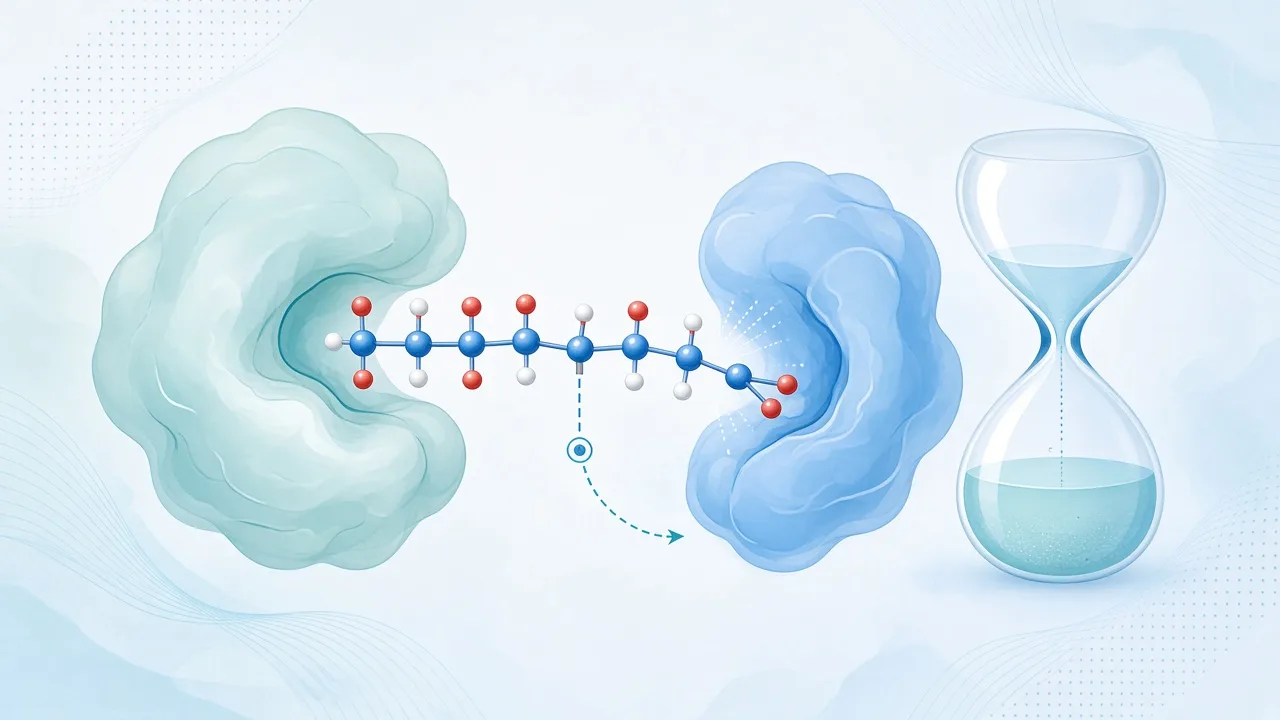
Educational biochemistry sources define peptides as short amino-acid chains linked by peptide bonds. Those bonds can be cut by proteases. Reviews of therapeutic peptides repeatedly note short plasma half-life and rapid clearance as central practical problems for many native sequences.
Stability engineering as research discussion, not DIY
That is why research papers discuss stability engineering, analogs, conjugation strategies, or formulation concepts. Those discussions are about making a molecule more tractable for study or development. They are not instructions for personal use.
Ask what conditions produced a half-life number
When you see half-life numbers, ask under what conditions they were measured. Serum, plasma, buffer, and in vivo contexts are different experiments. Lucana and colleagues review protease-resistant strategies in targeting and delivery research; the educational takeaway is conceptual, not a recipe list. Readers should also expect peptide papers to spend unusual amounts of text on degradation pathways, not only on desired signaling stories.
Receptor binding and signaling vocabulary
Many peptide papers focus on recognition: a sequence interacting with a receptor or other molecular partner. Binding, potency, selectivity, and downstream pathway readouts are common themes. Binding is not the same as selectivity, and neither is the same as a clinical benefit claim.
Why receptor language appears so often
Therapeutic-peptide reviews often note that extracellular targets such as GPCRs have been historically important in peptide drug discovery. That pattern helps explain why so much literature discusses receptors and signaling.
Direct binding, functional assays, and narrative analogy
Binding in a controlled assay means researchers observed an interaction under defined conditions. Signaling readouts can cascade across many steps; more steps usually means more room for overstatement. Ask whether a citation is direct binding evidence, functional assay evidence, computational prediction, or narrative analogy.
Synthesis as a research concept, not a DIY topic
Modern reviews commonly describe solid-phase peptide synthesis, associated with Merrifield, as a core laboratory framework for assembling short sequences for study. Protecting-group strategies and purification quality are part of that professional workflow.
Concept yes, protocol no
Viral Peptides explains synthesis only as a concept that helps you understand papers. We do not publish laboratory recipes, reagent lists, or production protocols. Research literacy includes knowing which details belong in professional methods and which do not belong in public how-to content.
What purity and mass confirmation mean in papers
When a methods section mentions purity percentage, HPLC, or mass spectrometry confirmation, those are quality-control ideas in research manufacturing, not consumer product guarantees from informal markets. Concept yes, protocol no.
Purity and analytics literacy for paper readers
Purity claims appear constantly in peptide research communication. In papers, purity is usually tied to a method, a threshold, and a batch context. In marketing, purity can become a slogan detached from method. Prefer the first pattern.
Chromatography and mass confirmation as method-tied tools
Common analytical ideas include chromatographic separation and mass confirmation. Those tools help researchers ask whether the intended sequence is present and whether obvious impurities are limited under the reported method. They do not convert a research material into an approved medicine.
Identity versus purity, and batch context
Identity and purity are related but not identical. Nickname-only discussion is a red flag. Batch-to-batch variability also matters: research reports often describe a characterized lot, while informal commerce may not offer equivalent transparency. When a website repeats a purity percentage with no method, treat it as incomplete communication until methods appear.
Approved medicines versus investigational peptides

Some peptides are approved medicines for specific labeled uses after formal development and regulatory review. Many others discussed in wellness media are investigational, experimental, or only studied in nonclinical models. Those categories must stay separate.
Why collapsing categories is a literacy red flag
Reviews of the therapeutic peptide landscape emphasize that approved peptides and candidates in development are not the same category. Approval status is use-specific and jurisdiction-specific. If a page collapses those categories into one enthusiastic story, treat that as a literacy red flag.
Investigational status has internal diversity
Investigational status also has internal diversity. A candidate in late trials is not the same evidence object as a sequence with only cell data. Regulatory documents and clinical pharmacology guidances are part of formal pathways, not consumer manuals.
Incretin examples that keep the categories visible
For a worked example of an approved dual GIP/GLP-1 agonist landscape, read tirzepatide research status. For an investigational triple-agonist case study that is still not an approved finished drug, read retatrutide investigational status. The category map that frames both is GLP-1 peptide medicines explained.
Conflict of interest and funding literacy
Funding and author relationships do not automatically invalidate a paper. They do change how carefully you should inspect design, endpoints, and spin. Disclosure exists so readers can calibrate, not so readers can dismiss science by slogan.
Funding, ties, and academic incentives
Ask who paid for the work, whether authors have financial ties to a product narrative, and whether the paper separates results from promotional language. Academic incentives matter too: novelty pressure and positive-result bias shape what gets written.
What media summaries often strip away
Media summaries often strip disclosures entirely. If a viral post cites a paper, open the paper and look for funding and conflict statements. Match confidence to design quality and transparency, not to excitement alone.
CONSORT and trial registry literacy
CONSORT is a reporting guideline family intended to improve how randomized trials are described. It does not make a trial perfect. It makes important design details harder to hide.
Registration, completion, publication, and replication
ClinicalTrials.gov and similar registries help the public locate study records, status updates, and basic protocol facts. Registration is not completion. Completion is not publication. Publication is not replication.
Registry pages are not results papers
A common overstatement pattern is citing a registry page as if it were a results paper. Outcome switching is another reason registries matter: if a public record lists one primary outcome and a later paper emphasizes another, lower automatic trust until the discrepancy is explained. Peptide readers benefit from the same transparency expectations used in other therapeutic areas.
Common overstatements in peptide research talk
Overstatement usually follows a pattern: a narrow finding is rewritten as a broad promise. Another pattern is importing clinical language onto preclinical work. A third is treating mechanism diagrams as proof of real-world benefit.
Nickname inflation and category errors
Good research communication keeps uncertainty visible. It names the model, names the endpoint, and resists converting every pathway figure into lifestyle advice. Nickname inflation is another pattern: a sequence becomes a brand-like token that absorbs every hopeful anecdote nearby.
Re-running overstatement checks on exciting pages
Category errors also drive hype. People collapse approved peptide medicines, investigational candidates, and informal research chemicals into one casual shelf. Peptide research literacy refuses that collapse. When a compound page feels exciting, return here and re-run the overstatement checks.
Expanded glossary for Research & Science reading
Key terms work better when they sit in one place. This glossary expands research-facing vocabulary you will meet across papers and related articles.
- In vitro: experiments in cells or biochemical systems outside a living animal.
- In vivo: experiments in living organisms, often animal models in preclinical work.
- Endpoint: the predefined measure a study uses to answer its main question.
- Surrogate endpoint: an intermediate measure used as a stand-in for a later outcome of interest.
- Half-life: a stability or time parameter under defined experimental or biological conditions.
- Protease: an enzyme that can cleave peptide bonds and contribute to peptide breakdown.
- Receptor binding: measured or inferred interaction between a ligand and a receptor system in a defined assay.
- PK (pharmacokinetics): exposure and time-course behavior of a molecule in a biologic system.
- PD (pharmacodynamics): biologic response related to target engagement or effect readouts.
- CONSORT: reporting guidance intended to improve transparency in randomized trial publications.
- Registry record: a public study listing that describes protocol basics and status, not automatically final results.
- Investigational: studied or developed but not established as an approved medicine for a stated use in a stated jurisdiction.
- Purity (analytical): a method-tied estimate of how much of a sample matches the intended species under reported conditions.
Where to go next
If you want compound-specific educational context, start with the related articles listed above. If you need foundational vocabulary first, return to Peptide Basics.
Safety framing and comparisons when claims compete
If your question is about responsible framing, compounding boundaries, or unapproved GLP-1 marketplace noise, open peptide safety education and compounded vs approved peptide medicines. If you are comparing claims across compounds or news cycles, open peptide comparisons and research news.
Take the evidence ladder with you
When you leave this page, take the evidence ladder with you: what was measured, in which model, at which tier, and whether the wording stayed honest about uncertainty.
Frequently asked questions
What is the Research & Science guide for?
It is an educational overview of how peptide studies are designed, reported, and interpreted, so you can read literature with better context and fewer category errors.
Does a published peptide study mean a product is approved?
No. Publication and regulatory approval are different. Many papers are preclinical or early-stage and do not establish approved medical use for a specific indication.
Where can I check if a human study is registered?
Public registries such as ClinicalTrials.gov are a common starting point for locating registered human studies, status information, and basic trial details.
What is the difference between in vitro and animal evidence?
In vitro work happens in cells or biochemical systems outside a living animal. Animal evidence adds organism-level physiology in a model species, but still does not automatically equal human proof.
Why do so many peptide papers discuss half-life and proteases?
Many native peptides are rapidly broken down because proteases can cut peptide bonds. Stability limits shape study design, analog research, and how carefully readers should interpret exposure language.
How should I read receptor binding claims?
Treat binding as evidence of an interaction under defined assay conditions. Ask about method, selectivity, and whether any downstream or clinical endpoint was actually measured before accepting broader claims.
What does CONSORT help me evaluate?
CONSORT supports clearer reporting of randomized trials. It helps readers look for transparent design details such as outcomes, randomization, and participant flow.
Is this page medical advice?
No. Viral Peptides publishes research literacy content only. It is not diagnosis, treatment advice, or a recommendation to use any compound.
Sources & citations
Key definitions and research-literacy points in this guide are grounded in the publicly available educational and review sources below. Links open the original pages so you can verify context yourself.
- National Institutes of Health. Glossary of Common Terms (clinical research phases).
- Lau JL, Dunn MK. Therapeutic peptides: Historical perspectives, current development trends, and future directions. Bioorg Med Chem. 2018. PubMed PMID: 28720325.
- Wang L, et al. Therapeutic peptides: current applications and future directions. Signal Transduct Target Ther. 2022. PubMed PMID: 35165272.
- Zheng B, Wang X, Guo M, Tzeng CM. Therapeutic Peptides: Recent Advances in Discovery, Synthesis, and Clinical Translation. Int J Mol Sci. 2025. PMC12154100.
- Forbes Kaprive J, Krishnamurthy K. Biochemistry, Peptide. StatPearls. NCBI Bookshelf.
- Lucana MC, Arruga Y, Petrachi E, et al. Protease-Resistant Peptides for Targeting and Intracellular Delivery of Therapeutics. Pharmaceutics. 2021. PMC8708026.
- U.S. Food and Drug Administration. Clinical Pharmacology Considerations for Peptide Drug Products (draft guidance).
- EQUATOR Network. CONSORT reporting guideline for randomized trials.
- ClinicalTrials.gov. Home and study registry overview.
Related articles
More specific explainers that go deeper on individual topics.

Peptide Receptor Binding Kinetics
Educational guide to affinity, occupancy, and binding kinetics for peptides, and how kinetics differ from efficacy claims in research papers.

BPC-157 Research: Evidence Overview
Educational review of BPC-157 research: what it is, preclinical themes in literature, evidence limits, and why it is not presented as an approved medicine.