
Peptide Safety Education Guide
Educational guide to peptide safety literacy: known unknowns, quality and identity questions, research-use language, and responsible reading without use instructions.

Peptide safety education is less about recipes and more about judgment. This guide is for readers who want clear boundaries between published science, marketing language, and personal medical decisions. It explains what Viral Peptides will teach, what it will never instruct, and how careful readers evaluate evidence, quality claims, and regulatory context. Nothing here is medical advice, dosing guidance, reconstitution instruction, sourcing counsel, laboratory synthesis how-to, or administration direction. Those topics stay outside the line on purpose.
Key takeaways
- Safety education explains concepts, uncertainty, and reading habits. It does not tell anyone how to use, dose, reconstitute, source, synthesize, or administer peptides.
- FDA communications about certain bulk substances used in compounding have highlighted safety-information gaps and quality themes such as impurities and immunogenicity risk considerations. Those pages inform literacy; they are not use manuals.
- Identity, purity, and provenance questions belong in every careful reading of peptide claims. Popularity is not a certificate of quality.
- Research-use-only language is a boundary reminder, not proof of safety and not the same thing as regulatory approval for human treatment.
- Approved finished drugs, compounded-medicine context, and research-use marketing language sit in different educational categories. Mixing them casually is a common source of confusion.
- Advisory votes, nominations, and news headlines are not the same as final agency decisions or product approvals. Prefer primary official documents.
- Sport, workplace, and professional rules can still apply even when a discussion is educational. WADA and other official sources matter more than influencer summaries.
- Children, pregnancy, and breastfeeding contexts require clinician guidance. This site does not provide medical advice for those situations or any other personal-use decision.
Educational disclaimer
This guide is for research literacy and education only. It is not medical advice. Read our disclaimer.
What this Safety & Guides page covers
This guide is a framework for peptide safety education. It does not try to be a catalog of every named research peptide, and it does not try to substitute for clinical care. Instead it teaches how to read peptide information without mistaking curiosity for instruction.
What you will find in the sections ahead
You will find sections on education versus advice, known unknowns, immunogenicity and impurity themes discussed in official communications at a high level, identity and purity literacy, research-use language, stability concepts without protocols, compounding versus approval literacy, advisory votes versus final decisions, sport and workplace rules, caution around adverse-event anecdotes, responsible sharing, calculator disclaimer framing, and clear boundaries for children and pregnancy contexts.
Why missing protocols are the editorial standard
If you came here looking for a protocol, stop and recalibrate. The absence of dosing, reconstitution steps, sourcing tips, synthesis recipes, and administration instructions is not an incomplete draft. It is the editorial standard.
Education is not medical advice

A page can discuss published research and still be unsafe if it quietly becomes a how-to guide. Viral Peptides keeps a hard line: we explain concepts, literature, and regulatory context; we do not direct personal use.
Education questions versus advice questions
Education answers questions like what a paper studied, what an agency page says about information gaps, or what quality language means in professional settings. Advice answers questions like what you should take, how much, how often, where to buy it, how to prepare it, or how to administer it. Crossing that line turns literacy into unauthorized instruction.
Disclaimer language and the myth of one safe checklist
Disclaimer language is not decoration. It is part of accurate communication about uncertainty. Educational articles cannot examine your history, medications, allergies, organ function, pregnancy status, sports status, or legal constraints. A licensed clinician can. A blog post cannot.
Readers sometimes ask for “just the safe way” as if safety were a single checklist that fits everyone. Real safety depends on person, product, setting, evidence, and oversight. When those variables are missing, confident instructions are a red flag, not a gift.
Soft asks that escalate into instructions
Another common trap is the soft ask: people request “general education” and then push for actionable specifics in the comments. Good editorial practice refuses that escalation. Explaining what a half-life means in a paper is education. Turning that explanation into a personal schedule is advice. The second move is not a natural continuation of the first; it is a category change.
Judge sources by refusal and use the filter table
If you are comparing sites, judge them by what they refuse to say as much as by what they publish. A long article that never crosses into protocols can still be useful. A short article that races toward steps can be harmful even when it sprinkles citation links on top.
Use the table below as a quick filter for this site and for other sources you encounter online. If a page claims to educate while quietly filling the right-hand column, treat it as advice dressed in educational clothing.
Education versus advice: what this site does and does not do
| Topic area | This site does (education) | This site does not do (advice / instruction) |
|---|---|---|
| Research discussion | Summarize study design, endpoints, and limits in plain language | Tell you to use a compound because a paper exists |
| Regulatory context | Point to official FDA compounding and risk communications | Interpret agency pages as permission for personal use |
| Quality literacy | Explain why identity, purity, and provenance questions matter | Vouch for any vendor, batch, or certificate as safe for you |
| Calculators and units | Support educational unit-conversion concepts only | Provide dosing, reconstitution, or administration protocols |
| Health decisions | Encourage clinician consultation and primary sources | Diagnose, treat, prescribe, or personalize medical plans |
| Children and pregnancy | State absolute limits: not medical advice; see a clinician | Offer any use guidance for minors, pregnancy, or breastfeeding |
Known unknowns: what safety literacy looks like
Safety literacy starts by naming uncertainty out loud. For many compounds discussed casually online, human safety data may be limited, incomplete, outdated, or tied to different formulations, routes, doses, manufacturing controls, and clinical settings than the ones people mention in comments.
Reviews and official risk pages that name constraints
Therapeutic-peptide reviews such as Wang and colleagues (PMID 35165272) and Lau and Dunn (PMID 28720325) describe a field with real medicines and real development challenges. They also remind careful readers that peptide science is not one interchangeable category. Sequence, target, stability, manufacturing, and clinical evidence can differ completely from one molecule to the next.
FDA pages discussing bulk substances that may present significant safety risks in compounding contexts have described themes such as limited safety information and quality concerns. Those communications should be read carefully and in context. They are signals that evidence and quality questions matter. They are not informal permission slips, shopping lists, or use manuals.
Known, unknown, inferred, and individual risk
A useful habit is to ask: What is known about this specific substance in a controlled clinical or pharmaceutical setting? What is unknown? What is being inferred from a different molecule, a different route, an animal model, or a marketing claim? If those answers are fuzzy, confidence should drop.
Known unknowns also include individual risk. Two people can read the same abstract and still face different medical realities. Education can teach you to respect that gap. It cannot close it for you.
Product sameness and study-setting unknowns
Another known unknown is product sameness over time. Even when a name stays constant in online discussion, manufacturing context, analytical controls, and documentation can differ. Educational readers should resist the assumption that last year’s anecdote describes this year’s object.
Study-setting unknowns matter too. Cell assays, animal models, healthy-volunteer studies, and disease-specific trials answer different questions. Translating any one of them into everyday certainty is a literacy failure, not a bold insight.
Prefer incomplete honesty over polished overconfidence
When internet culture rewards certainty, naming uncertainty can feel unsatisfying. That discomfort is part of adult reading. Prefer incomplete honesty over polished overconfidence.
Immunogenicity and impurity themes from official communications
At a high level, FDA communications about certain peptide-related bulk substances used in compounding have raised safety-information and quality themes that careful readers should understand conceptually. Two recurring educational themes are impurities and immunogenicity risk considerations.
Impurity and immunogenicity themes in plain language
Impurity themes are about what else may be present besides the named sequence people talk about. In serious pharmaceutical and research settings, related substances, degradation products, residual process materials, and incomplete characterization are treated as quality problems that require documentation and control. Informal marketing often skips that discipline and sells a name as if a name were a finished, fully characterized product.
Immunogenicity themes are about the possibility that a substance, or materials associated with it, could interact with the immune system in unwanted ways. Educational readers do not need a clinical immunology lecture to grasp the point: immune responses can be unpredictable, context-dependent, and poorly characterized when safety information is limited. That is why official risk communications treat information gaps as meaningful rather than as paperwork trivia.
Literacy tools, not scare stories or use instructions
These themes are not a license to invent scare stories, and they are not a license to invent use instructions that supposedly avoid the issues. They are literacy tools. When a source never mentions characterization, impurities, immunogenicity, or evidence limits, ask why the silence feels so convenient.
Clinical pharmacology seriousness and avoiding action fantasies
FDA also publishes educational materials on clinical pharmacology considerations for peptide drug products. Those documents belong to formal drug-development and review conversation. They illustrate how seriously identity, pharmacokinetics, immunogenicity planning, and product quality are treated when peptides move through regulated pathways. Casual online discussion rarely matches that seriousness.
A practical reading move is to separate hazard themes from action fantasies. Learning that impurities and immunogenicity appear in official risk language should make you more careful about claims, not more inventive about workarounds. “I read the risk page, so I know how to handle it” is not literacy. It is overconfidence wearing a citation.
Keep the altitude high
Keep the altitude high. This section explains why agencies talk about impurities and immunogenicity. It does not translate those themes into personal-use tactics, purification recipes, or “safer stack” folklore.
Identity and purity literacy
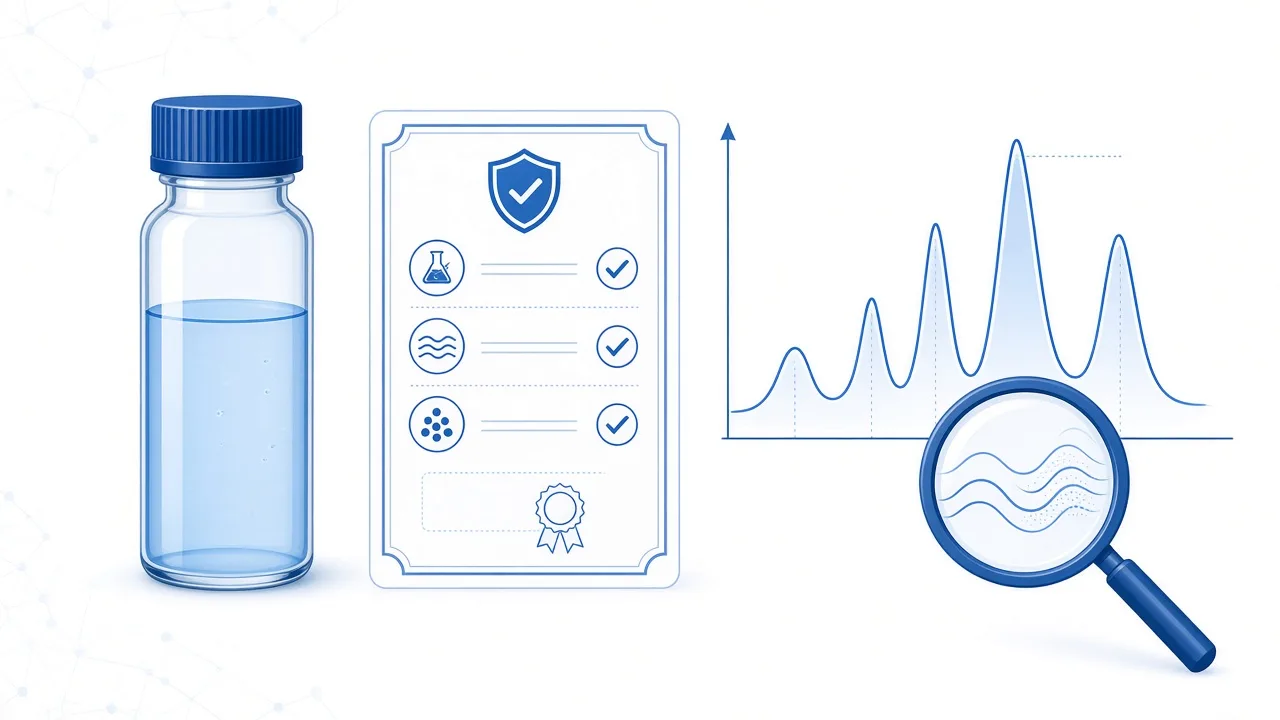
In professional research and pharmaceutical settings, identity and purity are measured and documented. Identity answers whether the material matches the claimed chemical or biological entity. Purity answers how much of the material is the intended entity versus other substances. Educational biochemistry sources such as StatPearls (NBK562260) remind readers that peptides are defined chemical structures. That definition only helps if the object in front of someone actually matches the name on a label.
Unverifiable purity claims and certificate theater
Therapeutic-peptide development reviews emphasize manufacturing and analytical challenges even in serious settings. That alone should make readers skeptical of unverifiable purity claims circulating on social platforms. If identity, purity, and provenance are unclear, confidence should drop, regardless of how popular a name has become.
A careful reader looks for transparency about methods, limitations, and documentation rather than for theatrical guarantees. Certificates, assay names, and purity percentages can be educationally interesting when authentic and contextualized. They can also be meaningless when copied, incomplete, mismatched to the batch, or presented without method detail. Literacy means asking follow-up questions, not collecting screenshots as talismans.
Naming discipline and humility about single percentages
Identity literacy also includes sequence and naming discipline. A single residue change can mean a different experimental molecule. Casual renaming, nickname stacking, and “same as” comparisons are common online shortcuts. Educational readers should treat name drift as a reason to slow down, not speed up.
Purity literacy includes humility about what a single number can mean. A percentage without method, without related-substance discussion, and without clear linkage to a specific batch is a weak claim dressed as precision. Serious settings treat analytical context as part of the result. Informal posts often treat the number as a brand asset.
Judgment while reading, not procurement advice
None of this is sourcing advice. Knowing which questions matter does not tell you where to obtain anything, and this site will not fill that gap. The point is judgment while reading, not procurement while browsing.
A reading checklist, not a purchasing guide
The table below turns quality curiosity into a reading checklist. It is not a purchasing guide and not a lab protocol. It is a way to notice when claims are thin.
Quality questions careful readers ask
| Question | Why it matters | What a careful reader looks for |
|---|---|---|
| Is the identity of the substance clear? | A popular nickname is not the same as a defined sequence or finished product | Consistent naming, sequence or product identification, and avoidance of vague “same as” claims |
| How is purity described? | Unverified purity talk can hide impurities, degradation, or unrelated material | Method context, limitations, and skepticism toward absolute guarantees without detail |
| What is the provenance story? | Quality and documentation travel with manufacturing and handling history | Clear chain of context rather than anonymous hype or recycled screenshots |
| Does the claim match the regulatory category? | Approved drug, compounded-medicine context, and research-use marketing are different | Language that does not blur categories to imply clinical status that is not earned |
| What safety information is missing? | Information gaps are themselves a safety signal in official communications | Explicit acknowledgment of unknowns instead of silence or bravado |
| Who benefits if you stop asking? | Marketing thrives when questions feel inconvenient | Sources that welcome scrutiny and point to primary documents |
What research-use language does and does not mean

Research-use-only language is common around experimental materials. It communicates an intended-use boundary for laboratory or research settings. It does not magically create safety. It also does not equal regulatory approval for human treatment.
Research-use labels, lifestyle implications, and boundary reminders
Readers should be alert when marketing places research-use labels next to lifestyle, body-transformation, or self-experiment implications. That combination is a literacy red flag because it borrows the seriousness of research framing while inviting non-research behavior.
Educational content on this site treats research-use framing as a boundary reminder. It is not a product category to celebrate, not a badge of underground sophistication, and not a coded wink toward personal use.
Three educational buckets that get mixed online
Compare three educational buckets that get mixed online: approved finished drugs with formal labeling and oversight pathways; compounded-medicine context under specific regulatory frameworks discussed by FDA; and research-use marketing language around experimental materials. Those buckets answer different legal, quality, and evidence questions. Collapsing them into one casual “peptide” conversation is how people lose the plot.
Evidence laundering across similar nicknames
A related confusion is evidence laundering: citing a clinical paper about an approved peptide medicine to imply confidence about an unrelated research-labeled material with a similar nickname. Sequence families are not interchangeable identities. Pathway status is not transferable by branding proximity.
Honest labels narrow claims; theater widens them
When you see research-use language used honestly, it should narrow claims. When you see it used as theater, it often widens claims while pretending to stay cautious. Train yourself to notice which direction the label is doing.
Approved drug versus compounded context versus research-use marketing language
| Educational category | What careful readers understand | Common confusion to avoid |
|---|---|---|
| FDA-approved finished drug | A specific product reviewed under drug pathways, with formal labeling and manufacturing expectations tied to that approval | Assuming every peptide-named discussion online shares that status |
| Compounded-medicine context | A distinct regulatory and quality conversation; FDA publishes compounding overviews and risk-focused bulk-substance communications | Treating compounding mentions as equivalent to approval of a finished commercial product |
| Research-use marketing language | Often signals intended laboratory or research framing, not demonstrated safety or approved human treatment | Reading research-use labels as lifestyle permission or as proof of clinical legitimacy |
Stability concepts without handling protocols
Peptides can be chemically and enzymatically fragile. Educational reviews often discuss protease sensitivity and short half-life as major constraints in biological settings. Lucana and colleagues (PMC8708026), for example, discuss protease resistance in the context of targeting and delivery research. Storage and handling matter in laboratory and pharmaceutical contexts for related reasons: the molecule and the matrix can change over time under defined conditions.
Conceptual discussion so papers make sense
This site may discuss stability at a conceptual level so papers and regulatory documents make sense. Stability concepts help you understand why methods sections mention temperature, light, solvents, or degradation assays. They do not authorize personal handling instructions.
What we will not publish
We will not publish step-by-step storage, reconstitution, dilution, or administration protocols for personal use. We will not convert half-life language into lifestyle timing tips. We will not turn degradation chemistry into a home-lab checklist.
Deep stability literacy without home-lab coaching
Conceptual stability literacy can still be deep. Readers can learn that degradation pathways exist, that analytical methods are used to watch them in formal settings, and that published half-life values are condition-dependent. Those ideas help you read papers without pretending you run a pharmacy.
If a source teaches stability only as a gateway to DIY technique, that source has left education and entered coaching. Viral Peptides stays on the education side of that door.
Compounding versus approval literacy

Compounded medicines and FDA-approved finished drugs are not the same regulatory pathway. FDA maintains educational resources on human drug compounding and has published risk-focused communications about certain bulk substances that may present significant safety risks when used in compounding.
What approval literacy and compounding literacy notice
Approval literacy means noticing what was reviewed, for which product, under which pathway, with which labeling. Compounding literacy means noticing that compounding exists under specific frameworks and constraints, and that agency risk pages exist because quality and safety questions are not academic. Neither literacy track turns a webpage into a clinic.
Prefer primary documents over viral slogans
Educational readers should prefer primary regulatory documents over social-media summaries. Headlines compress. Comment threads invent. Official pages, read in full, usually preserve nuance that viral posts discard.
When people say “it is just compounding” or “it is basically approved,” ask which finished product, which indication, which oversight, and which evidence they mean. Vague category talk is often a substitute for specifics.
Risk education is not a consumer product review
It also helps to remember that public education about compounding risk is not the same thing as a consumer product review. Agency pages can warn, clarify frameworks, and highlight information gaps without answering whether any particular person’s clinician should prescribe anything. That clinical decision sits elsewhere, with licensed care and applicable law.
Where incretin marketplace confusion belongs next
When the conversation shifts from general compounding literacy to unapproved GLP-1 related products or research-only consumer marketing, stay with compounded vs approved peptide medicines and the FDA consumer pages it cites. A dedicated incretin compounding literacy article will join this path on its scheduled publish date.
Advisory votes are not final decisions
Advisory discussions, nominations, committee votes, draft documents, and risk lists can change over time. News coverage of those events can be useful for awareness and still be a poor substitute for the primary record.
Votes, nominations, and compressed social slogans
An advisory vote is not automatically a final agency decision. A nomination is not automatically a prohibition story with one simple moral. A social post about “the FDA just banned” or “the FDA just approved” may skip process, scope, product identity, and effective dates.
Find the official page before forming a conclusion
Educational practice: find the official page, read the actual category of action, note the date, and separate what was recommended from what was decided. If you cannot tell the difference, you do not yet have a conclusion. You have a homework assignment.
Tracking process instead of collecting vibes
This patience protects readers from whiplash. Regulatory conversation is iterative. Literacy means tracking process, not collecting vibes.
Sport and workplace rules still matter
Even when a discussion is educational, real-world rules can apply to readers. The World Anti-Doping Agency publishes a Prohibited List that athletes and support personnel must take seriously. Many non-approved substances and related categories can create compliance risk in sport regardless of how casually they are discussed online.
Workplace, licensing, and local-rule limits of this site
Workplace drug policies, professional licensing rules, military rules, and local laws can also matter. This site cannot inventory every jurisdiction or every employer policy. If rules apply to you, use official sources and qualified advisors. Do not rely on wellness influencers for compliance.
Separate legality, anti-doping, employment, and medical questions
Educational takeaway: legality, anti-doping status, employment policy, and medical appropriateness are separate questions. Passing one informal vibe check online does not answer the others.
Educational content is not athletic clearance
Athletes sometimes assume that educational content equals clearance. It does not. Clearance, if it exists at all in a given sport context, comes through official anti-doping education, team or federation channels, and the current prohibited-list categories. Read those sources directly. Do not outsource compliance to a content site that refuses to give use advice in the first place.
Adverse-event anecdotes deserve caution
Personal stories about side effects or “no side effects” spread quickly because they feel concrete. They are still weak evidence when stripped of product identity, dose context, medical history, concomitant substances, confirmation methods, and follow-up. Education can respect someone’s experience without treating a thread as a safety database.
Absence and presence of anecdotes both need humility
Absence of anecdotes is not proof of safety. Presence of alarming anecdotes is not automatic proof of a specific causal mechanism. Both directions need humility. Case reports and pharmacovigilance systems exist because serious evaluation requires structure that comment sections lack.
Emergencies are clinician questions
If someone is experiencing a medical emergency or worrying symptoms, that is a clinician and emergency-care question, not a content-strategy question. Do not crowdsource urgent care from peptide forums.
What was confirmed versus what was assumed
When you read anecdotes for literacy, ask what was confirmed, what was assumed, and what cannot be known from the post. That habit protects you from both panic contagion and false reassurance.
Responsible sharing of peptide information

If you share educational articles, keep the caveats attached. Stripping uncertainty from a nuanced explainer is how misinformation travels. A headline without the boundary language becomes a different document.
Do not convert education into personalized recommendations
Do not turn educational content into personalized recommendations for other people. That crosses from literacy into unlicensed advice. “You should try this” is not a friendly gloss on a science explainer. It is a different act.
Point friends to primary papers and official pages
Point friends to primary papers and official pages when claims become specific or high-stakes. Secondary summaries, including ours, are starting points for orientation. They are not the end of the evidence trail.
Resist forwarding secret protocols
Responsible sharing also means resisting the urge to one-up people with secret protocols. If the most forwardable part of a post is a how-to, it probably should not be forwarded from an education-first community.
Optional literacy aid: red-flag phrases online
| Phrase pattern | Why it is a caution signal | Better reader response |
|---|---|---|
| “Research use only, but here is how people run it” | Borrows research framing while inviting personal-use instruction | Treat the boundary language as real and stop at education |
| “Same as the approved one” | Collapses product identity, pathway, and quality controls | Ask which finished product and which evidence are actually meant |
| “Pharma grade / purest / no sides guaranteed” | Absolute guarantees often outrun documentation | Demand method detail and accept uncertainty when detail is missing |
| “FDA said it is fine” or “FDA just banned everything” | Over-compresses complex regulatory process into a slogan | Open the primary FDA page and read scope, date, and category of action |
| “Ask your doctor, then here are the steps anyway” | Uses a disclaimer as cover for instructions | Keep the clinician referral and discard the protocol pitch |
Unit-conversion literacy framing
Concentration and volume language in research education is for literacy only. It helps readers understand how laboratory teaching examples talk about amounts. It is not medical dosing advice, not a reconstitution coach for personal use, and not an administration planner.
Leaving the educational frame
If a unit-conversion example is treated as a personal protocol, the reader has left the educational frame. Educational pages cannot know the substance, the setting, the legality, the medical history, or whether any use is appropriate. Numbers without that context are not care.
Math literacy is allowed; instruction creep is not
Editorial rule of thumb: math literacy is allowed; instruction creep is not. If explaining a unit requires telling someone what to do with a vial in real life, we stop before that sentence.
Children, pregnancy, and breastfeeding: absolute boundaries
This site does not provide medical advice for children, adolescents, pregnancy, trying to conceive, or breastfeeding. Those contexts involve specialized clinical judgment, different evidence standards, and higher stakes for unsupported experimentation.
What educational pages may note, and what they will not offer
Educational pages may note that pediatric and perinatal questions belong with qualified clinicians. They will not offer dosing ideas, “gentle” protocols, stacking folklore, or sourcing tips dressed as parental research.
Seek licensed clinical care for those situations
If you are seeking care for a minor or for pregnancy-related questions, speak with an appropriate licensed clinician. Do not treat any Viral Peptides page, calculator output, or comment summary as guidance for those situations.
Absolute language is intentional
Absolute language is intentional here. Softening it would invite exactly the misuse this guide exists to prevent.
Where to go next
Continue with the related Safety & Guides articles listed above. Use peptide research and science when you want study-design literacy. Use Peptide Basics when you need vocabulary before judgment.
Disclaimer and About pages as part of the framework
Read the site disclaimer and About page for editorial standards. Those pages are part of the safety framework, not fine print to skip.
Prefer FDA and WADA primary pages for rules context
For regulatory context, prefer FDA compounding overview pages and the FDA communications on bulk substances that may present significant safety risks. For sport rules, prefer the current WADA Prohibited List and official anti-doping education from relevant organizations.
Primary literature over influencer carousels
For scientific orientation, primary literature and high-quality reviews such as Wang et al., Lau and Dunn, Lucana et al., and foundational biochemistry explainers remain better anchors than influencer carousels.
Education prepares questions; it cannot replace care
If a health decision is involved, speak with a qualified clinician rather than treating any webpage as instructions. Education can prepare better questions. It cannot replace care.
Frequently asked questions
Does this page tell me how to use peptides safely?
No. It explains safety literacy, evidence limits, quality questions, and regulatory context. It does not provide use instructions, dosing, reconstitution steps, sourcing advice, synthesis how-to, or administration directions.
Why discuss FDA compounding risk pages?
Because official communications about safety-information gaps, impurities, and immunogenicity-related concerns are part of responsible public education around peptide-related substances. They inform careful reading. They are not permission for personal use.
Is research-use-only a safety guarantee?
No. It is a labeling and intended-use boundary, not proof that a substance is safe, appropriate, high quality, or approved for human treatment.
How should I read advisory votes or breaking regulatory news?
Treat them as process signals. Confirm the primary official document, note the date and scope, and remember that advisory votes are not automatically final decisions or product approvals.
Can athletes rely on wellness blogs for peptide compliance?
No. Athletes should consult official anti-doping sources such as the WADA Prohibited List and their sport’s compliance channels. Educational blogs are not compliance tools.
Are unit-conversion examples on this site medical advice?
No. Any concentration or volume examples are educational literacy only. They are not dosing, reconstitution, or administration guidance for personal use.
What if my question involves a child or pregnancy?
This site does not provide medical advice for children, pregnancy, or breastfeeding. Speak with a qualified clinician. Do not interpret educational pages as guidance for those contexts.
Where is the broader medical disclaimer?
See the site disclaimer page. All Viral Peptides educational content is not medical advice and is not a substitute for professional care.
Sources & citations
Key definitions and research-literacy points in this guide are grounded in the publicly available educational and review sources below. Links open the original pages so you can verify context yourself.
- U.S. FDA. Certain Bulk Drug Substances for Use in Compounding that May Present Significant Safety Risks.
- U.S. FDA. Human Drug Compounding overview page.
- Wang L, et al. Therapeutic peptides: current applications and future directions. Signal Transduct Target Ther. 2022. PubMed PMID: 35165272.
- Lau JL, Dunn MK. Therapeutic peptides: Historical perspectives, current development trends, and future directions. Bioorg Med Chem. 2018. PubMed PMID: 28720325.
- Lucana MC, Arruga Y, Petrachi E, et al. Protease-Resistant Peptides for Targeting and Intracellular Delivery of Therapeutics. Pharmaceutics. 2021. PMC8708026.
- Forbes Kaprive J, Krishnamurthy K. Biochemistry, Peptide. StatPearls. NCBI Bookshelf.
- World Anti-Doping Agency. The Prohibited List.
- U.S. FDA. Clinical Pharmacology Considerations for Peptide Drug Products (PDF).
Related articles
More specific explainers that go deeper on individual topics.

Peptide Safety Education First
How to read peptide content responsibly: what this site is for, what it will not provide, and how research literacy differs from personal-use advice.

Research Peptide Storage Basics
Educational themes on lyophilized versus solution peptide stability from research literature. Concepts only, not personal laboratory SOPs or protocols.