
Bacteriostatic water, often shortened to BAC water, shows up in many online peptide conversations as a diluent topic. Readers usually want one number: how long it lasts. The accurate educational answer separates two clocks: the manufacturer’s expiration date on an unopened vial, and the beyond-use window that applies after a multi-dose vial is first entered. This article explains those concepts using public CDC multi-dose vial literacy and typical bacteriostatic water for injection labeling themes. It is not medical advice, not pharmacy compounding instruction, and not a reconstitution or dosing protocol.
What people mean by BAC water
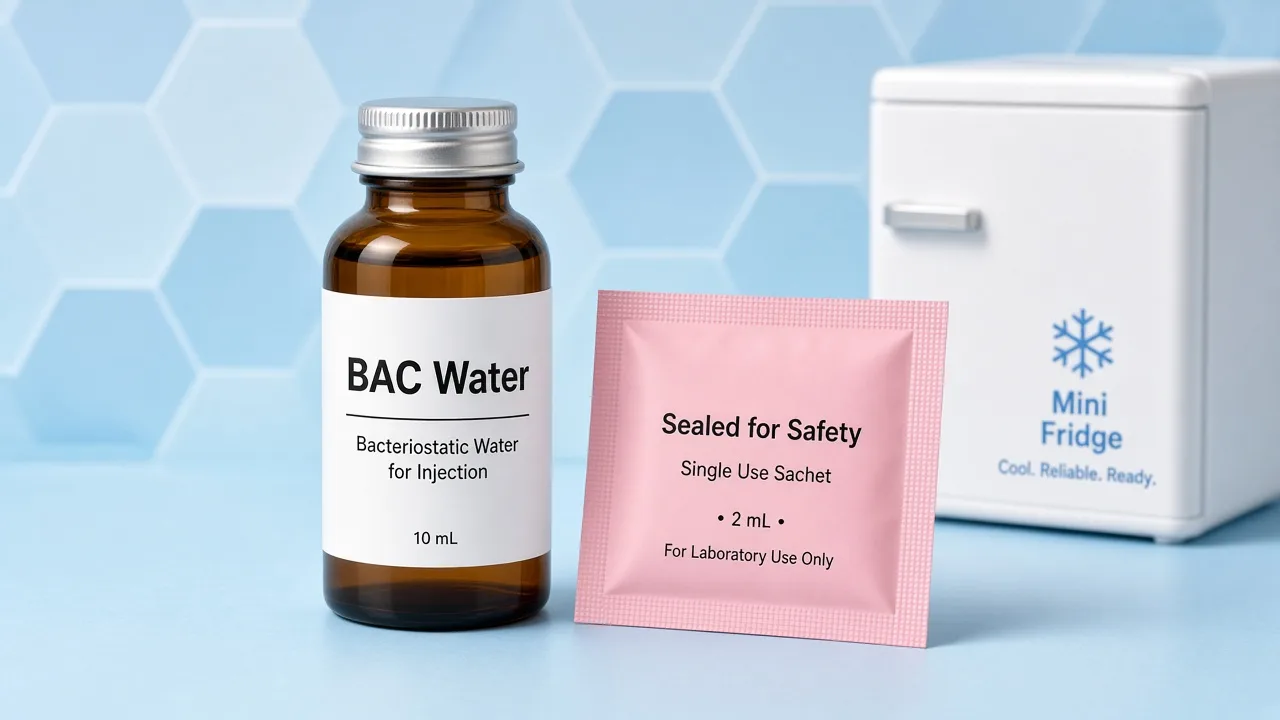
In online peptide discussions, BAC water usually means Bacteriostatic Water for Injection: sterile water containing a bacteriostatic preservative, commonly benzyl alcohol at about 0.9 percent in labeled U.S. products. The preservative is there to help suppress growth of many bacteria after the stopper is entered in a multi-dose container context.
That chemistry label does not automatically answer lifestyle questions. It also does not turn an educational article into permission to prepare research chemicals for personal use. Neighboring pages such as research peptide storage basics and peptide safety education first keep the same boundary.
Not the same as plain sterile water
Sterile Water for Injection without a preservative is a different product story. Multi-dose bacteriostatic water and single-dose sterile water are easy to confuse in informal forums. Educational reading starts by naming which labeled product is being discussed.
Not a reconstitution protocol
Mentioning diluent literacy is not the same as teaching how to reconstitute a peptide vial. This site refuses reconstitution steps on purpose.
Two clocks: labeled expiration versus beyond-use after entry

Shelf-life questions collapse when readers mix two different dates. CDC injection-safety education for multi-dose vials separates the manufacturer’s expiration date for an unopened vial from the beyond-use date that applies after the vial is opened or needle-punctured.
- Unopened / not accessed: discard according to the manufacturer’s expiration date.
- Opened or accessed: date the vial and discard within 28 days unless the manufacturer states another opened-vial date.
- Hard ceiling: the beyond-use date should never exceed the manufacturer’s original expiration date.
Where the 28-day figure comes from
The commonly repeated 28-day window is tied to USP General Chapter 797 multi-dose container practice as summarized in CDC injection-safety education. It is a default beyond-use concept for entered multi-dose vials unless labeling specifies otherwise. It is not a private peptide-forum invention, and it is not a guarantee that a partly empty vial remains appropriate for every setting.
When the opened clock starts
Educational multi-dose guidance treats first entry, such as needle puncture of the stopper, as the event that starts the opened-vial window. Remaining milliliters do not reset that clock. Looking clear is not a substitute for dating and discard discipline in clinical safety education.
What the preservative does and does not do

Benzyl alcohol in bacteriostatic water is discussed as a bacteriostatic preservative for labeled multi-dose sterile water products. CDC multi-dose vial education also stresses a critical limit: preservatives help limit bacterial growth; they do not protect against viruses and do not fix unsafe injection practices.
Visual checks are necessary but not sufficient
Product labels commonly instruct users not to use solutions that are not clear or containers whose seals are not intact. Cloudiness, particles, discoloration, or a compromised closure are discard signals in labeling literacy. Clear liquid alone does not prove the vial is within a valid beyond-use window.
Label warnings belong to clinicians, not forums
Official bacteriostatic water labeling includes important contraindications and warnings in clinical contexts, including benzyl alcohol concerns for neonates. This educational site does not interpret those warnings into personal-use plans. Clinician and pharmacist guidance applies to real medication decisions.
Common misreadings in peptide-forum shelf-life talk

Online peptide conversations often stretch BAC water dating into slogans. Literacy puts the slogans back into category.
- Misreading: fridge storage restarts or erases the opened multi-dose window.
- Misreading: if it still looks clear after months, the 28-day concept no longer matters.
- Misreading: BAC water dating automatically becomes a peptide solution dating protocol.
- Misreading: research-use marketing language replaces labeled pharmaceutical dating rules.
Diluent dating is not peptide-solution dating
How long a labeled diluent vial remains within a multi-dose beyond-use window is not the same question as how a dissolved research peptide behaves chemically. For peptide solid-versus-solution stability themes, use research peptide storage basics. Do not merge the two clocks into one lifestyle rule.
RUO marketing does not rewrite vial dating
Research-use-only framing does not create a special shelf-life exemption. See what research-use-only means for label literacy, and compounded vs approved peptide medicines for regulatory category confusion.
Where this article sits in Safety & Guides
This page belongs under Safety & Guides because it teaches dating and contamination-literacy boundaries without giving use instructions. Pair it with peptide safety education first when you need the wider responsibility frame, and with the Peptide Calculator only for educational unit-conversion math, not as a reconstitution guide.
Final limit statement
If you need institutional sterile compounding procedure, use your pharmacy or laboratory quality system and current USP standards. If you need advice about an approved medicine, use the product label and a licensed clinician or pharmacist. This article is neither a protocol nor a substitute for those sources.