
Peptide Comparisons and News Literacy
Educational guide to comparing peptide claims, reading research news responsibly, and separating peer-reviewed evidence from headlines and trend cycles.

Comparisons and news coverage can help you stay oriented, or they can amplify confusion. This guide teaches a calmer method: compare study designs and claim types first, then use news as a pointer back to primary sources rather than as a final authority. Nothing here ranks products, recommends use, or provides dosing guidance.
Key takeaways
- Useful peptide comparisons match like with like: same model type, similar endpoints, and clear status differences between approved, investigational, and informal claims.
- News about advisory votes, trends, or viral compounds is not the same as peer-reviewed consensus or regulatory approval.
- Landscape reviews show peptide development is broad and uneven. Popularity in media is not a scientific ranking.
- When two compounds are compared online, ask whether the comparison is mechanistic, preclinical, clinical, legal, or commercial.
- Preprints, press releases, and social amplification can be useful alerts, but they are weaker evidence than carefully reported peer-reviewed work.
- Use this guide to interpret comparison articles and news explainers without treating them as medical advice.
Educational disclaimer
This guide is for research literacy and education only. It is not medical advice. Read our disclaimer.
What this Comparisons & News guide covers
This page explains how to compare peptide claims fairly and how to read research news without treating headlines as conclusions. It is written for readers who see endless versus articles, trend roundups, and sudden spikes of attention around individual sequences, and who want a steadier way to judge what those pieces are actually saying.
What comparison articles should and should not do
Comparison articles on Viral Peptides should help you understand differences in evidence, mechanisms discussed in literature, and open questions. They are not product rankings, shopping guides, or scoreboards for lifestyle decisions. News explainers should point you back to papers, registries, and official pages whenever a claim becomes specific.
Why landscape reviews matter for versus content
Therapeutic-peptide reviews by Lau and Dunn, Wang and colleagues, and more recent landscape work such as Zheng and coauthors (PMC12154100) describe a field that is scientifically active and commercially uneven. That background matters for comparisons: the literature is not a neat tournament bracket. Attrition, delivery limits, and selective clinical progress are normal features of the field.
Educational limits and related pillars
This guide stays educational. It will not tell you how to use any compound, how to dose anything, or which product to buy. If you need personal health decisions, speak with a licensed clinician. Use Research & Science for study-design literacy, Safety & Guides when claims become use-adjacent, and Peptide Basics if vocabulary is still getting in the way.
What a fair comparison needs
A fair comparison states the axis of comparison. Mechanism hypothesis, preclinical endpoint, human trial phase, regulatory status, anti-doping status, and commercial packaging are different axes. Mixing them creates false precision. Two molecules can share a research theme and still be incomparable on clinical maturity.
Match evidence classes instead of inventing a level contest
It also matches evidence classes. Comparing a large clinical program for an approved medicine with a handful of animal papers on an investigational sequence is not a level contest. Reviews of therapeutic peptides repeatedly show that approved products and early candidates sit in different development realities, even when both get casual online attention.
Name unknowns instead of filling silence
A fair comparison names unknowns. The absence of evidence is not evidence of equivalence. Missing human data, missing long-term safety information, or missing formulation details should appear as gaps, not as silence that readers fill with wishful thinking.
Time windows belong in the frame
Time windows belong in the frame as well. A 2024 review summarizing decades of peptide drug development is not answering the same question as a single new animal study posted last week. Fair writing tells you whether the comparison is historical landscape, current investigational chatter, or a narrow endpoint duel.
Description is not recommendation language
Finally, a fair comparison separates scientific description from recommendation language. Saying Compound A has more published animal work on Endpoint X than Compound B is a literature observation. Saying Compound A is better for you is a different kind of claim, and this site avoids that second move.
A practical comparison checklist
Use this checklist when you read any peptide versus peptide article, including ours. The point is not to invent a winner. The point is to notice whether the writer matched like with like, or quietly switched standards midway through the piece.
- Are both compounds being discussed in the same study type?
- Are endpoints comparable, or only thematically related?
- Is regulatory status stated for each side?
- Are safety-information gaps acknowledged?
- Is anti-doping or sport-rule status separated from scientific popularity?
- Is the piece selling a winner, or explaining trade-offs in the literature?
Name the comparison type and the evidence bar
Start by naming the comparison type. Is the article comparing mechanisms discussed in papers, preclinical models, clinical phases, regulatory status, sport rules, or market noise? Then ask whether both sides are being judged with the same evidence bar.
Watch endpoints and status language
Watch endpoints carefully. Two papers can both mention tissue repair language while measuring completely different outcomes in different species over different time windows. Thematic similarity is not endpoint equivalence.
Check status language. Approved medicine for a labeled indication, investigational candidate, research-only discussion, and informal wellness marketing are not interchangeable labels. NIH educational materials on trial phases also remind readers that early human studies emphasize safety exploration, while later phases ask different effectiveness questions in larger groups.
Ask what a chart is actually plotting
If the article uses charts, ask what unit the chart is actually plotting. Percent change from baseline in a tiny animal group is not the same unit as patient-relevant outcomes in a registered human trial. Pretty visuals can make mismatched units feel comparable.
Fair comparison checklist axes: what good and bad comparisons do
| Axis | Good comparison asks | Bad comparison does |
|---|---|---|
| Evidence class | Are both sides animal, early human, late-phase, or approved-label evidence? | Stacks a large clinical program against sparse animal papers as if they were equal. |
| Endpoint | Are measured outcomes similar enough to compare? | Treats thematically related titles as if endpoints matched. |
| Model system | Same species, injury model, or assay family? | Imports findings across models without naming the jump. |
| Regulatory status | Approved, investigational, or informal claim? | Uses research interest as a stand-in for approval. |
| Uncertainty | What is unknown for each side? | Fills silence with confident ranking language. |
| Non-science axes | Are price, packaging, or social buzz labeled as non-efficacy? | Treats popularity metrics as scientific scores. |
Research news versus peer-reviewed literature

News can be valuable when it alerts you to a meeting, a paper, a recall, or a policy discussion. It becomes misleading when summary language hardens into certainty. A headline is an invitation to look closer, not a substitute for methods, limitations, and primary data.
Peer review, CONSORT spirit, and compression for speed
Peer-reviewed papers and registered trials remain the better ground truth for scientific claims. Reporting guidelines such as CONSORT exist to improve transparency in clinical trial reports: clear randomization details, outcomes, and reporting of what was planned versus what was analyzed. News rooms are not bound to that structure, and they often compress nuance for speed.
News first for awareness, primary source second for judgment
A healthy workflow is news first for awareness, primary source second for judgment. If a story mentions a randomized trial, ask whether the report follows transparent reporting norms. If it mentions a human study, ask whether a registry entry exists. If it mentions an agency discussion, open the underlying official page.
Landscape papers and the slow selective reality
Therapeutic-peptide landscape papers help here because they show how uneven progress really is. Wang and colleagues, Lau and Dunn, and Zheng et al. all describe broad discovery activity alongside practical barriers. News cycles rarely convey that slow, selective reality.
Explanatory news versus adjudicative tone
Also notice whether a story is explanatory or adjudicative. Explanatory news helps you locate a paper or meeting. Adjudicative news tells you who won. Peptide topics are especially vulnerable to adjudicative tone because audiences arrive already primed for versus framing.
News types and what they are good for
| News type | What it is good for | What it is not |
|---|---|---|
| Peer-reviewed paper summary | A pointer to methods, endpoints, and limitations in the published record | A final verdict that replaces reading the paper |
| Preprint coverage | Early awareness of a possible finding still under community scrutiny | Settled evidence or peer-reviewed consensus |
| Company or lab press release | Notice that an organization wants attention for a milestone | Independent appraisal of study quality |
| Advisory meeting story | Awareness of an intermediate regulatory or expert process step | Final approval or a completed policy decision |
| Trend or search-volume roundup | A map of what audiences are talking about right now | A ranking of scientific strength |
| Recall or risk communication | A prompt to read official safety or quality language carefully | A casual use guide or shopping signal |
Preprint caution: early, useful, and unfinished
Preprints can speed scientific conversation. They also arrive before formal peer review is complete. That means methods may still be challenged, analyses may change, and conclusions may soften or harden after critique. Treat preprint coverage as provisional by default.
Mark preprint status clearly in versus content
When a news story leans on a preprint, look for whether the authors state limitations, whether raw claims outrun the data, and whether later peer-reviewed versions revise key numbers. Comparison writers should mark preprint status clearly rather than blending it into the same evidence tier as a carefully reported journal article.
Timeline and maturity versus a fair duel
Preprints are especially risky in versus content because readers already want a scoreboard. An early animal finding on one side and a later-phase human program on the other can look like a dramatic contrast when the real issue is timeline and evidence maturity, not a fair duel.
Alerts folder versus judgments folder
Educational habit: if a claim matters to you, wait for or seek the peer-reviewed version, then re-check endpoints and sample size. Speed is not a quality metric. A calm reader can still track preprints; the discipline is to keep them in the alerts folder rather than the judgments folder.
Say so when only one side rests on preprint material
If two compounds are compared and only one side rests on preprint material, say so plainly. Hidden asymmetry in review status is one of the most common ways modern comparison content becomes unfair without sounding unfair.
Press release caution: milestones are not methods
Press releases exist to communicate institutional messages. They can announce enrollment, topline results, partnerships, or regulatory filings. They are not independent methods sections. They often emphasize optimism and minimize caveats.
The same literacy questions you would ask of a paper
When a release says a peptide program showed promising results, ask the same literacy questions you would ask of any paper: What model? What endpoint? How many participants or animals? Was there a control? Are results published, registered, or only announced?
Do not import press-release adjectives into side-by-side frames
Comparison articles go wrong when they import press-release adjectives into a side-by-side frame. Words like breakthrough, superior, or game-changing are marketing temperature, not scientific units. Prefer numbers, designs, and status labels over adjectives.
Confirm phase language against public glossary definitions
If a release cites a trial, open ClinicalTrials.gov or the equivalent registry. Confirm phase language against NIH glossary definitions rather than against promotional paraphrases. Early phases are not interchangeable with confirmatory studies.
Look for independent write-ups after a release
A second habit helps: search for an independent write-up or the underlying paper after reading a release. If the only source repeating the claim is the originating organization and its mirrors, keep your confidence provisional.
Obesity and incretin trial headlines as a practice case
When the feed is full of weight-loss percentages and Phase 3 adjectives, use peptide news vs peer review and how to compare peptide studies as the current checklist. A dedicated obesity-trial headline guide will join this pillar on its scheduled publish date.
Advisory meetings, votes, and policy headlines

Headlines about advisory votes or compounding discussions can sound like final approval. Often they are intermediate process events. Agency staff analyses, committee recommendations, and final regulatory actions are different steps. Collapsing them into one triumphant or catastrophic story misreads how policy works.
Safety-information gaps can stay central amid public interest
FDA risk communications about certain bulk substances used in compounding show another literacy lesson: safety-information gaps can remain central even when public interest is high. Those pages discuss themes such as limited safety information and quality concerns for certain substances and contexts. They are signals for careful reading, not informal permission slips.
Open the official document before a strong opinion
When a news story matters to you, open the underlying official document before forming a strong opinion. Ask what decision, if any, was actually made. Ask what remains open. Ask whether the story is about one jurisdiction while readers casually generalize worldwide.
Do not mix regulatory status with scientific popularity
Comparisons that mix regulatory status with scientific popularity create especially noisy charts. A molecule can be culturally loud and still sit in a contested compounding or investigational context. Fair writing keeps those lanes separate.
Proximity in a feed is not proximity in the record
Advisory literacy also helps when two compounds are placed side by side after a meeting week. One may have been discussed in a specific agenda item while the other was merely trending nearby. Proximity in your feed is not proximity in the administrative record.
How peptide trend cycles work
Therapeutic-peptide landscape reviews show a field with many candidates, shifting therapeutic-area focus over decades, and substantial attrition. Media trend cycles move faster than that reality. A compound can become culturally loud while remaining scientifically early. Another can be clinically important and still under-discussed in wellness media.
What drives cultural loudness
Trend cycles often follow searchable names, influencer repetition, sports conversations, and packaging aesthetics. None of those forces is a peer-review filter. Zheng and colleagues, Wang and colleagues, and Lau and Dunn all help readers see the slower scientific timeline behind the noise: discovery, optimization, delivery challenges, and selective translation.
Trend awareness versus trend obedience
Trend awareness is useful. Trend obedience is not a research method. If a comparison article simply lists what is trending this month, treat it as audience mapping. If it claims those trends reflect evidence strength, treat that as a literacy failure.
Watchlists tied to primary sources
A calmer approach is to keep a short watchlist of topics you care about, then check whether new attention corresponds to new papers, new registry entries, or new official communications. Attention without a new primary source is usually just recirculation.
Seasonality and non-science causes of spikes
Seasonality shows up too. Conference weeks, athlete news cycles, and retail holidays can all inflate search curves without changing the underlying literature. A fair peptide comparisons habit is to annotate spikes with possible non-science causes before assuming a breakthrough occurred.
Popularity versus evidence: buzz is not study tier
| Signal people notice | What it usually reflects | Better evidence question |
|---|---|---|
| Search volume spike | Audience curiosity and media recirculation | Did a new peer-reviewed paper or registry update appear? |
| Social media repetition | Network effects, aesthetics, and persuasion | What study design and endpoints are actually cited? |
| Influencer before-and-after talk | Anecdote and uncontrolled storytelling | Is there controlled evidence, or only narrative? |
| Forum consensus | Shared belief inside a community | Does the literature support the claim type being made? |
| Retail packaging prominence | Commercial presentation | What is the regulatory and quality context? |
| Peer-reviewed clinical program | Formal development effort under defined protocols | What phase, outcomes, and limitations are reported? |
Educational pair example: research-discussion context, not a winner
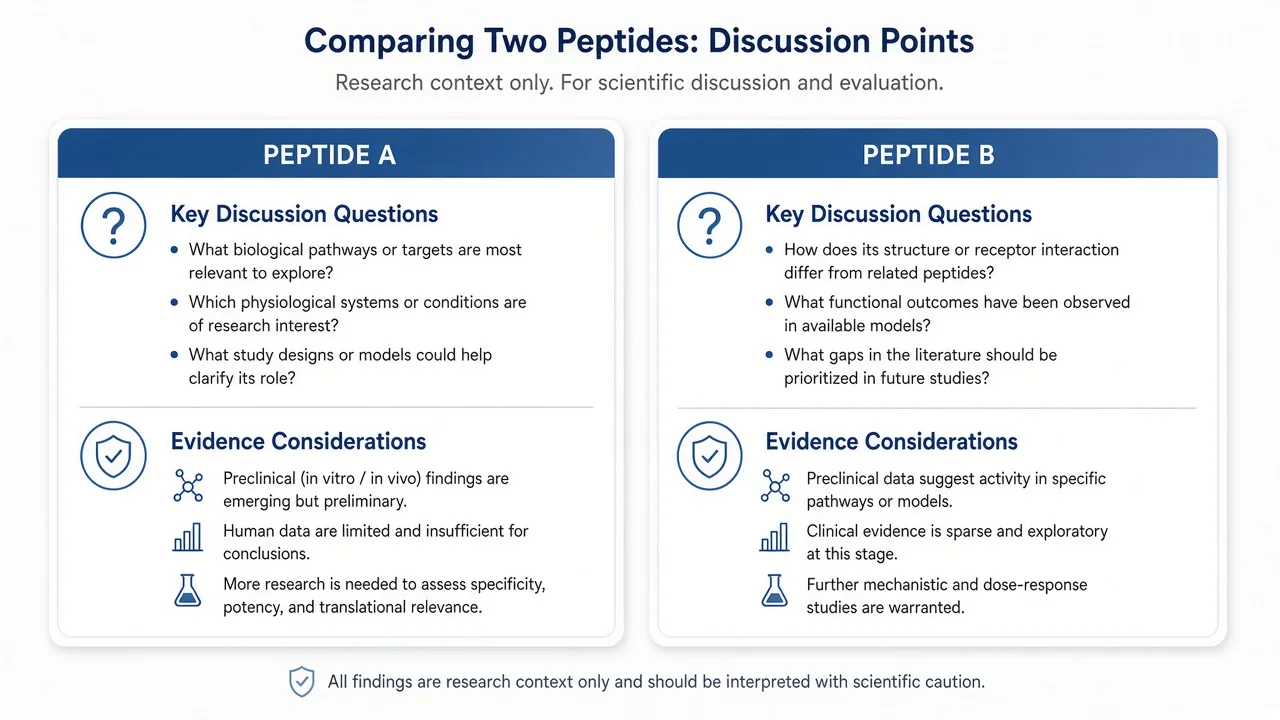
Readers often ask for educational comparisons between widely discussed research peptides. The table below is an example of the only kind of versus framing this site endorses: a research-discussion comparison of literature context, evidence type, and uncertainty. It is not a ranking, not a use recommendation, and not a claim that either sequence is appropriate for any person.
Why popularity makes careful phrasing matter
Names such as BPC-157 and TB-500 appear frequently in online conversation. That popularity is exactly why careful phrasing matters. A fair educational article can note that public discussion often groups them thematically, then immediately separate theme from evidence maturity, study mix, and open questions.
Use the table as a template for other pair articles
Use the table as a template for reading other pair articles. If a piece cannot fill these cells honestly, it is probably not ready to compare the compounds at all.
Educational research-discussion comparison template (example pair). Not a ranking and not use advice.
| Comparison lens | BPC-157 (educational context) | TB-500 / thymosin beta-4–related discussion (educational context) |
|---|---|---|
| Why the pair appears online | Often grouped in wellness and research-forum conversation around tissue-related themes | Often grouped in the same informal conversation clusters |
| Literature context to check | Ask what models and endpoints dominate the cited papers | Ask what models and endpoints dominate the cited papers |
| Evidence type commonly mixed in media | Preclinical and informal claims are frequently blended | Preclinical and informal claims are frequently blended |
| Uncertainty to keep visible | Human evidence strength, formulation differences, and safety-information gaps may be uneven or limited depending on the claim | Human evidence strength, formulation differences, and safety-information gaps may be uneven or limited depending on the claim |
| What a fair article should not do | Declare a lifestyle winner or imply dosing guidance | Declare a lifestyle winner or imply dosing guidance |
| Better next step for readers | Read primary papers and status sources; use Research & Science literacy tools | Read primary papers and status sources; use Research & Science literacy tools |
Metrics that mislead in comparison content
Social engagement, search volume, and influencer repetition are not efficacy metrics. List price and packaging aesthetics are not purity certificates. Mechanism diagrams are not outcome trials. Each of those signals can be interesting for a different question, and each becomes misleading when borrowed as a proxy for scientific strength.
Fragile effect sizes and CONSORT-minded clarity
Even inside science, effect sizes from tiny studies can look dramatic and fail to replicate. Comparison writers should resist turning fragile numbers into scoreboard graphics. CONSORT-oriented thinking helps here even outside formal randomized trials: be clear about what was measured, in whom, and with what limitations.
Selective citation counts are not validated progress
Another misleading metric is selective citation counts. A compound can accumulate many low-quality mentions without gaining confirmatory human evidence. Landscape reviews of peptide therapeutics remind readers that clinical translation is selective. Volume of chatter is not volume of validated progress.
Prefer transparent uncertainty over fake clarity
Prefer transparent uncertainty over fake clarity. A sentence that says the records are hard to compare is often more honest than a polished chart with invented parity.
Be suspicious of invented composite scores
Be suspicious of composite scores invented by content sites. A single number that blends popularity, anecdote, and one abstract into a ranking is usually rhetoric dressed as measurement. Ask for the formula. If there is no transparent formula, there is no metric.
How to read a versus article without getting scored
Begin with the title and subhead. If they promise a winner, expect persuasion pressure. If they promise an educational contrast, look for whether the body keeps that promise. Then scan for axis statements: mechanism, model, clinical phase, regulation, or commerce.
- Identify the comparison axis in the first screen of content.
- Label each major claim by evidence class.
- Separate scientific status from sport rules and commerce.
- Note what the article admits it does not know.
- Open at least one primary source before forming a strong opinion.
Map each claim to a source type
Next, map each claim to a source type. Peer-reviewed paper, preprint, press release, registry entry, agency page, or social anecdote. If the article cannot show its sources, your confidence should drop regardless of how confident the prose sounds.
Watch for category errors across status lanes
Watch for category errors. Approved peptide medicines discussed in therapeutic reviews are not automatically comparable to investigational sequences with sparse public data. Anti-doping status from WADA lists is not a biological efficacy score. FDA compounding risk communications are not shopping advice.
End with a literacy check, not a purchase impulse
End with a personal literacy check rather than a purchase impulse. Can you state, in one sentence, what is actually known on each side? If not, the article entertained you without informing you.
Rewrite the comparison in neutral language
A useful finishing move is to rewrite the comparison in neutral language: Compound A has evidence type X for endpoint Y; Compound B has evidence type Z for endpoint W; these are / are not directly comparable. If you cannot complete that sentence from the article, the article did not finish its job.
Registry checks when human studies are claimed
When a news story or comparison article says there is a clinical trial, treat that as a claim that can often be verified. ClinicalTrials.gov exists so the public can inspect study registrations, phases, outcomes, and status updates. A registry identity is not proof that a study succeeded. It is proof that a study was described in a public system.
Keep phase words honest with public glossary language
Use NIH glossary language to keep phase words honest. Early phases typically focus more on safety and dosing exploration in smaller groups. Later phases ask effectiveness questions in larger groups and may compare approaches. After-approval learning continues in some programs. Casual articles often blur those distinctions.
Status fields catch vapor claims
Registry literacy also catches vapor claims. If a comparison says both compounds have human data, check whether the entries are interventional trials, observational studies, withdrawn records, or early terminated projects. Status fields matter.
Leave knowing how to verify
Educational comparisons should cite registry context when they rely on human-study language. Readers should leave knowing how to verify, not merely how to remember a headline.
A practical checklist for registry reading
A practical checklist for registry reading: confirm the official title, the listed sponsor, the primary outcome, the phase label, the recruitment status, and whether results are posted or only promised. Then ask whether the comparison article used those fields or merely borrowed the phrase clinical trial for authority.
Building calm update habits
Skim news weekly if you like, but review primary sources monthly for topics you care about. Keep a short list of trusted review papers and official pages. Lau and Dunn, Wang et al., and Zheng et al. (PMC12154100) are useful landscape anchors for therapeutic-peptide context. CONSORT and ClinicalTrials.gov are useful process anchors when human trials appear.
Alerts folder and judgments folder
Build a two-folder mental model: alerts and judgments. Alerts can come from headlines, preprints, and social posts. Judgments should wait for papers, registries, and official documents. Mixing the folders is how trend anxiety starts.
Which pillar to open for which question
Use Research & Science when you need design literacy. Use Safety & Guides when claims become use-adjacent or quality-risk themes appear, including FDA communications about certain bulk substances that may present significant safety risks in compounding contexts. Use WADA materials when sport eligibility is the actual question.
Calm as a reading schedule
That habit beats reacting to every viral post. Calm is not disengagement. Calm is a reading schedule that matches the speed of evidence rather than the speed of feeds.
A concrete routine for recurring versus topics
One concrete routine: pick two comparison topics you see often, save one landscape review and one official page for each, and revisit those anchors before reacting to the next viral versus graphic. The goal is fewer impulsive conclusions and more durable context.
Where to go next
Open the related Comparisons & News articles listed above for specific educational matchups and trend explainers. Use peptide research and science to pressure-test study quality. Use Peptide Basics if vocabulary is still getting in the way. Use peptide safety education when uncertainty, quality, or risk-communication themes become the main issue.
Practice registry and CONSORT-minded checks
If a comparison article cites human research, practice a registry check on ClinicalTrials.gov. If it cites a randomized trial report, skim with CONSORT-minded questions about outcomes and transparency. If it cites sport rules, open the WADA Prohibited List rather than relying on forum summaries.
Clearer reading, not faster deciding
None of these pages is medical advice or a recommendation to buy or use any compound. The goal of peptide comparisons literacy is clearer reading, not faster deciding.
Frequently asked questions
Are comparison articles ranking products?
No. Educational comparisons on Viral Peptides explain differences in research context and claim quality. They are not product rankings, scoreboards, or shopping guides.
Should I trust peptide news headlines?
Treat headlines as alerts. Verify details in primary papers, trial registries, or official regulatory documents before drawing strong conclusions.
What makes a peptide comparison fair?
Clear comparison axes, matched evidence classes, explicit regulatory or sport-rule context when relevant, and honest discussion of unknowns. A fair piece explains the record instead of crowning a winner.
How should I treat preprints and press releases?
As early or promotional signals. They can be useful for awareness, but they are weaker than carefully reported peer-reviewed studies and should be labeled as provisional or non-independent.
Do search trends show which peptide is better studied?
No. Search and social buzz measure attention. Study tier, endpoints, and development status measure evidence. Those signals often diverge.
Where can I verify clinical trial claims?
Start with ClinicalTrials.gov and related registries, then look for published results. Use NIH glossary language to keep phase terms accurate.
Why do you mention WADA or FDA pages in comparison literacy?
Because status questions are often mixed into versus articles. WADA lists address sport rules. FDA compounding risk communications address certain quality and safety-information themes. Neither is a substitute for efficacy ranking, and neither is use advice.
Is this page medical advice?
No. It is research and media literacy for educational purposes only. It does not provide dosing, administration, sourcing, or personal-use recommendations.
Sources & citations
Key definitions and research-literacy points in this guide are grounded in the publicly available educational and review sources below. Links open the original pages so you can verify context yourself.
- Lau JL, Dunn MK. Therapeutic peptides: Historical perspectives, current development trends, and future directions. Bioorg Med Chem. 2018. PubMed PMID: 28720325.
- Wang L, et al. Therapeutic peptides: current applications and future directions. Signal Transduct Target Ther. 2022. PubMed PMID: 35165272.
- Zheng B, Wang X, Guo M, Tzeng CM. Therapeutic Peptides: Recent Advances in Discovery, Synthesis, and Clinical Translation. Int J Mol Sci. 2025. PMC12154100.
- EQUATOR Network. CONSORT reporting guideline for randomized trials.
- ClinicalTrials.gov. Home and study registry overview.
- U.S. FDA. Certain Bulk Drug Substances for Use in Compounding that May Present Significant Safety Risks.
- World Anti-Doping Agency. The Prohibited List.
- National Institutes of Health. Glossary of Common Terms (clinical research phases).
Related articles
More specific explainers that go deeper on individual topics.

Latest Peptide Trends Without Hype
News-literacy guide to peptide trend cycles: what rises in public talk, how research attention moves, and how to separate signal from marketing noise.

BPC-157 vs TB-500 Research Compared
Compare how BPC-157 and TB-500 appear in research conversation: evidence types and uncertainty, not winners, rankings, or any personal-use advice.
Social media amplification and comparison distortions
Social platforms reward speed, certainty, and visual simplicity. Peptide comparisons often arrive as short dual-column graphics with crowning language. Those formats are almost designed to hide mismatched evidence classes.
False consensus from network recirculation
Amplification also creates false consensus. Seeing the same versus pair repeated can feel like scientific agreement when it is only network recirculation. Therapeutic-peptide reviews describe a complex development landscape; meme formats flatten that landscape into brand-like rivalries.
Anecdote stacking versus evidentiary quality
Another distortion is anecdote stacking. A dozen uncontrolled stories can feel heavier than one careful paper, even though they answer a different question. News literacy means noticing the difference between persuasive volume and evidentiary quality.
Mute the ranking impulse
Practical defense: mute the ranking impulse. Ask what study you would need to see before the comparison became scientifically interesting. Then go look for that study rather than for another viral graphic.
Share primary sources when you amplify
If you share comparison content yourself, share the primary source alongside it. Amplifying a careful paper is different from amplifying a scoreboard image that never disclosed its axes.