
Readers often ask one number after a peptide is dissolved: how long does it last? Research and formulation literature usually refuse a universal answer. Dry lyophilized material and peptides in solution are different stability contexts. Sequence chemistry, pH history, temperature, light, freeze-thaw stress, and container surfaces all matter. This article explains those educational themes so you can read storage claims more carefully. It is not a laboratory SOP, not a home storage manual, not medical advice, and not a reconstitution or dosing protocol.
Why one shelf-life number fails after reconstitution themes appear
Once a peptide leaves the dry cake and enters solution, water and molecular mobility change the degradation map. Educational readers who want a single forum countdown miss the variables that papers actually discuss.
This page extends research peptide storage basics. It stays next to diluent literacy in how long does BAC water last and sterile water vs bacteriostatic water, without merging those clocks into one lifestyle rule.
Educational scope and limits
We summarize research and analytical stability themes. We do not validate vendor claims, and we do not instruct personal preparation or storage.
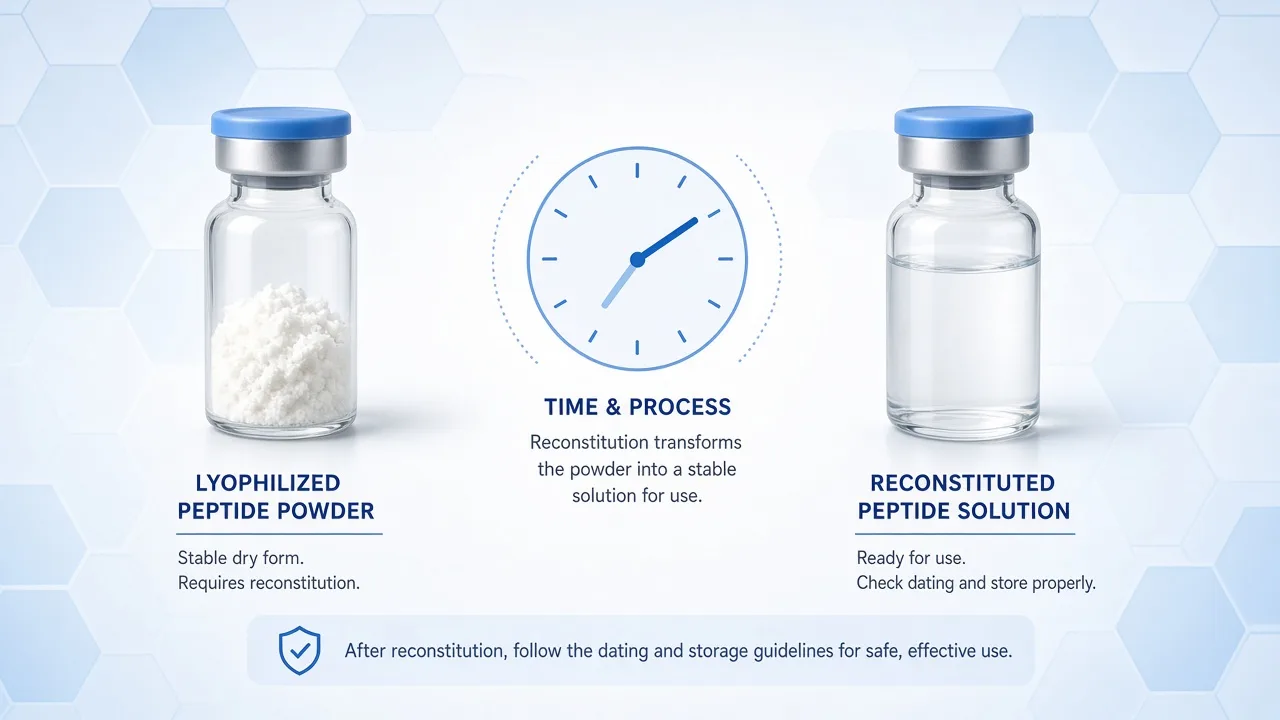
Lyophilized solid versus solution: the core contrast
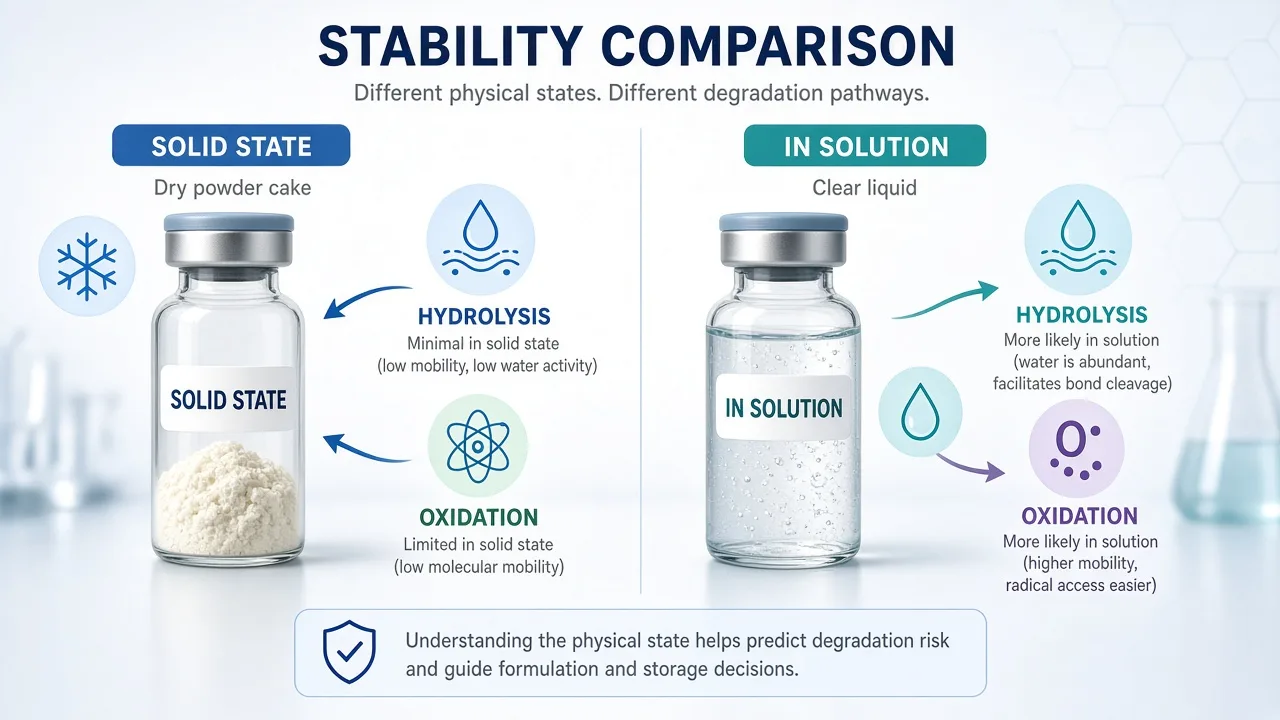
Reviews of peptide and protein instability often note that shelf behavior in solution can be much more limited than for many lyophilized materials held under protective conditions. Water supports hydrolysis and increases mobility that enables collisions and rearrangements.
- Solid-state themes: residual moisture, temperature, light, and solid-state pathways can still matter.
- Solution themes: pH, buffer species, temperature, oxygen, light, freeze-thaw, and surface adsorption often appear in educational maps.
- Transplant caution: solution pH-rate tables do not automatically become solid-state shelf rules, and the reverse is also unsafe reading.
Analytical handling is not personal instruction
Mass-spectrometry peptide assay guidance discusses calibrator storage themes, including preferences for lyophilized long-term holding in research settings and caution about repeated freeze-thaw of solutions. Those are laboratory literacy pointers, not home protocols.
Sequence dependence: why peptides disagree with each other
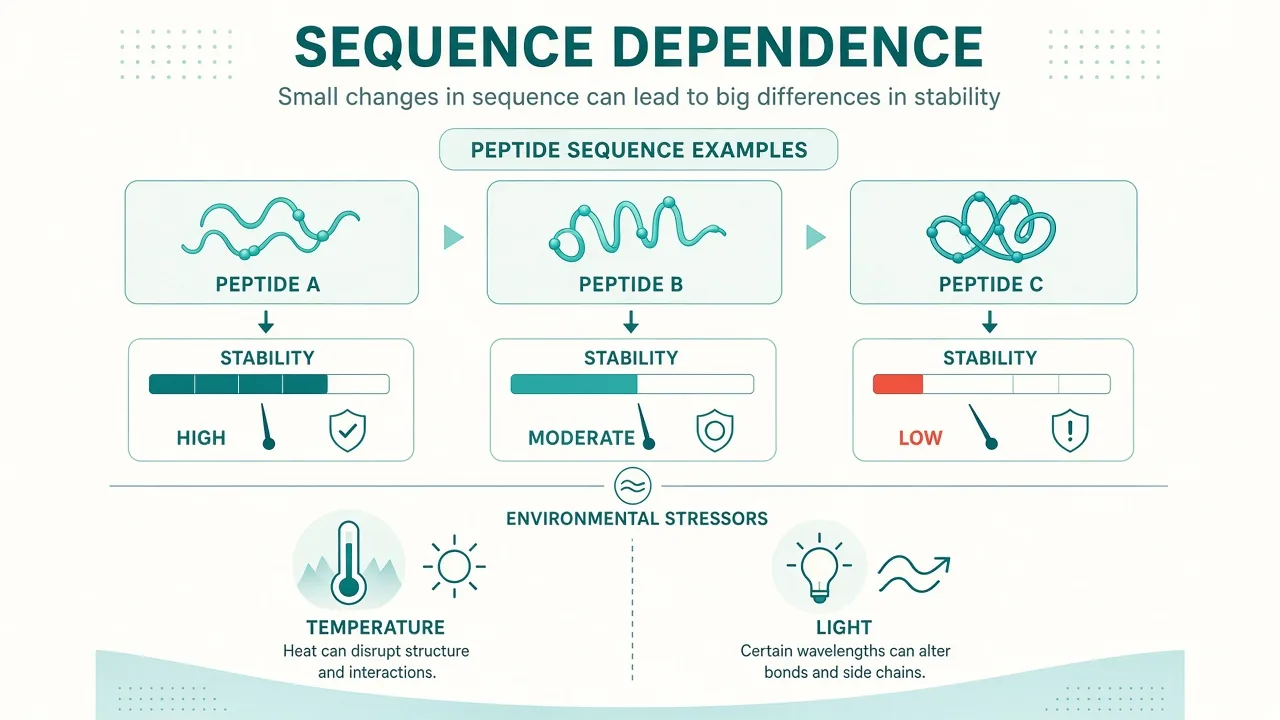
Asparagine and aspartic acid contexts are frequently flagged for deamidation and related isomerizations. Methionine, cysteine, and tryptophan often appear in oxidation discussions. Aggregation and adsorption can remove peptide from solution without every covalent bond breaking.
That is why a day-count copied from one nickname to another is weak literacy. The sequence is part of the stability question.
Common experimental stressors named in literature
Temperature elevation, light, oxygen exposure, and freeze-thaw cycles appear as stressors in formulation and analytical discussions. Naming stressors is not the same as publishing a personal refrigerator schedule.
Two clocks: diluent dating versus peptide solution integrity
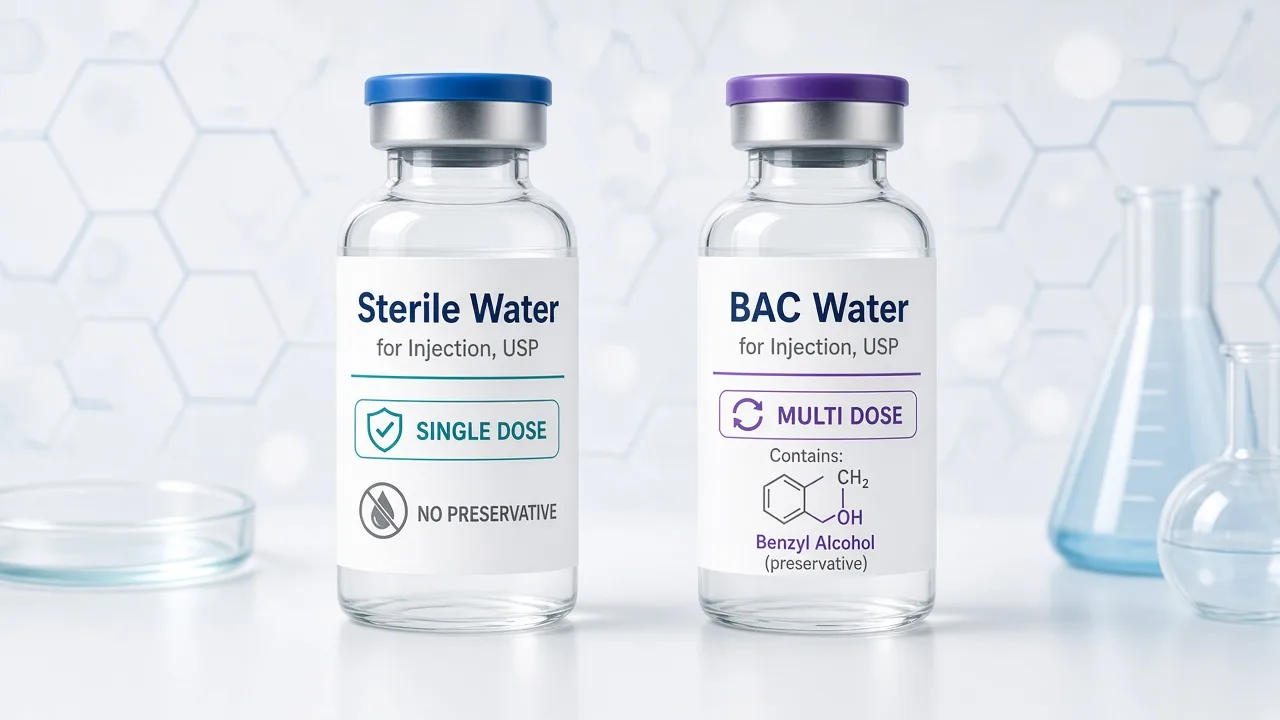
A multi-dose diluent can have a labeled or USP-linked beyond-use window after first puncture. A dissolved peptide can lose integrity on a different timeline driven by chemistry. Mixing those clocks produces false confidence.
- Diluent clock: product label and multi-dose beyond-use literacy, discussed in BAC water dating education.
- Peptide clock: sequence and condition-dependent chemical and physical stability in solution.
- Neither clock is permission to prepare or use research chemicals outside regulated contexts.
Approved medicines are a different lane
Labeled finished drugs follow their own product-specific storage instructions after preparation. Do not import forum peptide day-counts onto approved medicine labels, and do not import medicine labels onto informal research-chemical marketing.
Common misreadings about reconstituted shelf life
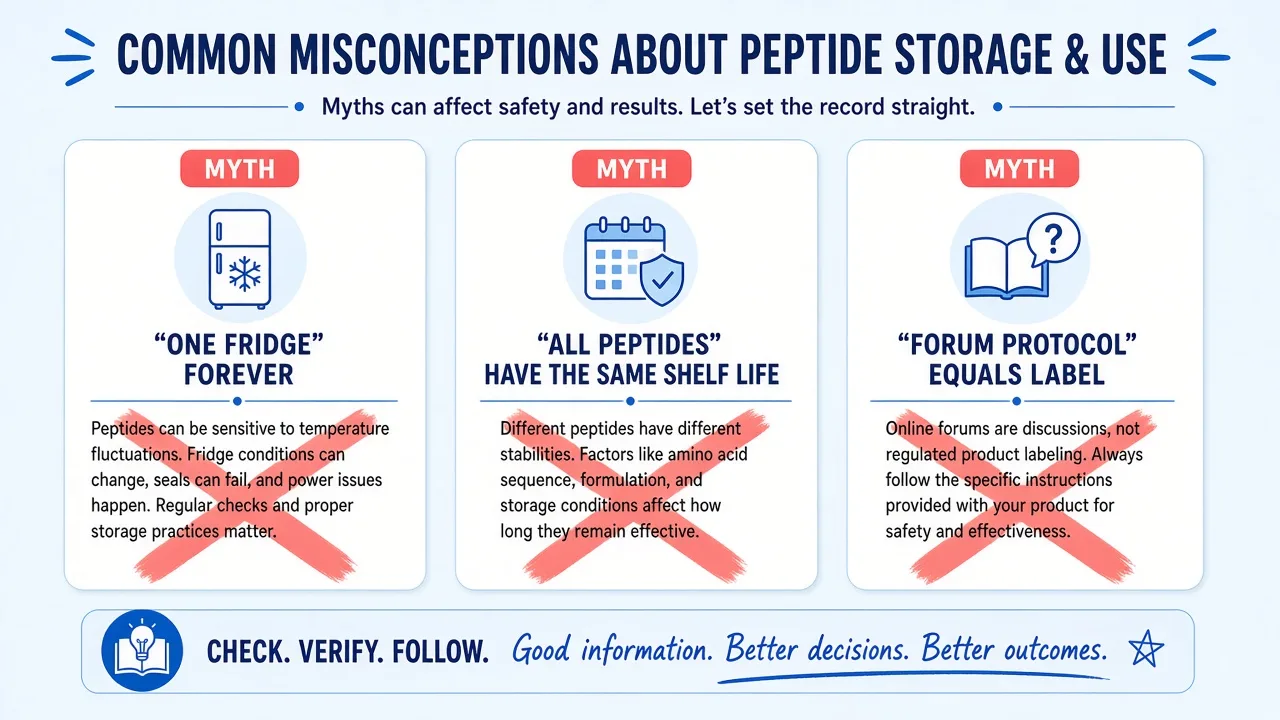
Online shorthand turns uncertainty into slogans. Literacy puts the slogans back into category.
- Misreading: cold storage creates one universal reconstituted shelf life for every peptide.
- Misreading: every sequence shares the same days-or-weeks rule found in a forum post.
- Misreading: clear liquid always means chemically intact peptide.
- Misreading: diluent beyond-use dating automatically equals peptide solution dating.
RUO marketing does not invent a stability certificate
Research-use-only framing is not a purity or stability warranty. See what research-use-only means and peptide safety education first.
Where this article sits in Safety & Guides
This page belongs under Safety & Guides because it teaches stability judgment without giving use instructions. Pair it with research peptide storage basics for the broader solid-versus-solution map, and with the Peptide Calculator only for educational unit-conversion math, not as a reconstitution guide.
Final limit statement
If you need an institutional procedure, use your laboratory quality system. If you need medical storage advice for an approved medicine, use the product label and a clinician or pharmacist. This article is neither.