

Oligopeptide and polypeptide are length-flavored words inside the broader peptide family. This article explains how educational sources and papers use those terms, where cutoffs come from, and why context still beats memorizing a single residue number. It is educational only and is not medical advice.
Why oligopeptide versus polypeptide language matters
Length words are orientation tools. They help readers guess whether a paper is talking about a short motif-like chain or a longer polymer approaching protein discussions. Used carelessly, the same words become false precision: a residue count treated like a verdict.
Place in Peptide Basics
This contrast sits beside Peptides vs Proteins. That sibling article compares short chains with folded proteins. This article stays inside peptide naming and asks how oligo and poly are used before the protein boundary becomes the main issue.
Hub and definition links
Start from Peptide Basics and What Are Peptides if you need the shared polymer vocabulary first. How Peptide Bonds Work explains the shared linkage that makes length categories possible in the first place.
Educational scope
The aim is reading clarity, not ranking molecules for personal decisions. No dosing, no protocols, and no product advice appear here.
IUPAC and textbook definitions of the length words

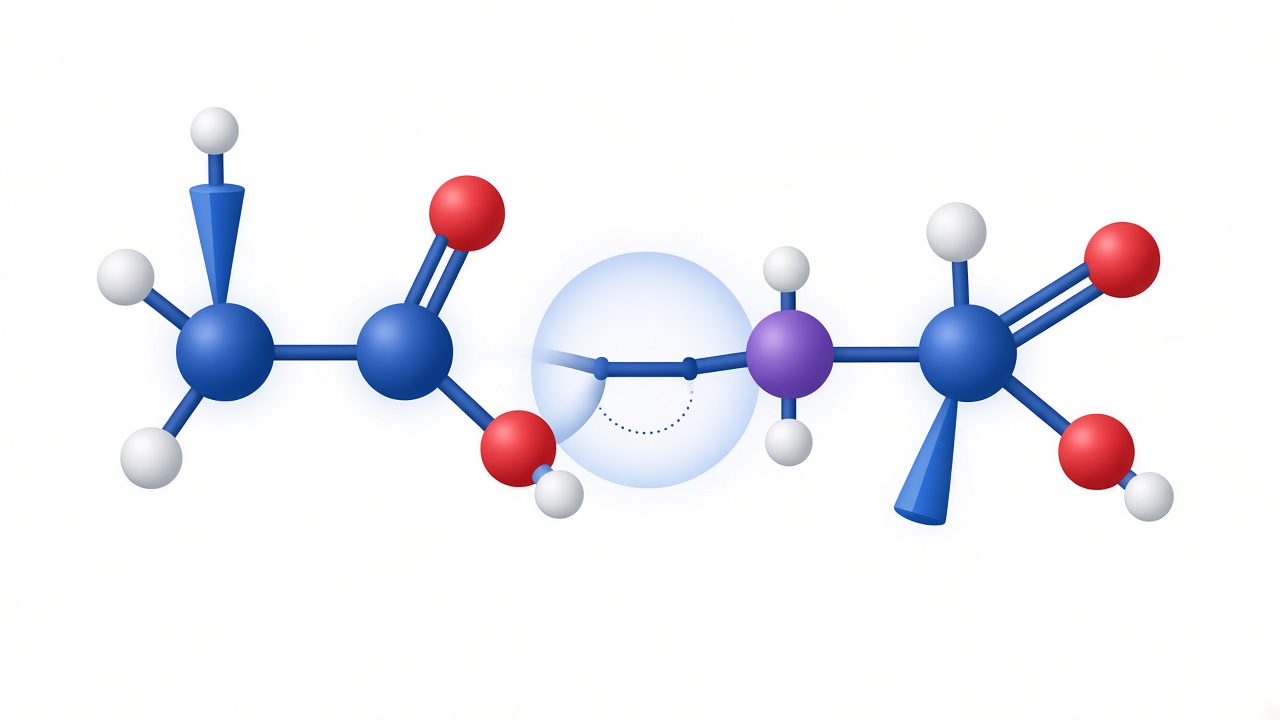
IUPAC gives the cleanest educational anchors. Peptides are amides from two or more amino acids linked carbonyl-to-nitrogen. Oligo is a prefix meaning a few repeating units, generally illustrated around 3 to 10 depending on compound class. Polypeptides are defined as peptides with ten or more amino acid residues.
Why ranges are approximate
IUPAC itself notes that oligo limits are not precisely defined in practice and vary with structure type. That honesty is useful. It tells beginners not to treat residue 9 and residue 11 as metaphysical opposites.
StatPearls framing
StatPearls peptide education emphasizes short amino-acid polymers as peptides. Teaching texts often nest dipeptides, oligopeptides, and longer polypeptides inside one continuous story. The nested story is more accurate than a viral graphic with one hard cutoff and no caveats.
Proteins nearby
Once chains become long enough to fold into stable domains, many writers shift toward protein language. That shift is educational convenience aligned with structure and function, not a denial that proteins are also polypeptide chains chemically.
How research papers actually use the terms
Journal usage is messier than glossary cards. Some methods sections call a 12-residue tool an oligopeptide out of habit. Some biology papers call any translated chain a polypeptide regardless of length. Reviews of peptide therapeutics may prefer peptide as the umbrella and avoid oligo and poly altogether.
- Prefer residue count when available.
- Treat oligo and poly as orientation labels.
- Expect field-specific naming habits.
- Separate length labels from function claims.
- Use IUPAC when you need a shared reference point.
Methods section cues
When length words appear in methods, look for an explicit residue count, molecular weight, or sequence. Those numbers are usually more informative than the label. If only the label appears, treat it as soft category language.
Field dialects
Organic chemistry naming, structural biology, immunology epitope talk, and pharmacology reviews do not police vocabulary identically. A careful reader learns the local dialect of the paper instead of importing one blog glossary into every field.
Polypeptide as a general polymer word
Polypeptide often functions as a general polymer word: a chain of amino acids, full stop. In that dialect, proteins are folded polypeptides. Confusing that usage with the IUPAC ten-or-more peptide definition creates unnecessary arguments.
Why length often correlates with research behavior talk
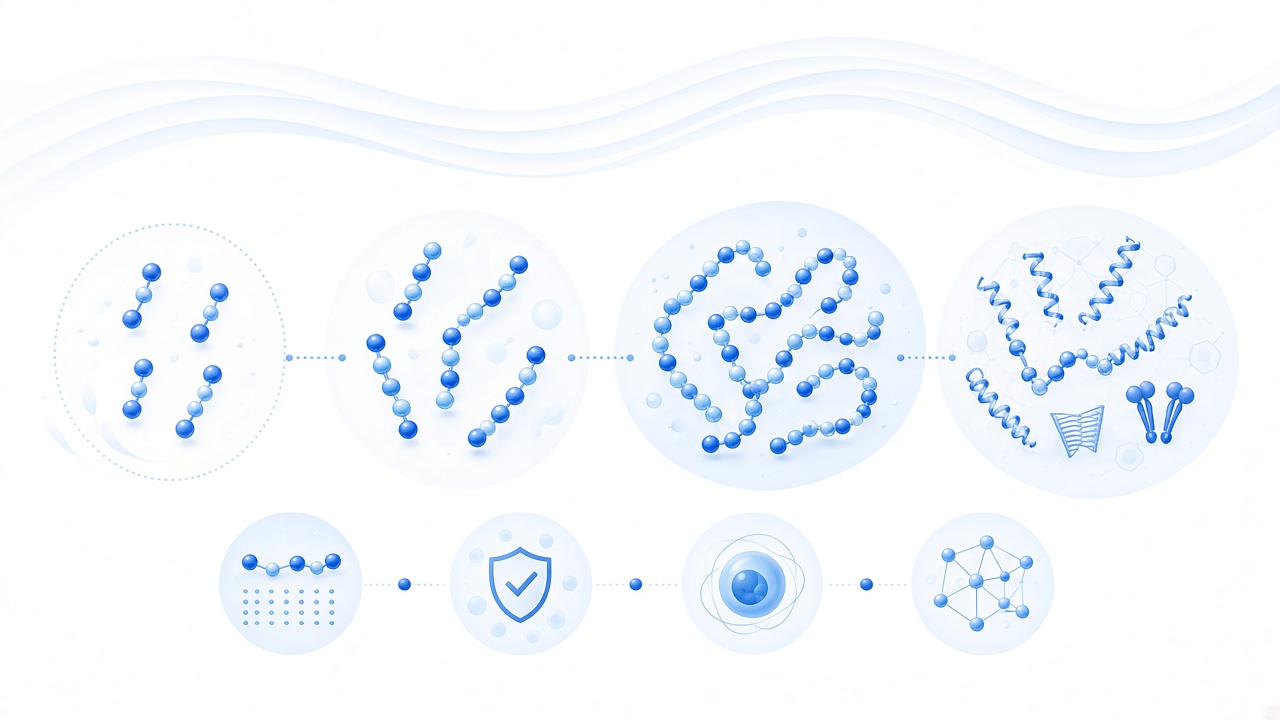
Length matters because conformational options grow with chain size. Short oligopeptides are frequently discussed as flexible motifs, digestion products, or recognition epitopes. Longer polypeptides are more often discussed with secondary structure, domains, or protein-like folding themes.
Correlation is not destiny
A short cyclic peptide can be conformationally constrained. A long disordered chain can remain flexible. Length is a useful prior, not destiny. Educational reading keeps that humility visible.
Stability and assay language
Half-life and protease discussions often intensify around shorter chains in experimental systems, but that is a research-methods theme, not a personal-use guide. See Peptide Half-Life for educational stability language without protocols.
Synthesis practicality in papers
Methods papers may note that shorter sequences are easier to assemble chemically, while longer chains raise coupling and purification challenges. That is laboratory practicality talk. It is not an instruction set for unsupervised synthesis.
Common misconceptions about oligopeptides and polypeptides
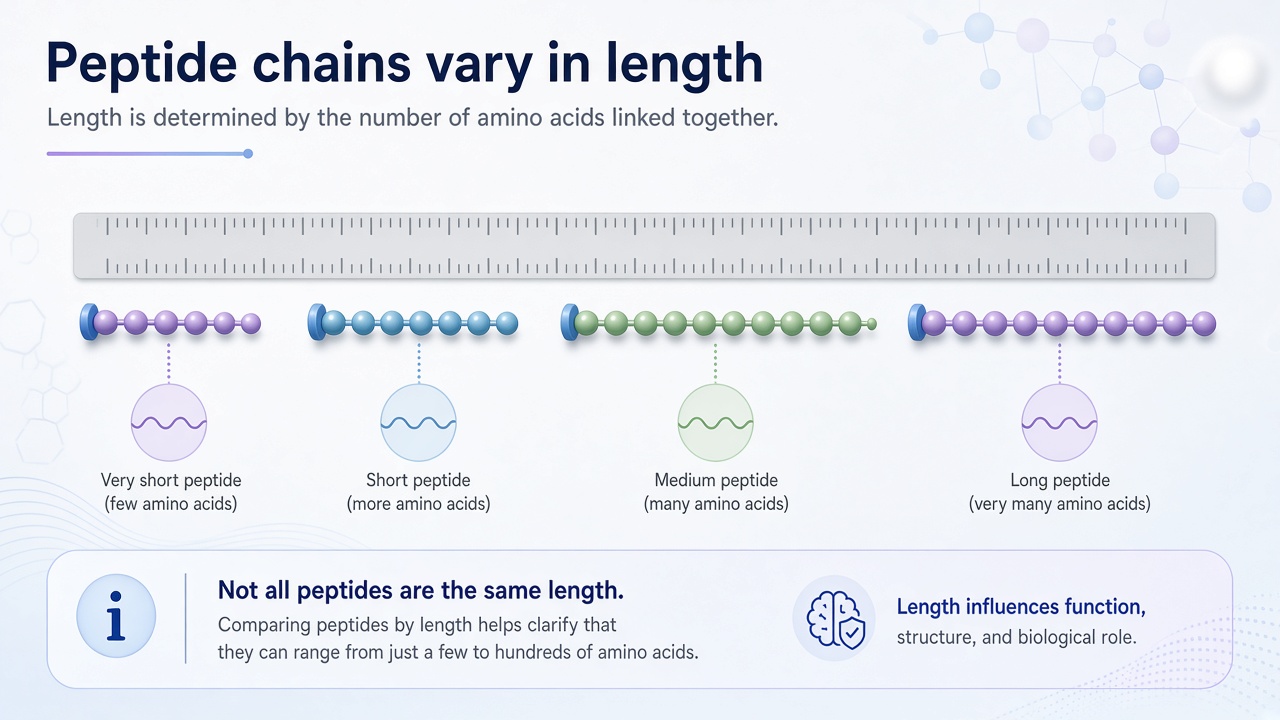
Misconception one: there is one universal residue cutoff everyone must use. Misconception two: longer always means stronger or more important. Misconception three: oligopeptide branding on a product page is a scientific classification you can trust without reading primary definitions.
Cutoff absolutism
Cutoffs help teaching. They fail as courtroom walls. If two reputable sources disagree by a few residues, that usually reflects convention, not a crisis in chemistry.
Longer is better
Biological importance does not scale monotonically with length. Short messengers can be central in physiology education, while long chains can be structural or catalytic. Evidence and role matter more than poly versus oligo branding.
Marketing borrowed jargon
Commercial copy sometimes uses oligopeptide as a prestige adjective. Educational readers should ask for sequence length, evidence type, and status context instead of accepting the adjective as proof.
How to read length labels critically
Build a short checklist. Does the source define oligopeptide or polypeptide? Does it give a residue count? Does it switch to protein language without saying why? Does function talk match the structural scale being implied?
Crosswalk to sibling articles
Use Peptides vs Proteins when the text jumps from peptide to protein without explanation. Use Types of Research Peptides when classification words multiply. Use Endogenous vs Synthetic Peptides when origin language is doing more work than length language.
Figures and tables
Figures that show cartoon chains without a residue legend are weak educational tools. Prefer tables or methods text that state length explicitly. Ambiguous cartoons are fine for intuition and poor for claims.
Glossary discipline
When writing notes for yourself, record both the paper's label and the residue count. That dual note prevents later confusion when another paper uses the opposite label for a similar length.
Links back to hubs and related explainers

Length vocabulary is a Peptide Basics skill. It prepares you for research-methods reading without pretending that nomenclature replaces evidence appraisal.
Peptide Basics
Return to Peptide Basics for the pillar overview. Keep What Are Peptides and How Peptide Bonds Work nearby when polymer fundamentals still feel shaky.
Research and Science
When a paper's length label is fine but the study design is the real puzzle, move to peptide research and science. Length naming will not rescue weak endpoints.
One practical habit
Translate every oligopeptide or polypeptide claim into: about N residues, used for question Q, in system S. If you cannot fill N, Q, and S, you do not yet understand the claim.
Limits and disclaimer
This explainer does not tell anyone what to take, buy, or prepare. It does not convert naming conventions into health claims. It does not replace IUPAC primary definitions or the methods section of any paper you need to interpret carefully.
Literacy goal
The literacy goal is modest and useful: hear length language as approximate scientific dialect, then demand numbers and context.
Closing sentence
Oligopeptide versus polypeptide is a map legend for chain size. It is not a scoreboard for biological value and not a guide for personal use.
When to stop
If a source refuses to define its length words while making strong practical claims, stop reading that source for science education and switch to primary references.