


Purity numbers appear everywhere in peptide research talk, often with more confidence than context. This article explains how educational readers can interpret purity and analytical identity claims in papers and material descriptions, what common methods are meant to show, and where public quality narratives over-reach. Not medical advice and not a buying guide.
Why peptide purity literacy matters
Synthetic peptide work depends on knowing what chemical object entered an experiment. Purity and identity analytics are how papers and laboratories argue that the object is close to the intended sequence. Public conversation often reduces that hard work to a single percentage and a green checkmark.
Research context
This article sits in Research and Science because it teaches how to read analytical claims. It pairs tightly with Peptide Synthesis Methodologies, where assembly routes create the impurity profiles analytics later inspect.
Not a shopping guide
Nothing here ranks vendors, teaches purchasing criteria for personal use, or converts analytical jargon into a consumer checklist for self-experimentation.
Status tracks remain separate
FDA compounding risk communications and WADA list education address status and risk-communication themes. Analytical purity does not absorb those domains automatically.
Purity versus identity: two questions papers must answer
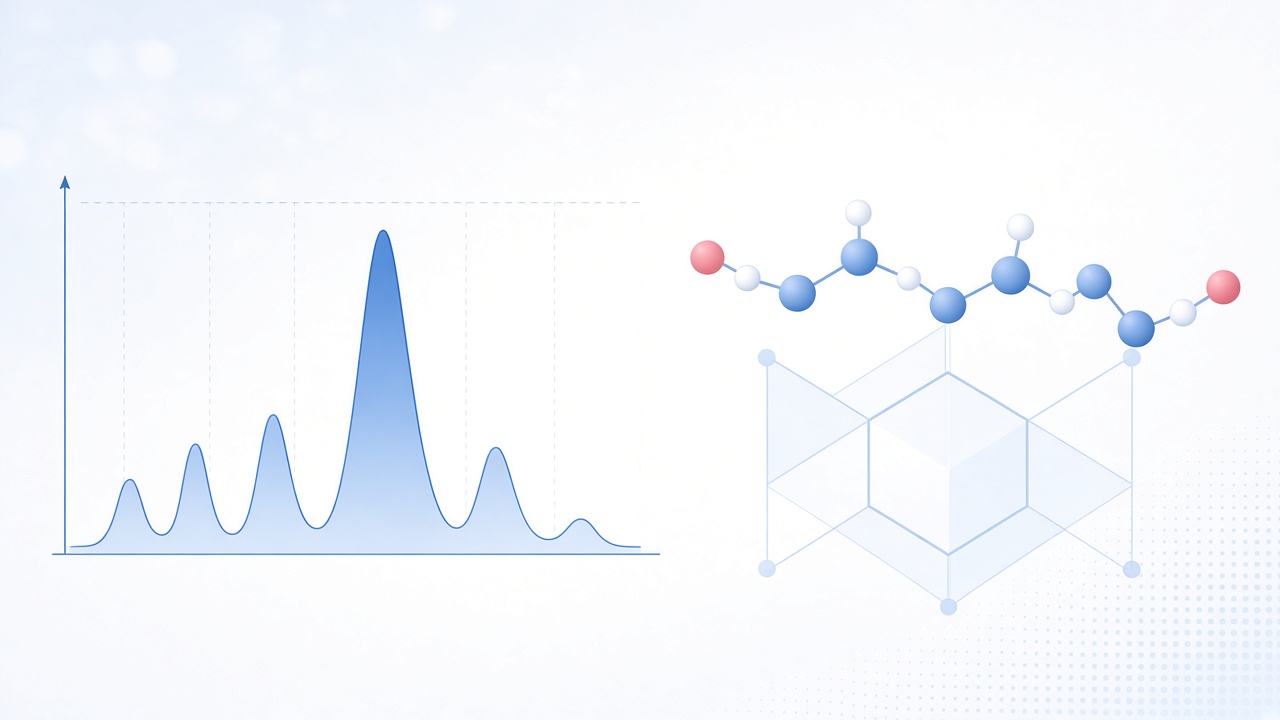
Identity asks whether the main component matches the intended peptide. Purity asks how much else is present that analytics can see. A sample can be mostly one peak and still be the wrong molecule if identity confirmation is weak. A sample can be the right molecule with meaningful impurities if purification was incomplete.
Why both appear in methods
Careful peptide methods sections often report chromatographic purity estimates plus mass confirmation. Reviews of peptide synthesis and translation discuss characterization as part of credible development stories. Educational readers should expect both ideas even when a social post mentions only purity.
Counter-ions and water
Peptide solids may include counter-ions and residual moisture that affect net peptide content by weight without appearing as separate sequence impurities in a chromatogram. Net peptide content and chromatographic purity are therefore not always the same conversation.
Sequence is necessary, not sufficient
Knowing the intended sequence from IUPAC-style peptide definitions is necessary. Knowing that a particular bottle or batch matches that sequence with acceptable impurity control is a separate empirical claim.
Common analytical languages you will see
High-performance liquid chromatography language appears constantly in purity talk. Mass spectrometry language appears constantly in identity talk. Neither is mystical. Both are method-defined measurements with assumptions.
- Method named (for example HPLC conditions summarized).
- Identity support named (for example MS).
- Percentage defined as chromatographic purity or another explicit metric.
- Limitations acknowledged (detection limits, isomers, salts).
- Link between material and experiment stated.
HPLC peak-area ideas
A simplified educational picture is that a chromatogram separates components in time, and relative peak areas are used to estimate contributions under chosen detection conditions. Detection wavelength, column, and gradient all influence what is seen. Invisible impurities are a real conceptual limit.
Mass spectrometry identity
Mass spectrometry supports molecular mass confirmation and, with appropriate experiments, richer structural confidence. A matching mass is strong supportive evidence and still benefits from orthogonal checks depending on study needs.
What educational readers should demand
Demand method naming, not only a percentage. Demand identity support, not only a pretty chromatogram screenshot. Demand batch context when a claim is about a specific material rather than a theoretical sequence.
How papers use purity claims in practice
In research papers, purity statements often justify that biological effects are unlikely to be dominated by obvious synthetic by-products. That justification is only as strong as the analytics and controls. A high purity number cannot rescue a poorly controlled biological assay.
Scrambled and vehicle controls
Even with good purity, controls matter. Vehicle effects and sequence-specific comparisons help show that an endpoint tracks the intended peptide rather than handling artifacts.
Impurity biology
Deletion sequences, truncation products, and chemically modified by-products can sometimes retain activity or interfere with assays. That is one reason characterization depth scales with claim strength in serious research programs.
Pharmaceutical versus research-use worlds
Approved medicine manufacturing quality systems and research-chemical documentation are not interchangeable. Educational readers should keep those institutional contexts distinct when interpreting labels.
Common misconceptions about purity percentages

Misconception: higher purity automatically means medically appropriate. Misconception: purity equals potency. Misconception: a COA image shared in a forum verifies every vial in a supply chain forever.
Purity is not potency
Potency concerns biological activity magnitude in a defined assay or clinical context. A pure inactive analog can be analytically beautiful and biologically uninteresting for a chosen endpoint.
Purity is not permission
Analytical quality talk does not create medical permission, sport permission, or legal permission. Status literacy remains a separate track via official pages when those questions arise.
Screenshot COA culture
Screenshots can be outdated, mismatched to batch, or incomplete. Educational reading treats them as claims needing context, not as sacred objects.
How to read purity and analytics claims critically
Use a disciplined checklist. What method? What identity confirmation? What exact metric does the percentage represent? What impurities would this method miss? How does the paper connect material quality to biological inference?
Synthesis link
Assembly route influences likely impurity families. Peptide Synthesis Methodologies helps you understand why analytics are not optional decoration after chemical construction stories.
Endogenous contrast
Endogenous versus synthetic literacy reminds you that a synthetic material needs analytical characterization in a way an endogenous measurement study may handle differently through bioanalysis of biological samples.
Safety education neighbor
When quality talk becomes a prelude to personal-use persuasion, switch to Safety-First Education. Uncertainty and responsibility framing belong there.
Hub links and related reading

Return to peptide research and science for the broader evidence map. Use Types of Research Peptides when classification language is tangled with quality language. Use What Are Peptides when foundational vocabulary is the real blocker.
What this page optimizes for
This page optimizes for skepticism that is specific rather than vague: asking better analytical questions instead of dismissing all numbers or worshipping all numbers.
Official references
For compounding risk communication themes, use FDA educational pages. For sport prohibited-list literacy, use WADA educational list resources. For chemistry definitions, use IUPAC and NCBI Bookshelf primers.
Practical note template
Try: Chromatographic purity reported as X by method M, identity supported by Y, limitations Z. That template resists hype compression.
Limits and disclaimer
This article does not provide laboratory procedures for purifying peptides, running HPLC, or interpreting a specific certificate for use decisions. It does not recommend purchase or administration of any material. It does not convert analytical confidence into health claims.
Intended use of the page
Use it to read research and secondary claims more carefully. Do not use it as a substitute for qualified laboratory quality systems or clinical governance.
Closing
Purity percentages are method-bound estimates. Educational integrity keeps the method visible, keeps identity beside purity, and keeps personal-use persuasion out of the analytics lesson.
Final sentence
A clean chromatogram can support a research inference. It cannot, by itself, tell you what anyone should take.