
Potency and efficacy are neighboring pharmacology words that social posts often fuse into one ranking of better. Potency asks how much ligand is needed for a stated effect size under stated conditions. Efficacy asks how large a functional response can appear once the pathway is engaged in that system. This article defines EC50 and Emax, walks a worked comparison, and keeps those curve features separate for peptide research readers. Educational only: not medical advice, and no dosing, assay recipes, or compound recommendations.
Why peptide readers need the potency versus efficacy split

Affinity literacy stops many binding overclaims. Potency literacy stops the next overclaim: treating a left-shifted curve as proof of a bigger biological win.
A careful reader asks two separate questions. How much ligand was needed for the stated effect? How large was the maximum response in that system?
This page pairs with affinity vs efficacy peptides. Binding preference, potency, and efficacy belong in separate columns. Practice sentence: “This assay shows a lower concentration for a defined effect; it has not yet shown a larger maximum response.”
What potency means, and what EC50 reports
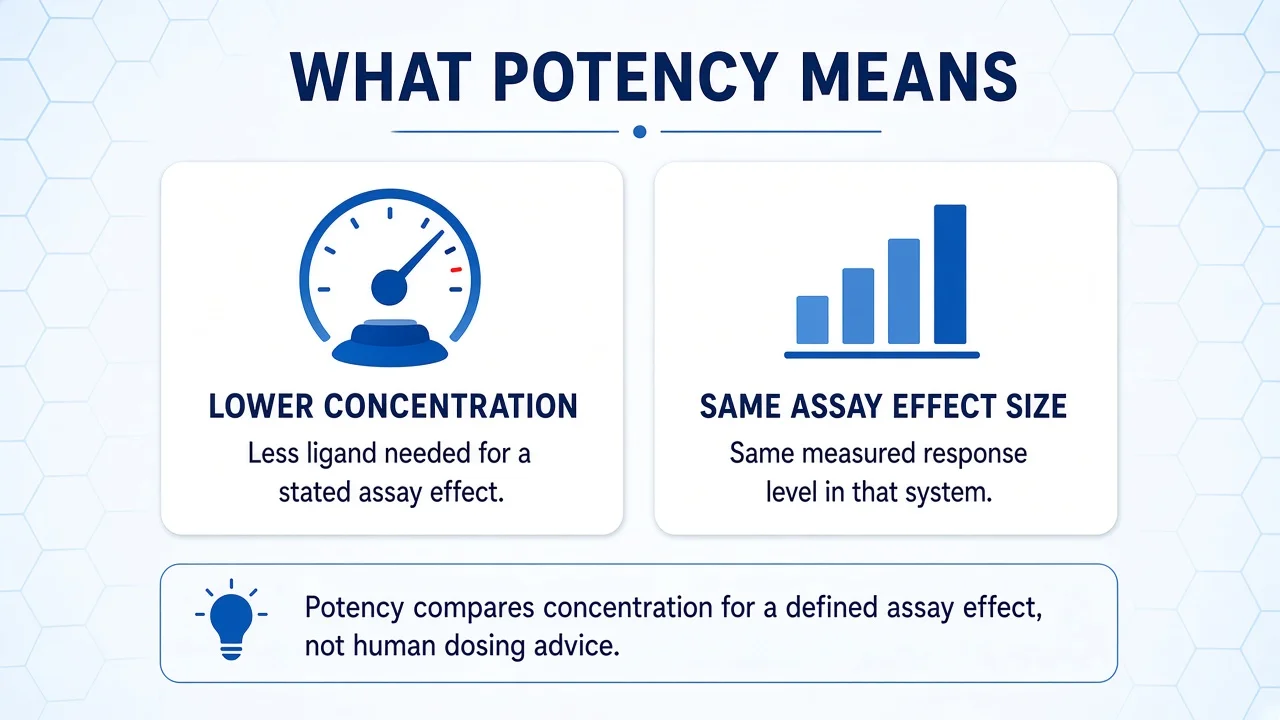
IUPHAR quantitative pharmacology language treats potency as an expression of activity in terms of the concentration or amount needed to produce a defined effect. The term is imprecise unless that effect is named, which is why papers usually report a specific summary such as EC50 rather than a free-floating potency vibe.
EC50 (also written [A]50) is the molar concentration of an agonist that produces 50% of the maximal possible effect of that agonist in the stated assay. A ligand that reaches the same defined effect at a lower concentration is described as more potent in that system.
Those numbers only mean what the assay measured. Changing the cell type, receptor expression, readout, or endpoint can change the ranking. Potency does not finish the story of maximum response size, selectivity, or translation beyond the assay.
What efficacy means beside potency, and what Emax reports
Efficacy, in this educational sense, is about response capacity once the target pathway is engaged. Teaching texts often point to Emax, the maximum response on the concentration-response curve for that ligand in the stated system.
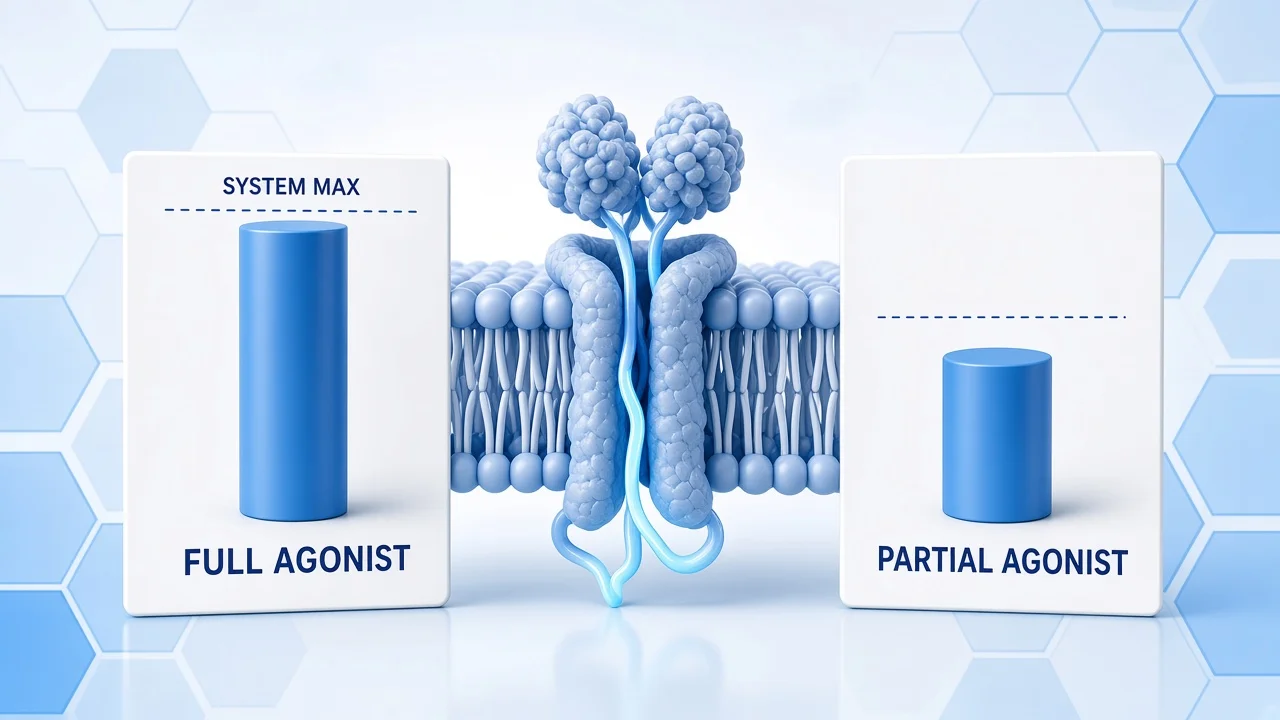
Full agonists can produce the maximum response available through that pathway in the stated system. Partial agonists produce less than that maximum even at high occupancy. That is why two ligands can share rough potency talk while differing in ceiling response, or share a ceiling while differing in how much ligand is needed to get there.
Efficacy claims need the assay named. Receptor density, spare receptors, and pathway amplification can all change the apparent ceiling. Pathway context continues in peptide cellular signaling.
Worked example: same Emax, different potency
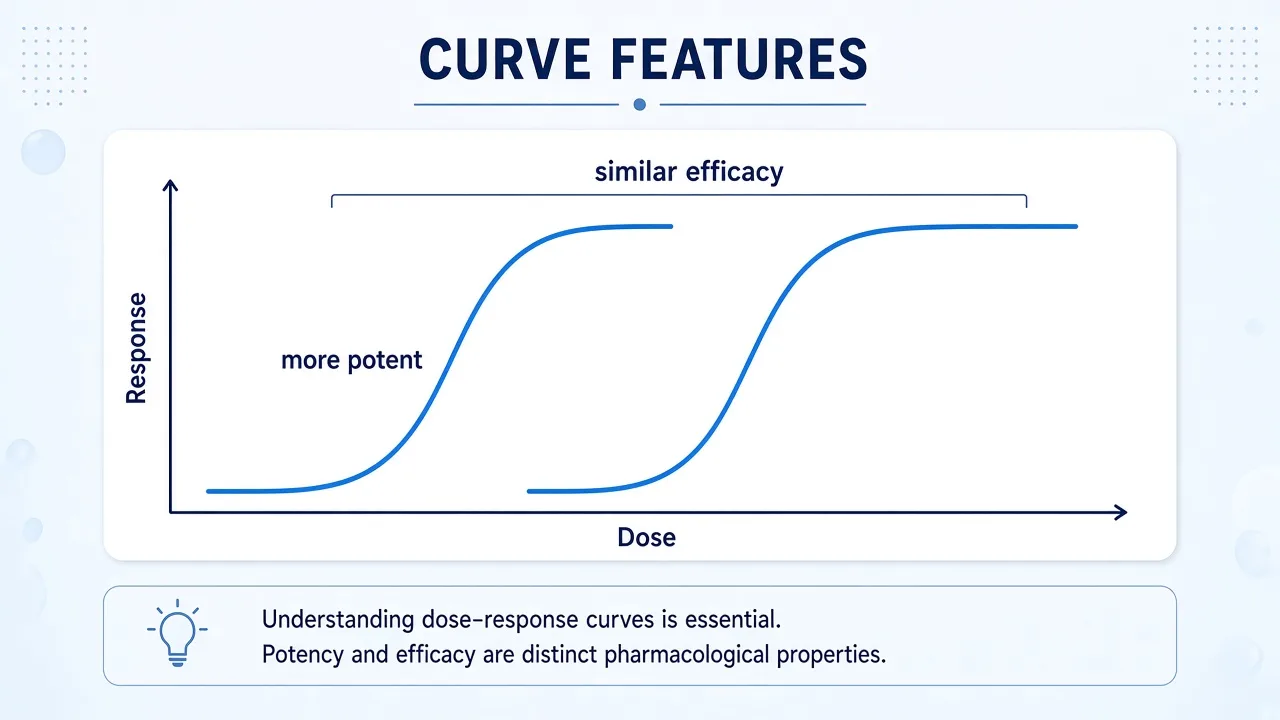
Imagine two hypothetical peptides tested in the same functional assay, with the same receptor, cell background, and endpoint. Both reach the same plateau height, so observed maximal efficacy (Emax) looks similar. Peptide A reaches half of that plateau at a lower concentration than Peptide B, so Peptide A has the lower EC50 and is more potent in that assay.
The table below keeps the columns honest. Same ceiling does not erase a potency difference. A potency difference does not invent a larger maximal response.
Hypothetical comparison in one matched functional assay (educational numbers only)
| Feature | Peptide A | Peptide B | Reader takeaway |
|---|---|---|---|
| Observed Emax | Same plateau height | Same plateau height | Similar observed maximal efficacy in this system |
| EC50 | Lower concentration for 50% of its own Emax | Higher concentration for 50% of its own Emax | A is more potent here; B is less potent here |
| What this does not prove | Human benefit or personal ranking | Human benefit or personal ranking | Matched assay literacy only |
Keep the example inside its box
These are teaching numbers, not measured results for named products. If the assay, endpoint, or receptor expression changed, both EC50 and apparent Emax could move. Fair comparison habits live in how to compare peptide studies.
Read the curve feature being claimed
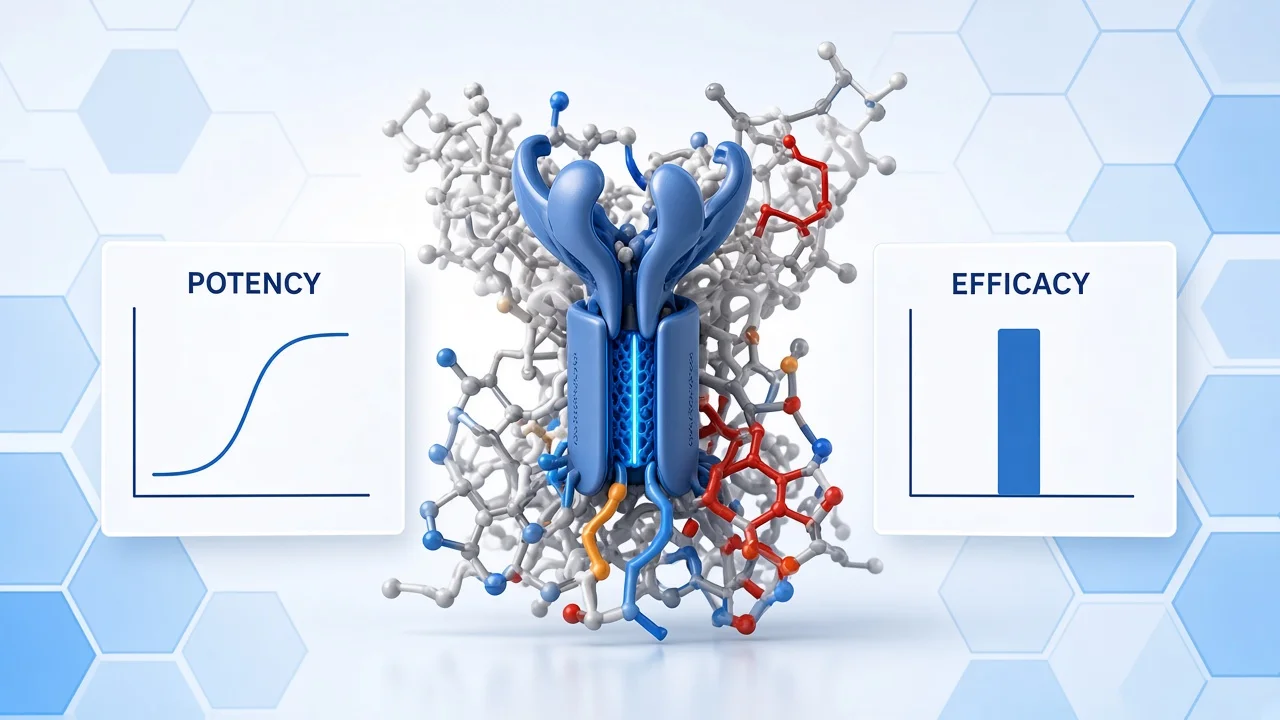
Concentration-response charts are literacy tools when you name the feature being compared. Left-right position of the curve often carries potency information (including EC50). Height of the plateau often carries efficacy information (including Emax).
Posts that say more potent while pointing at a taller bar are mixing columns. Posts that say stronger while showing only a midpoint shift are also incomplete.
- Potency question: how much ligand for a stated effect size (often summarized as EC50)?
- Efficacy question: how large is the maximum response (often summarized as Emax)?
- Affinity question: how favored is the bound complex?
- Context question: which assay, cell, pathway, and endpoint?
How affinity, potency, and efficacy relate without collapsing
Affinity can influence potency because tighter binding can reduce how much ligand is needed for occupancy. That does not make the words synonyms. A ligand can bind tightly and still show modest functional efficacy; another can show moderate affinity with a strong functional ceiling in the same system.
Return to affinity vs efficacy peptides and peptide receptor binding when a post jumps from nanomolar affinity straight to potency rankings.
Headline traps this split prevents
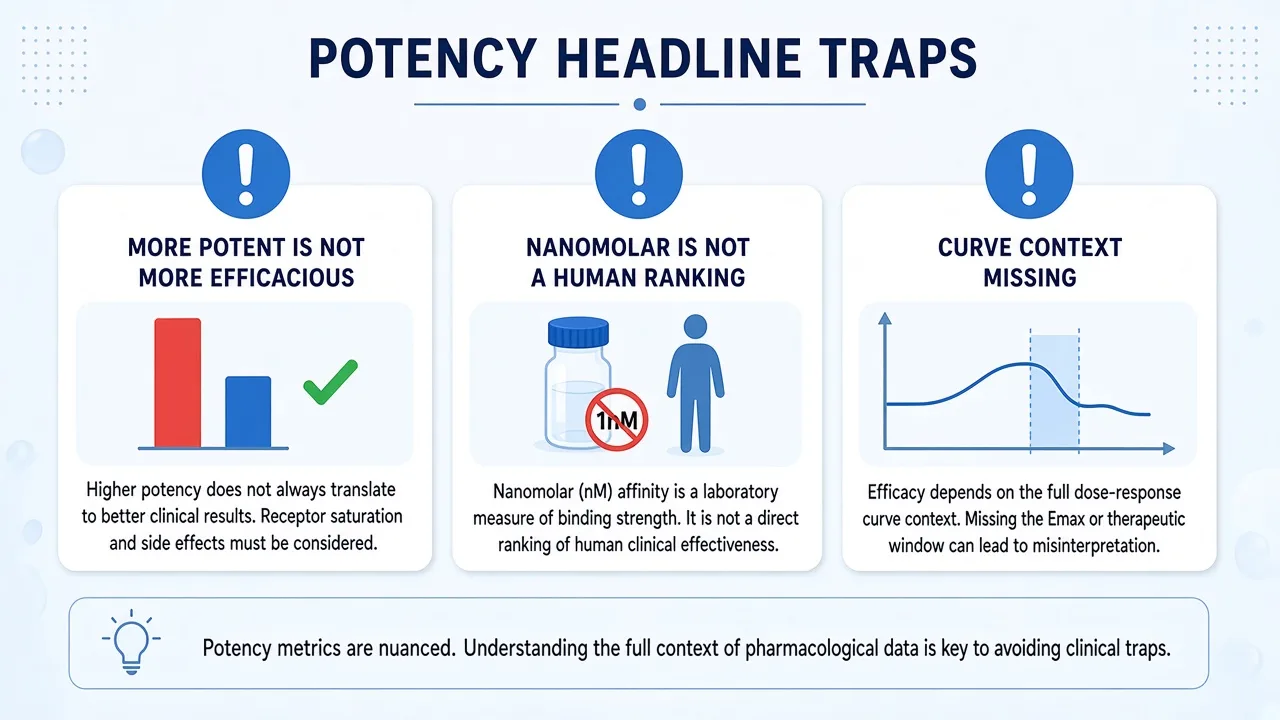
Trap one: more potent presented as more efficacious. Trap two: a lower EC50 treated as a universal winner. Trap three: affinity and potency used as interchangeable vibe words. Trap four: chart comparisons across unmatched assays. Trap five: seller potency tables with no system context.
- Name the potency claim separately from the efficacy claim.
- Name the assay system and endpoint.
- Refuse human leaps unless appropriate evidence exists for that leap.
Verification checklist before sharing a potency claim
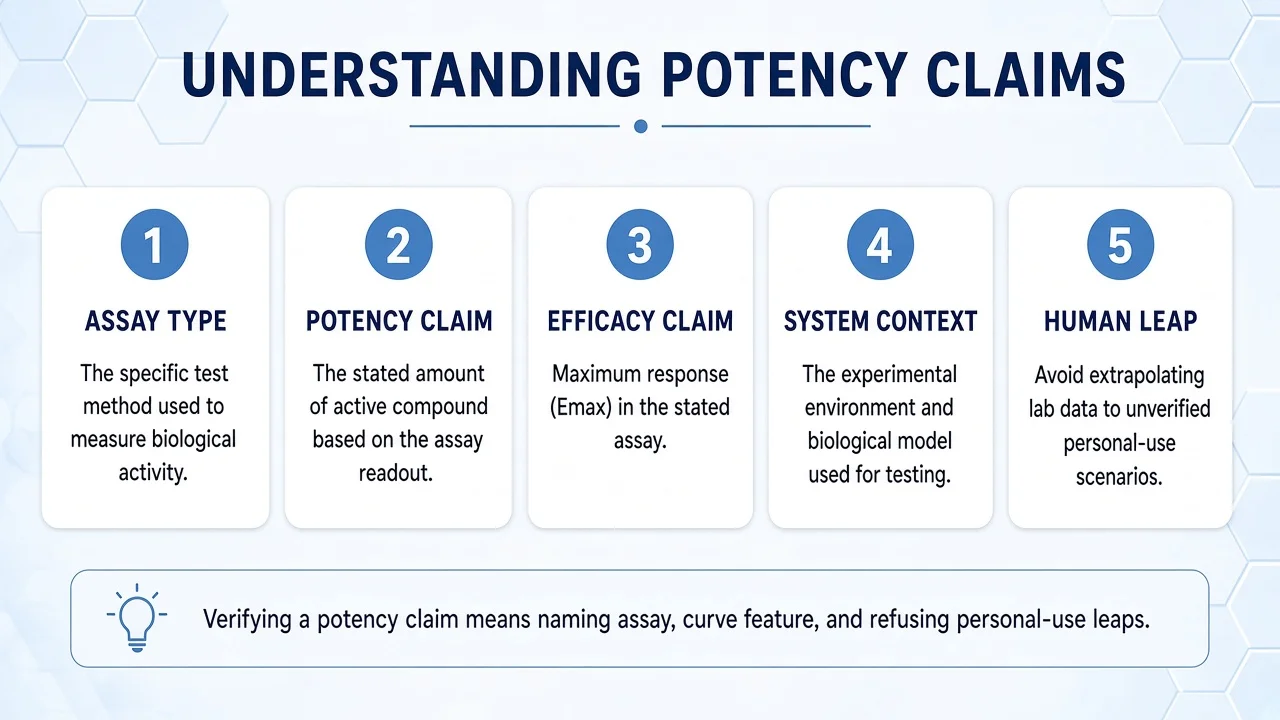
Use this checklist whenever a peptide post waves a potency number like a trophy. If the post cannot say whether it is talking about amount needed or maximum response, pause.
- Assay typed: functional response assay, binding assay, or unclear?
- Potency claim checked: what effect size and EC50 (or related) summary were reported?
- Efficacy claim checked: was Emax or maximum response compared at all?
- System named: receptor, cell type, pathway readout, conditions?
- Leap refused: is anyone converting this into personal-use advice?
Assay limits and what this page will not do
A well-run functional assay can answer a narrow potency or efficacy question inside its system. Moving from buffer to cell, animal, and human evidence classes still requires new checks. Keep in vitro vs in vivo peptide research and how to read peptide clinical trials nearby when a post converts curve language into lifestyle certainty.
This page will not publish dosing schedules, assay recipes, or compound rankings for personal use. It will not translate assay concentrations into lifestyle instructions, and it will not declare a peptide best from a single EC50 figure.
Links back to Research & Science
This page sits under peptide research and science. Start from affinity vs efficacy peptides for the binding-versus-response split, then return to peptide receptor binding for kinetics vocabulary.
When claims jump evidence classes, keep in vitro vs in vivo peptide research and how to compare peptide studies nearby. For the next column in this literacy set, continue with partial vs full agonist peptides.