
Agonist and antagonist are teaching labels for what a ligand does after it meets a receptor in a stated system, not vibe words for stronger or weaker peptides. An agonist promotes a measured response through that pathway. An antagonist reduces or blocks that response under stated conditions. This article keeps activation, blockade, competitive shift, and inverse agonism in separate columns for peptide research readers. Educational only: not medical advice, and no dosing, assay recipes, or compound recommendations.
Why peptide readers need the agonist versus antagonist split
Affinity literacy stops binding overclaims. Potency literacy stops midpoint overclaims. Full-versus-partial literacy stops ceiling overclaims. Agonist-versus-antagonist literacy stops the next overclaim: treating every ligand as a stimulator, or treating blockade as proof of uselessness.
A careful reader asks whether the post is describing activation of a measured pathway, opposition to that activation, or simply borrowing pharmacology vocabulary for marketing emphasis.
This page continues the set that includes affinity vs efficacy peptides, potency vs efficacy peptides, and partial vs full agonist peptides.
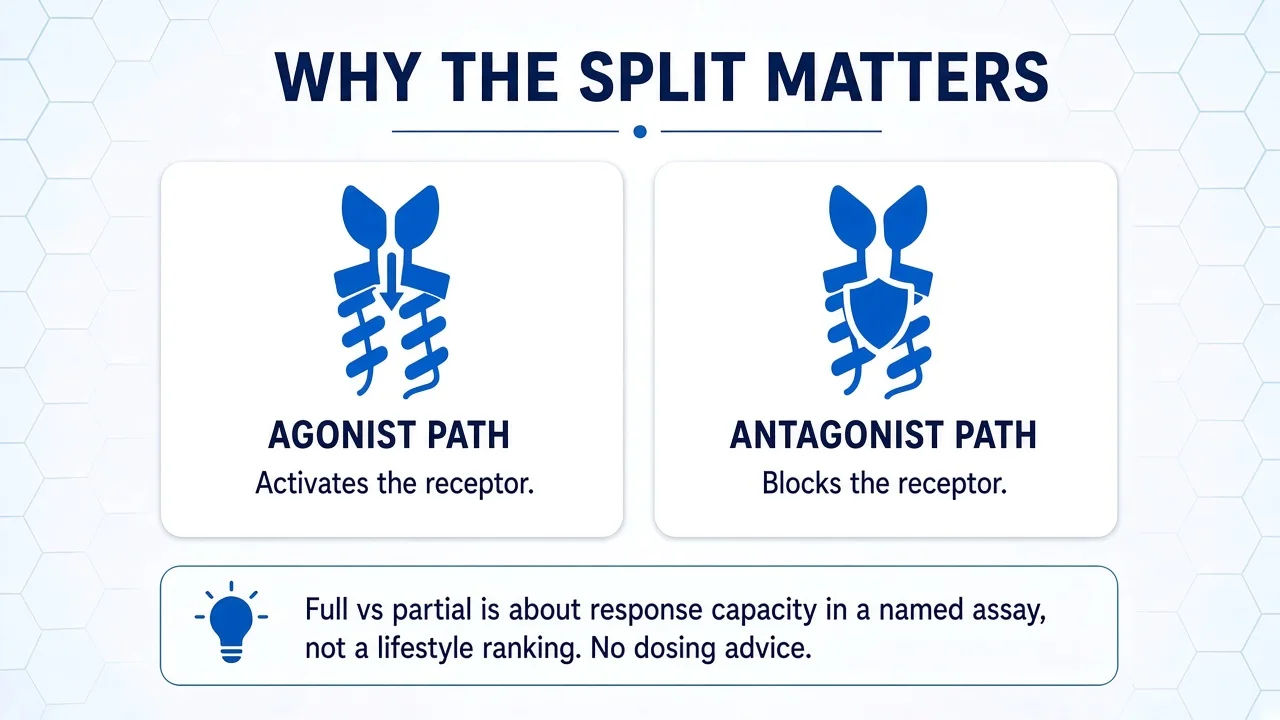
What agonist means in a stated system
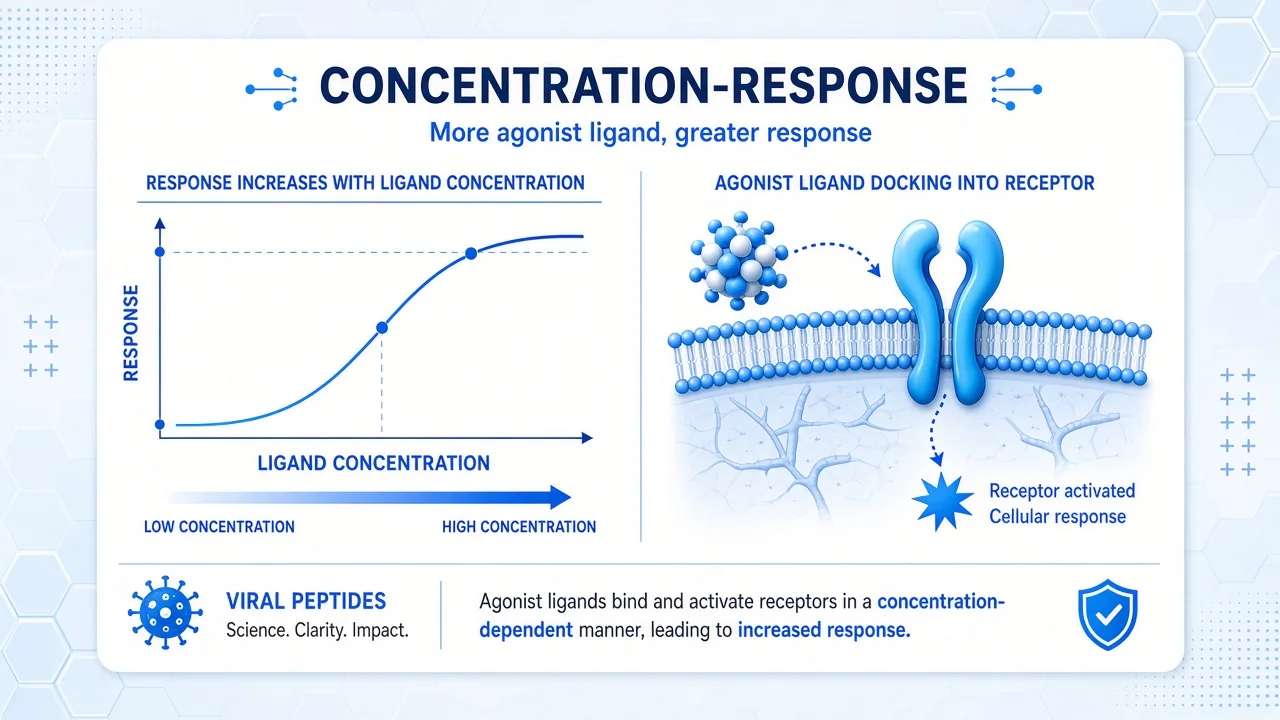
In educational pharmacodynamics, an agonist binds and promotes a measurable response through the pathway being read out. The concentration-response curve rises as agonist concentration increases, within the limits of that assay.
Agonist is the family label. Full and partial describe how high the response can climb once that family membership is established. A post that says agonist without naming the system and endpoint is incomplete.
Return to partial vs full agonist peptides when a screenshot collapses agonist into strong and antagonist into weak without assay context.
What antagonist means beside agonist
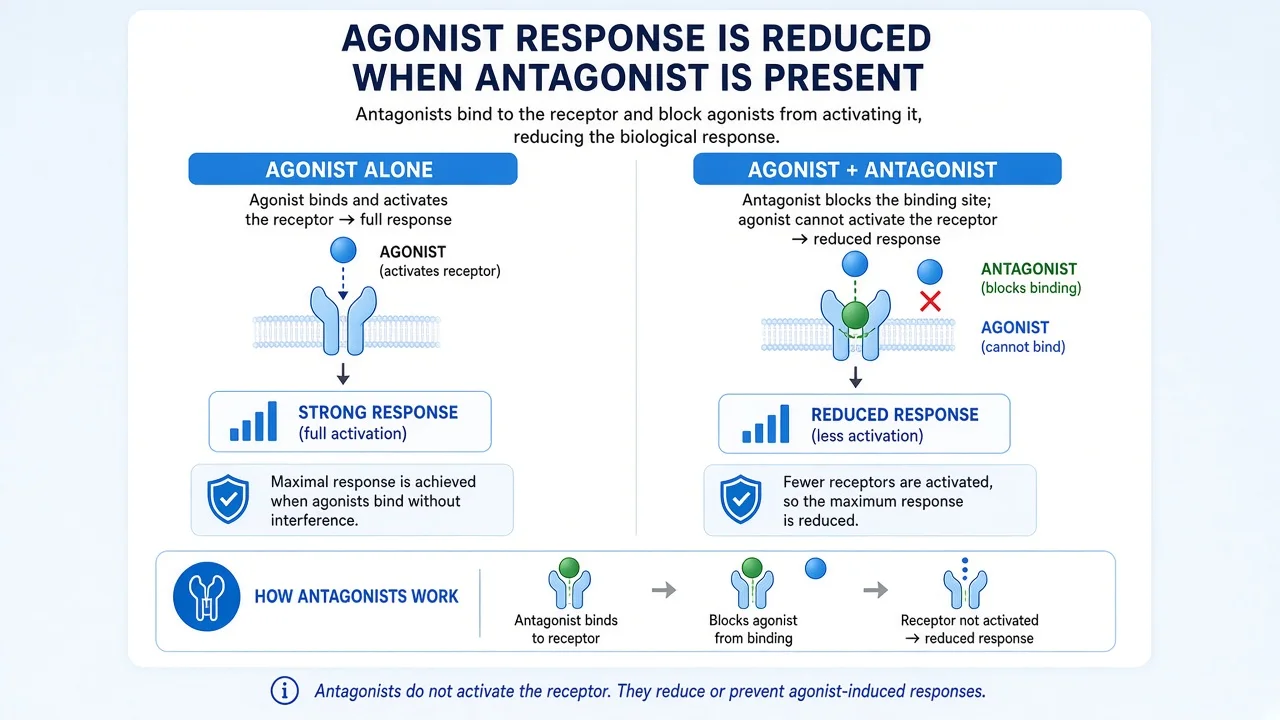
An antagonist reduces or blocks the measured effect of an agonist under stated conditions. Teaching examples often show rightward shifts or suppressed peaks on agonist curves when antagonist is present.
Antagonism still involves a ligand-receptor story. It is not a synonym for empty vial or inactive chemistry. Binding can be present while the functional readout of the agonist pathway is opposed.
Affinity talk alone cannot settle agonist versus antagonist class. You need the functional experiment that shows promotion or opposition of the measured response.
Competitive antagonism and curve shifts
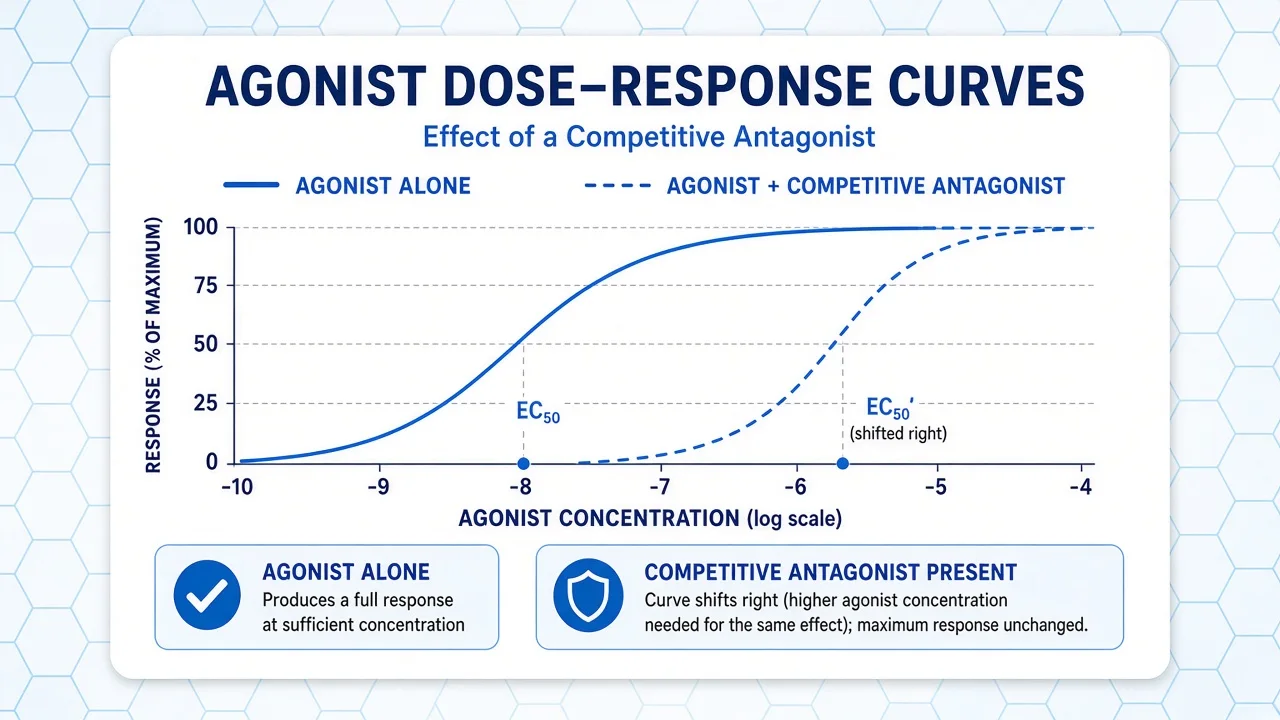
Competitive antagonists often contend for the same orthosteric site as the agonist. In many textbook systems, raising agonist concentration can overcome the blockade, producing a right-shifted curve with a preserved or near-preserved maximum when the system allows surmountability.
That classroom picture is a literacy tool, not a promise that every peptide labeled antagonist behaves that way. Noncompetitive or insurmountable patterns can suppress the maximum even at high agonist concentrations. Papers must report the pattern they observed.
Educational contrast for reading antagonist curve talk (not product data)
| Feature | Agonist alone | With competitive antagonist (typical teaching case) | Reader takeaway |
|---|---|---|---|
| Curve position | Reference concentration-response | Often right-shifted | More agonist may be needed for the same effect size |
| Maximum response | System Emax for that agonist | Often still reachable if surmountable | Do not invent a lifestyle ranking from the shift alone |
| What this does not prove | Human benefit | Universal blockade in every tissue | Matched assay literacy only |
Keep curve-shift claims inside their box
If the antagonist mechanism, contact time, or pathway readout changed, the observed pattern could change. Fair comparison habits live in how to compare peptide studies.
Inverse agonism: related, not identical
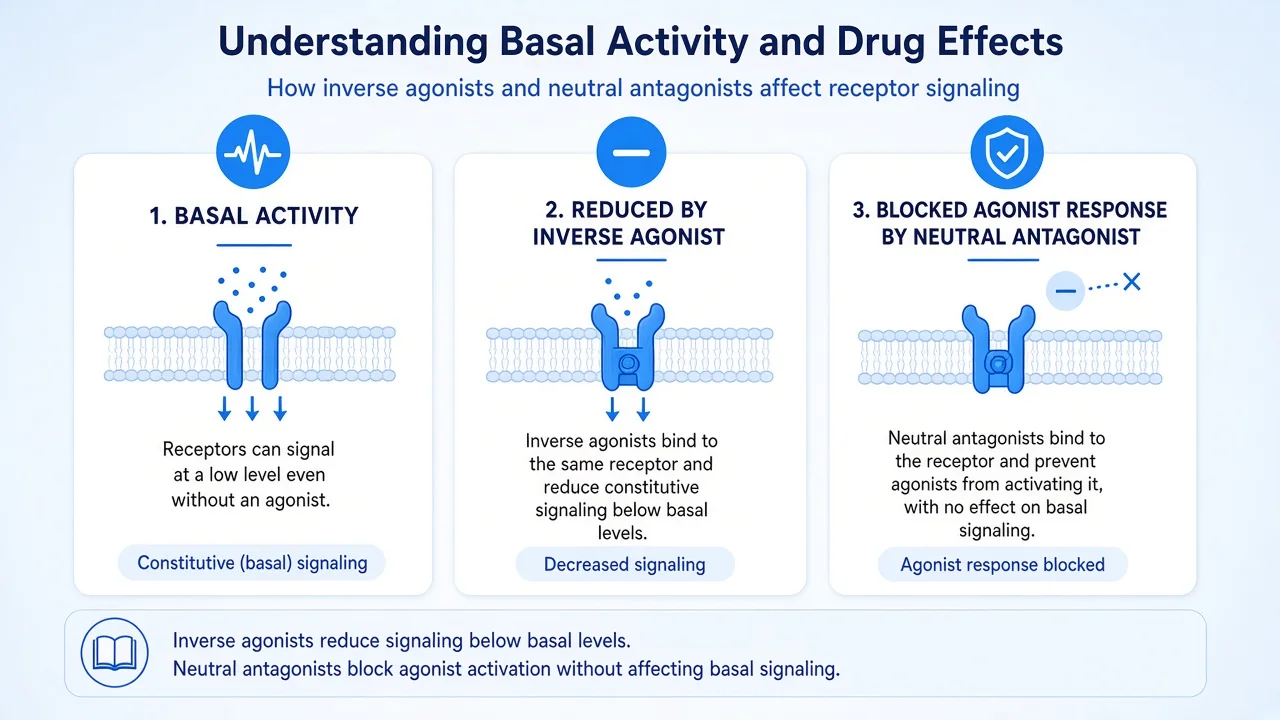
Some receptors show constitutive activity, a basal signal without added agonist. Inverse agonists reduce that basal activity. Neutral antagonists primarily block agonist action without that basal suppression.
Social posts often fuse inverse agonist into antagonist as if the words were interchangeable. They are related teaching labels, not automatic synonyms. Ask whether the paper measured constitutive activity and how it defined the ligand class.
Pathway-layer reading continues in peptide cellular signaling.
How affinity, potency, and agonist-versus-antagonist fit together
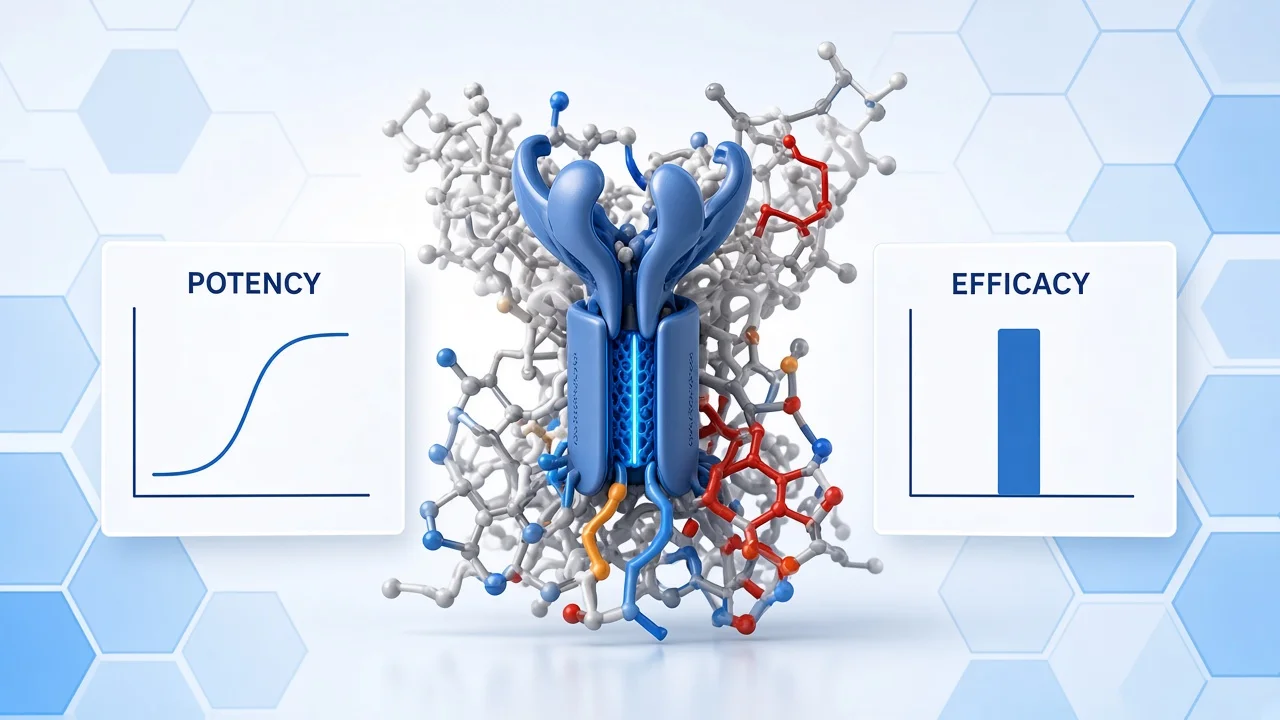
Affinity asks how favored the bound complex is. Potency asks how much ligand is needed for a stated effect size. Full versus partial asks about response ceiling among agonists. Agonist versus antagonist asks whether the ligand promotes or opposes the measured pathway response.
A ligand can be high affinity and still be an antagonist in the functional assay. Another can be an agonist with modest potency on an EC50 chart. Collapsing those words into one ranking is how social posts lose the plot.
Return to affinity vs efficacy peptides, potency vs efficacy peptides, and peptide receptor binding when a post jumps from nanomolar binding straight to agonist or antagonist class claims.
Headline traps this split prevents
Trap one: antagonist treated as code for useless. Trap two: agonist treated as proof of human benefit. Trap three: inverse agonist and antagonist fused without basal-activity evidence. Trap four: competitive curve shifts copied across unmatched assays. Trap five: seller tables with no system or comparator context.
- Name whether the claim is activation or blockade.
- Name the assay system and endpoint.
- Ask whether constitutive activity was measured before accepting inverse-agonist talk.
- Refuse personal-use leaps from ligand-class labels alone.
Verification checklist before sharing an agonist or antagonist label
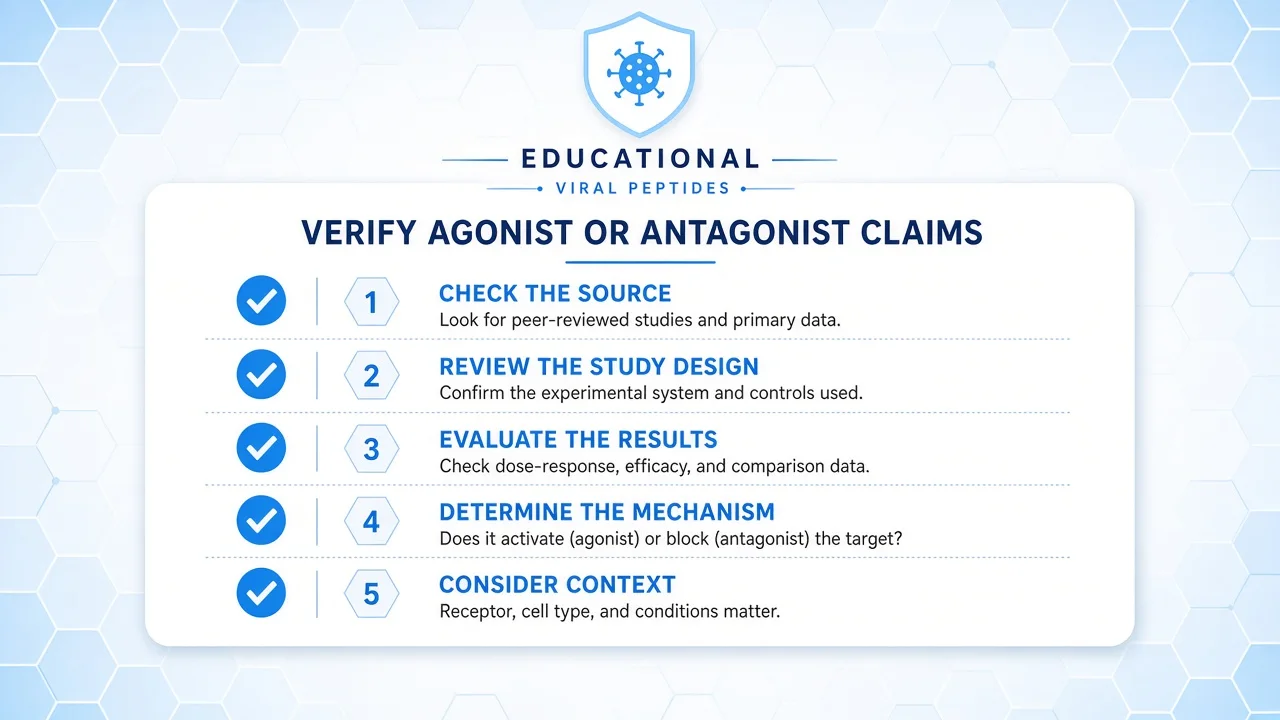
Use this checklist whenever a peptide post waves agonist or antagonist like a trophy. If the post cannot name the system and functional outcome, pause.
- Functional outcome named: activation, blockade, or basal suppression?
- Assay system named: receptor, cell type, pathway readout, conditions?
- Mechanism checked: orthosteric competitive talk versus other patterns?
- Related labels checked: full, partial, inverse, neutral?
- Leap refused: is anyone converting this into personal-use advice?
Assay limits and what this page will not do
A well-run functional assay can answer a narrow agonist-versus-antagonist question inside its system. Moving from buffer to cell, animal, and human evidence classes still requires new checks. Keep in vitro vs in vivo peptide research and how to read peptide clinical trials nearby when a post converts ligand-class labels into lifestyle certainty.
This page will not publish dosing schedules, assay recipes, or compound rankings for personal use. It will not translate blockade or activation labels into lifestyle instructions, and it will not declare a peptide best or safest from an agonist or antagonist word alone.
Links back to Research & Science
This page sits under peptide research and science. Read it after partial vs full agonist peptides, then return to peptide receptor binding for kinetics vocabulary.
When claims jump evidence classes, keep in vitro vs in vivo peptide research and how to compare peptide studies nearby.