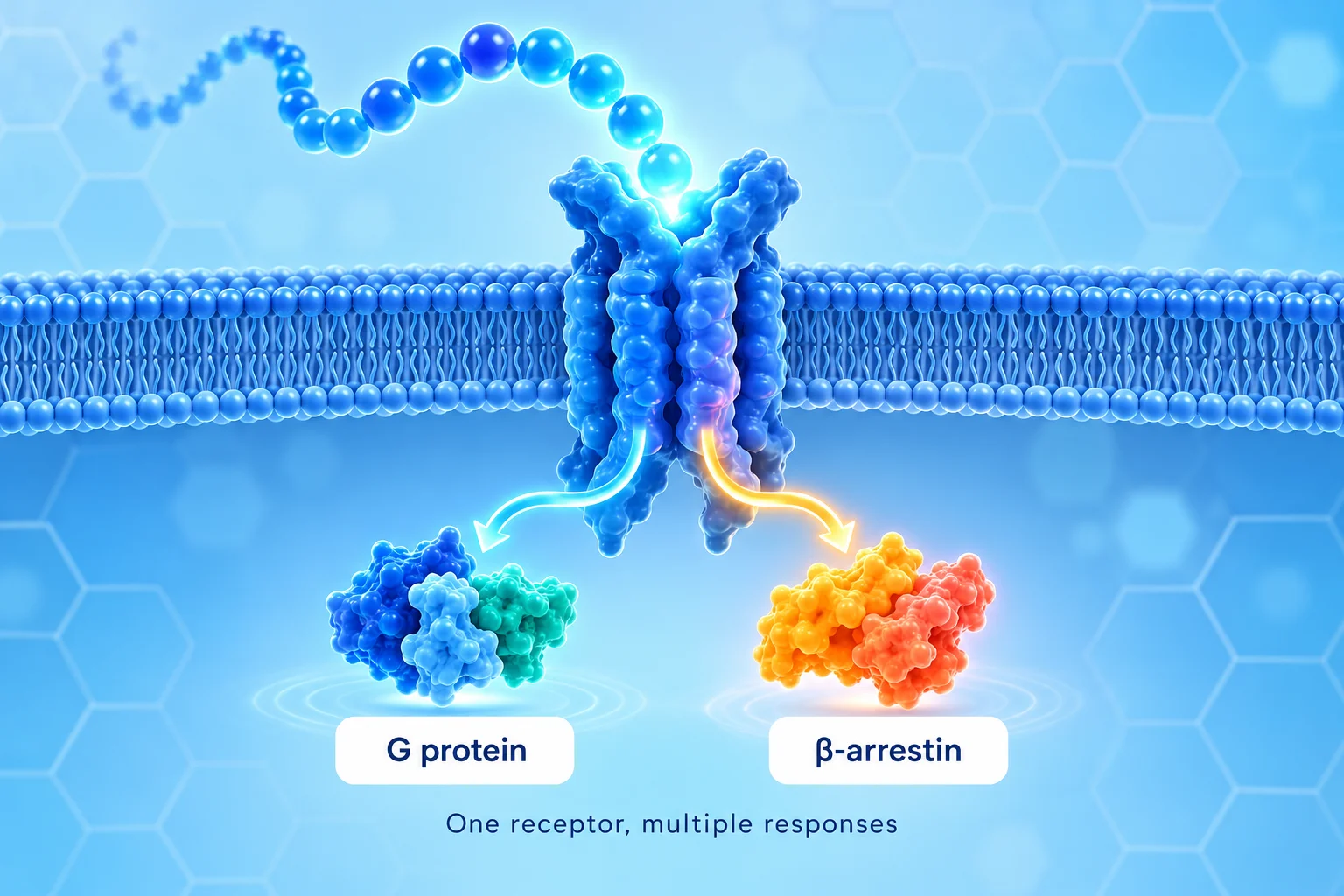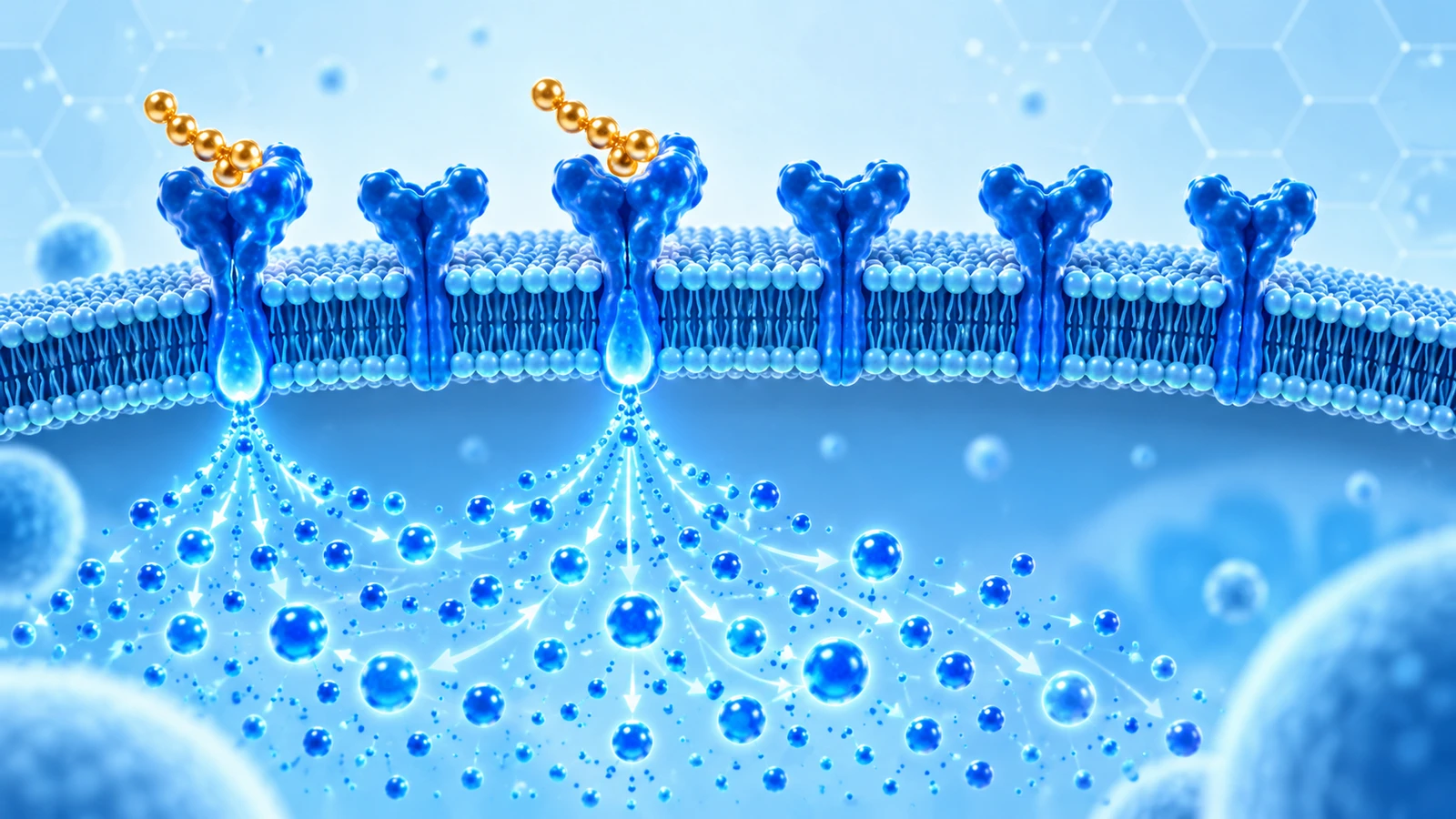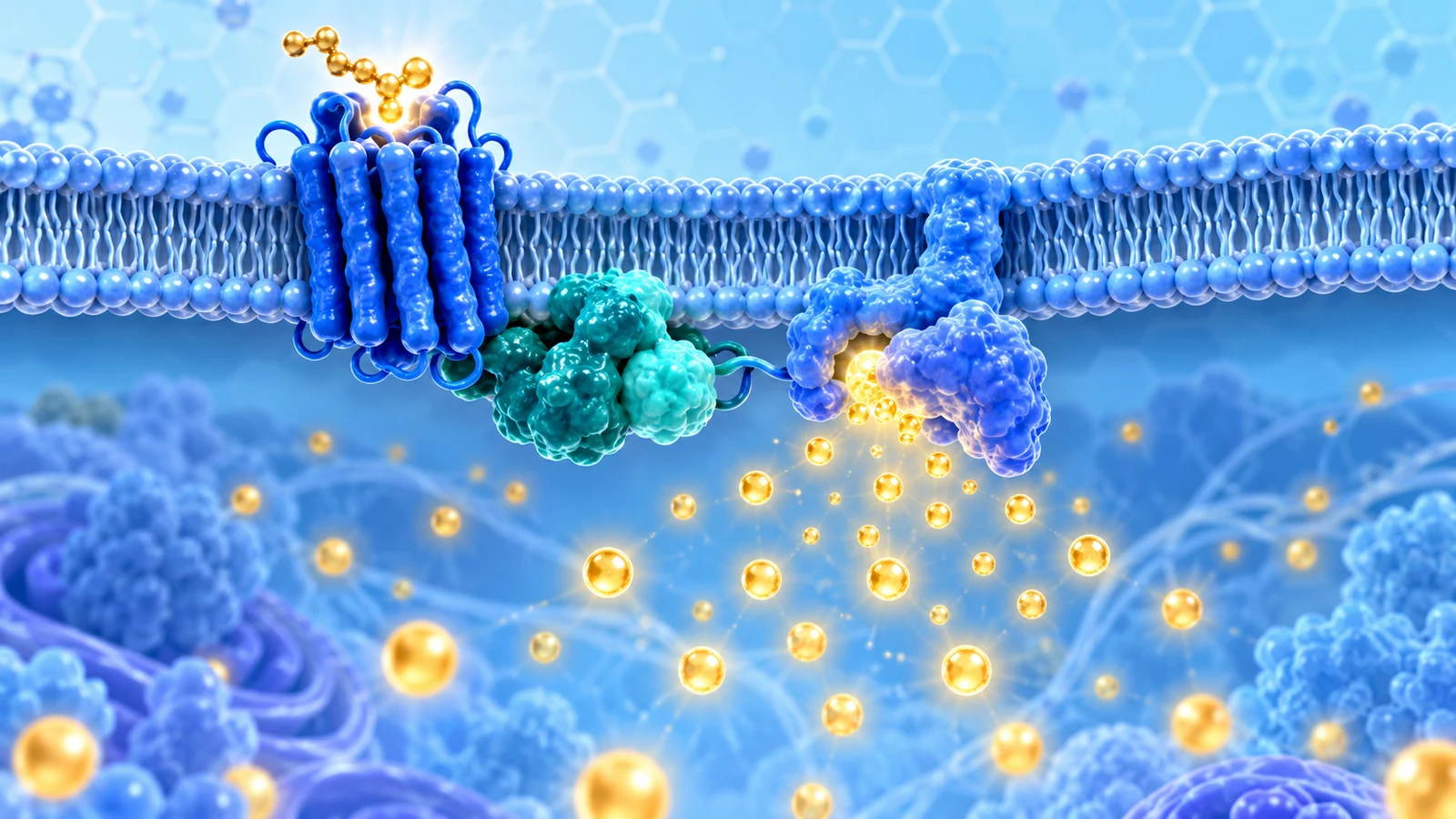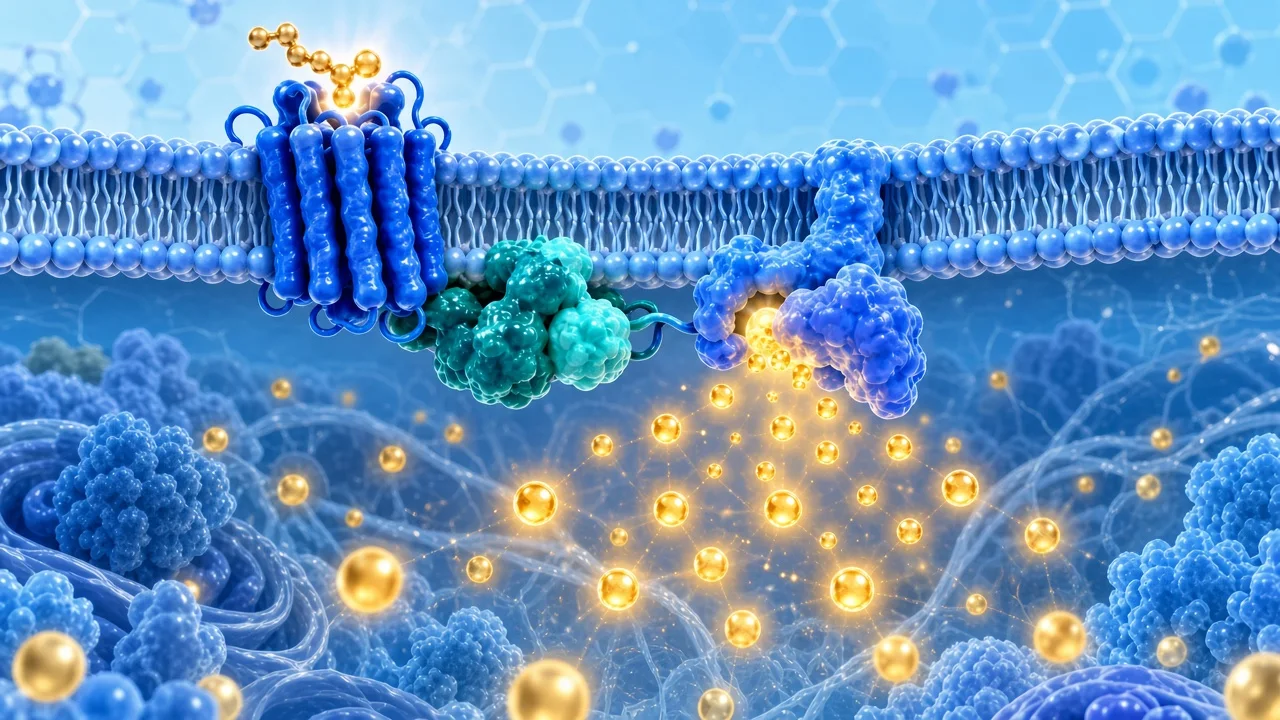


A rise in cAMP after a peptide receptor assay is only the middle of the story. Inside many cells, cAMP can engage protein kinase A, exchange proteins activated by cAMP (EPAC), and other sensors. Reading those results means knowing which effector was measured, which tool was used, and whether a shared messenger was treated as proof of a single downstream route.
Why a cAMP rise is not one downstream answer
Many peptide GPCRs that couple to Gs raise intracellular cAMP by activating adenylyl cyclase. Gi-linked receptors can reduce that rise when the assay includes a stimulus that first elevates cAMP. In either case, the messenger is not identical to every kinase, adhesion change, ion-channel event, or gene-expression outcome that follows.
PKA and EPAC are the two effector families most often taught beside peptide receptor cAMP work. Cyclic-nucleotide-gated channels and other sensors can also matter in specialized systems. The literacy point is simple: name the effector you mean. Saying the peptide activated cAMP signaling is broader than saying it activated PKA or EPAC in a stated assay.
This guide sits under the Research & Science hub and pairs with cAMP signaling and ERK and MAPK signaling. The illustrations are conceptual teaching figures, not concentration maps or product comparisons.
PKA and EPAC sense cAMP differently

PKA is a tetrameric kinase in its classic teaching form: regulatory subunits bind cAMP and release catalytic activity toward serine and threonine substrates. Those substrates can include metabolic enzymes, ion-channel regulators, transcription-factor related proteins, and many others depending on the cell.
EPAC proteins bind cAMP and act as guanine nucleotide exchange factors for Rap GTPases. That is a different biochemical job from phosphorylation. Reviews that compare Epac and PKA emphasize that the two families can act independently, together, or in opposition depending on relative abundance, localization, and the outcome under study. Read Cheng and colleagues.
de Rooij and colleagues identified Epac as a Rap1 exchange factor activated directly by cAMP, establishing that messenger sensing is not exclusive to PKA. That discovery expanded the reading frame for peptide papers that once treated every cAMP-linked outcome as a PKA story by default. Read the Epac identification study.
Start with the effector class before interpreting the biological claim.
| Measurement | Question it can address | What it does not establish alone |
|---|---|---|
| cAMP abundance or sensor | Did messenger levels change? | Which effector carried the next step |
| PKA reporter or substrate phosphorylation | Did a PKA-linked readout change? | That EPAC was inactive |
| EPAC or Rap activation assay | Did an EPAC-linked exchange event change? | That PKA was inactive |
| Selective tool plus outcome | Does reducing or mimicking one route change the response? | Every possible compensating pathway |
| Later cellular function | Did a measured cell behavior change? | Which cAMP effector was required |
Selective tools separate shared messengers from shared routes

A membrane-permeable cAMP analog can raise messenger tone without telling you which effector dominated. Analogs and inhibitors designed to prefer PKA or EPAC, together with genetic knockdown or knockout, are the usual way papers try to separate the branches. Read the selectivity claims carefully. Preferential does not mean absolute, and cell context can change apparent selectivity.
If a PKA-directed intervention removes most of a response, that supports a PKA contribution under those conditions. It does not automatically prove EPAC was irrelevant everywhere, and it does not prove that the same peptide would behave identically in another cell type. The reverse is true for EPAC-directed tools.
Reporter design matters too. A PKA activity reporter, an EPAC biosensor, and a generic cAMP sensor answer different questions. Collapsing them into one vibe word for stronger cAMP erases the distinctions that make mechanism talk possible.
Anchoring and compartments shape which outcomes appear
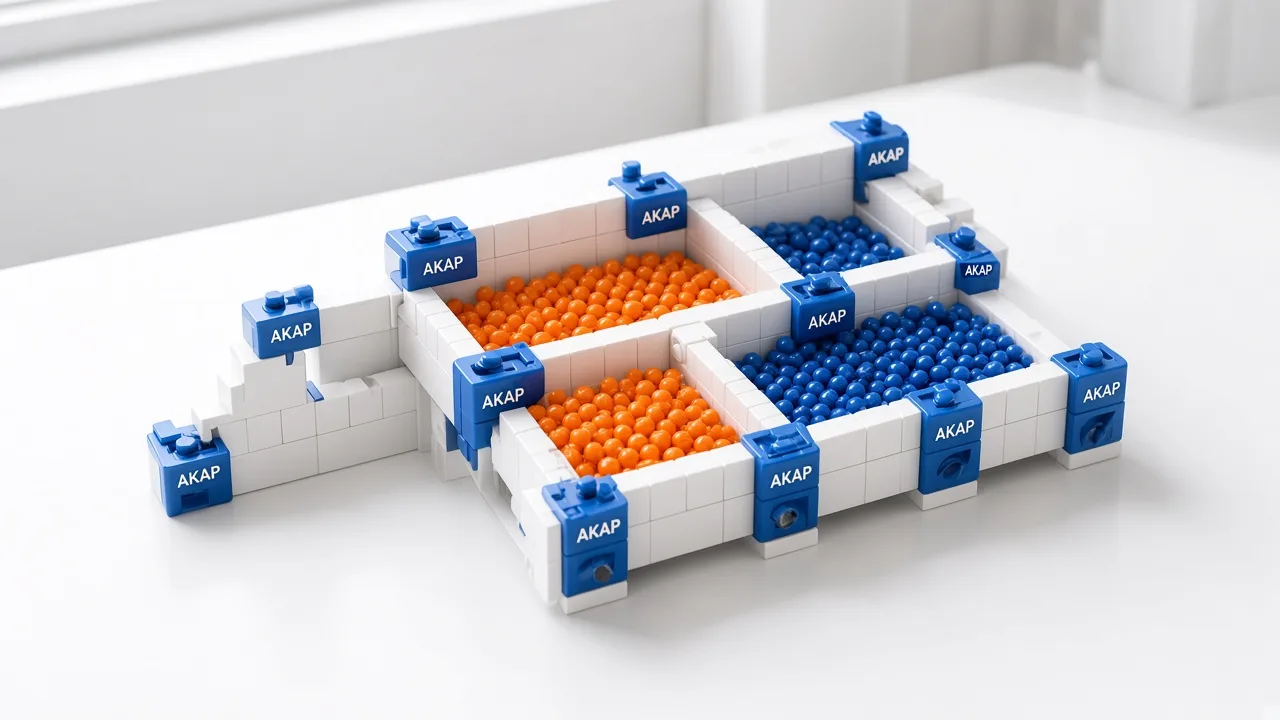
AKAPs help place PKA near selected substrates, membranes, or organelles. That targeting can create local response modules even when a whole-cell cAMP average looks similar across conditions. Wong and Scott review how AKAP complexes organize signaling in space and time. The literacy lesson is that a global messenger number and a local kinase event are not interchangeable summaries. Read the AKAP review.
Phosphodiesterases can also sculpt local messenger pools by degrading cAMP near selected neighborhoods. A PDE inhibitor that raises a reporter signal may be revealing that local breakdown mattered, not that the peptide suddenly became a stronger receptor agonist in every sense.
Endosomal and surface signaling windows can feed different effector neighborhoods. Pair this page with endosomal signaling literacy when a paper claims sustained intracellular cAMP without naming which effector carried the late outcome.
Parallel pathways are not automatic synonyms
A paper may report both a PKA phosphorylation event and an EPAC-linked Rap change after the same peptide. That establishes two responses. It does not establish that one caused the other, or that both are required for a later cellular function.
Write the claim at the width of the evidence. Two parallel readouts support a fork in the pathway map. Causal dependence needs perturbation and, when possible, restoration experiments aimed at each branch.
Peptide examples that teach effector literacy
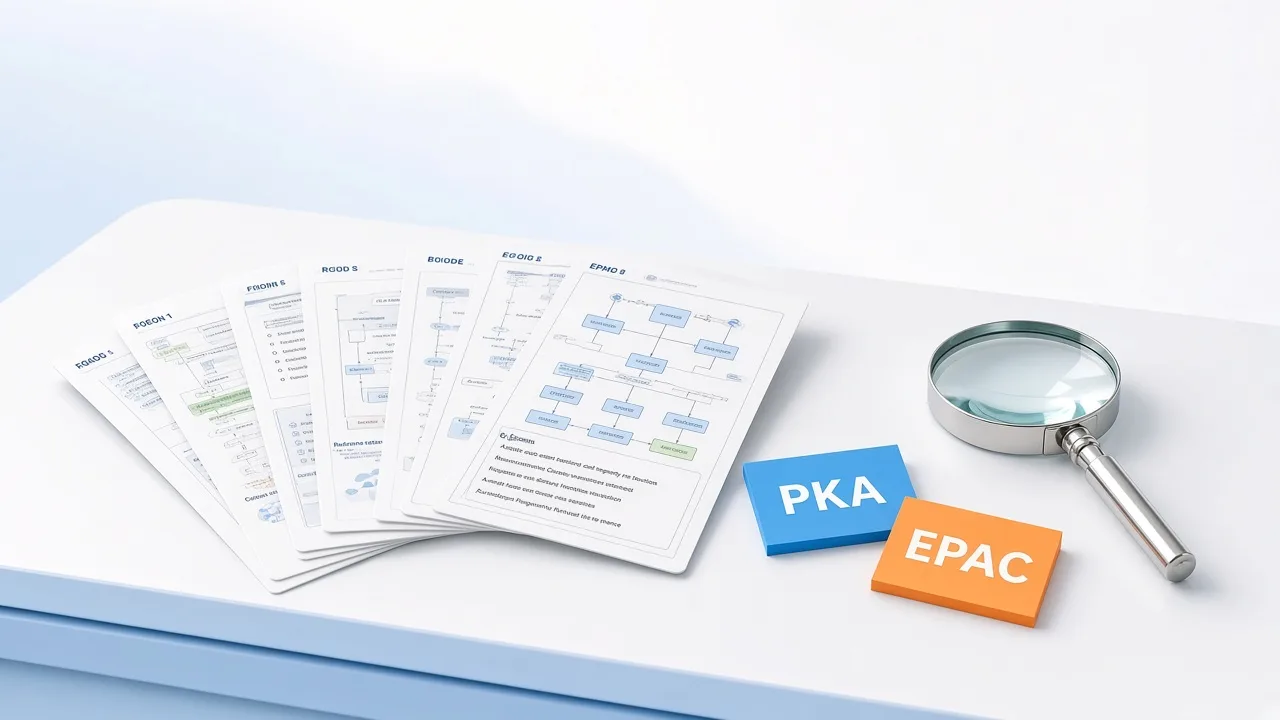
GLP-1 receptor research often discusses cAMP, PKA, and later kinase events in the same models. Quoyer and colleagues, for example, linked temporally distinct ERK components in beta-cell models to different upstream contributions, including a PKA-linked early window. That structure is useful teaching: timing and effector identity can differ even when the receptor family is the same. Read the GLP-1 study.
Other peptide systems that raise or lower cAMP, including receptors taught in the Gi and Gs-linked cAMP guides, can be read with the same fork. Ask whether the authors measured messenger, kinase, EPAC-linked exchange, or a later function.
These examples illustrate how to keep effector language precise. They do not establish which peptide is better for people, and they do not support personal-use protocols. Keep clinical claims on clinical evidence.
Invented qualitative teaching contrasts only. These are not results for real products.
| Claim style | Stronger literacy rewrite | Still missing without more data |
|---|---|---|
| This peptide activates PKA | In this model, a PKA-linked reporter or substrate changed after the ligand | Clinical superiority |
| cAMP means PKA did it | Messenger rose; effector identity needs separate tests | Automatic route assignment |
| EPAC blocker killed the effect so EPAC is the drug target story | An EPAC-directed intervention changed this measured outcome under these conditions | Human dose or safety ranking |
| Stronger cAMP means better medicine | This assay showed a larger messenger or effector response versus this reference | Human benefit |
Effector choice intersects bias and ERK literacy
Biased agonism comparisons sometimes include cAMP beside arrestin or ERK. Adding PKA versus EPAC makes the map finer. Two ligands could look similar on a bulk cAMP sensor and diverge on a PKA reporter, or the reverse. That is still a comparative assay problem, not a moral ranking of good and bad peptides. See biased agonism literacy.
ERK sits further downstream and can be influenced by more than one cAMP effector route, as well as by non-cAMP routes. A phospho-ERK change after a peptide does not identify PKA or EPAC by itself. Use the ERK and MAPK guide when a paper jumps from messenger to kinase without naming the middle link.
Receptor reserve and amplification can also separate occupancy from the size of a PKA or EPAC reporter change. A sensitive effector assay may look saturated while a less amplified readout still climbs. Keep receptor reserve beside this page when potency language starts to outrun the measurement.
A practical checklist for reading the next PKA or EPAC paper

Start by rewriting the main result as one bounded sentence: in this cell model, this ligand changed this PKA-linked, EPAC-linked, or shared cAMP readout at this time relative to this control. That wording preserves the information needed to judge the finding.
For example, suppose a paper shows a large cAMP rise and a later adhesion change. Those observations alone do not prove EPAC drove adhesion through Rap, and they do not prove PKA was required. Effector-selective tools and effector-specific sensors are what turn a fork in the cartoon into a supported claim.
- Identify the receptor, species, cell background, and whether expression is native or engineered.
- Name the measured quantity: cAMP, PKA reporter or substrate, EPAC or Rap assay, or a later function.
- Check whether selective tools or genetic interventions were used, and how selectivity was justified.
- Ask whether localization, AKAPs, or PDEs were part of the argument.
- Separate messenger abundance from effector activity and from cellular outcomes.
- Keep conclusions within the model studied. Use clinical evidence for clinical claims.
Carry effector identity into the conclusion
When comparing articles, record the effector beside every cAMP-linked potency or efficacy value. Two apparently conflicting numbers may address different branches of the same messenger tree. Agreement between cAMP and a PKA reporter also does not make those measurements interchangeable.
A useful interpretation follows the evidence from receptor to messenger to named effector to cellular function, while identifying which links were measured and which remain proposed. That approach preserves the value of a PKA or EPAC experiment without asking it to answer human benefit, safety, or dosing questions it was never designed to test.