

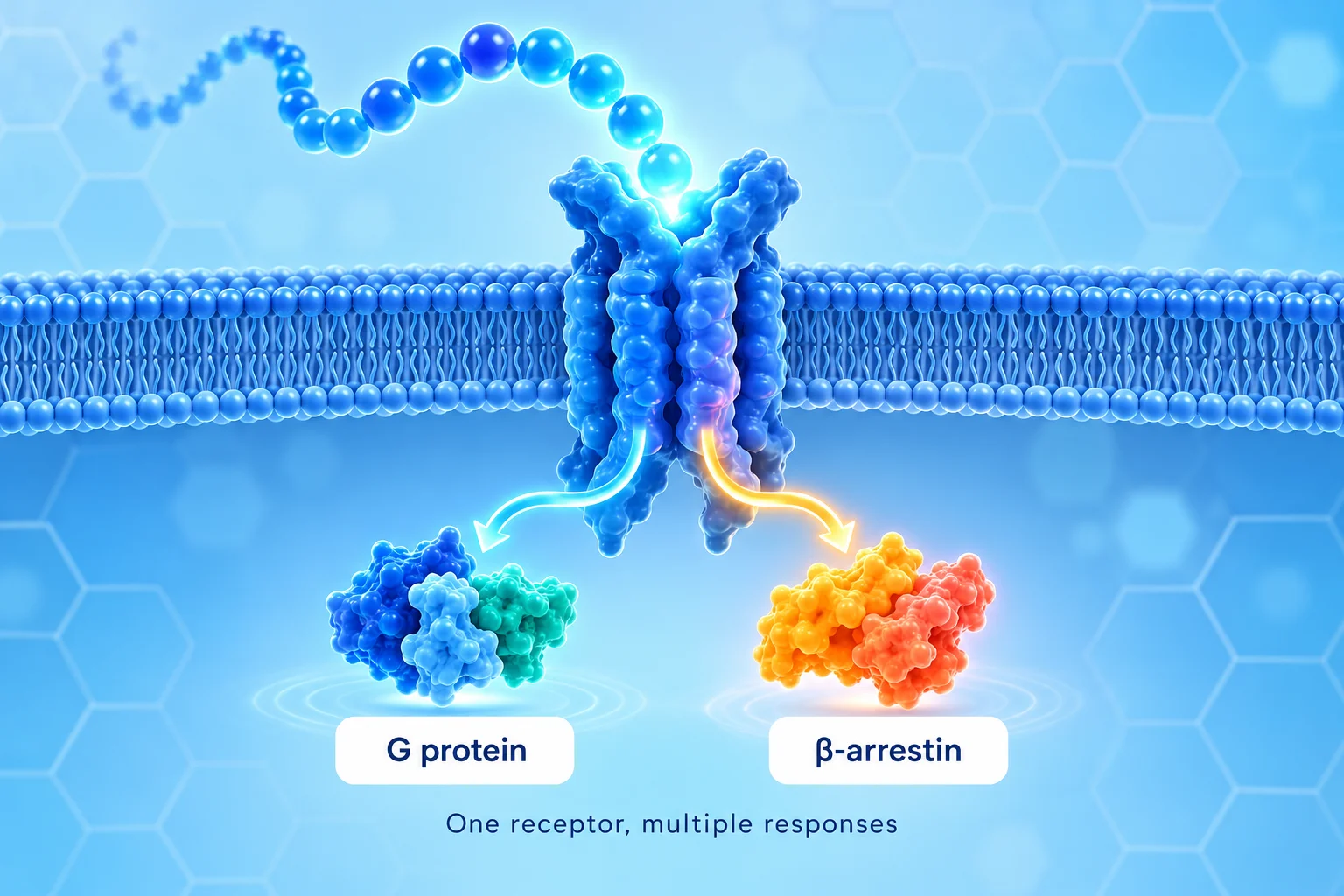
Biased agonism describes a ligand favoring one receptor signaling pathway over another relative to a reference ligand in a defined experimental system. It adds a new question to the agonist story: not just whether a receptor responds, but how the pattern of responses changes. Understanding that comparison helps you read peptide research without mistaking a laboratory signaling preference for a proven clinical advantage.
Why activation is only the beginning of the story
The previous explainer, agonist vs antagonist peptides, asks whether a ligand promotes or opposes a measured receptor response. That is a useful starting point, but a receptor can connect to more than one cellular process. Two agonists can therefore share a receptor target without producing an identical pattern of downstream activity.
Think of an experimental report as a set of questions rather than a single strength score. Did the ligand bind? Did the cell produce a response? Which response was measured? Was another pathway examined in the same comparison? Each answer adds information that the previous answer could not supply.
This article belongs to the Research & Science guide and focuses on reading those comparisons. The illustrations are conceptual, not molecular structures or measured datasets. For the foundations, start with peptide cellular signaling.
What biased agonism actually compares
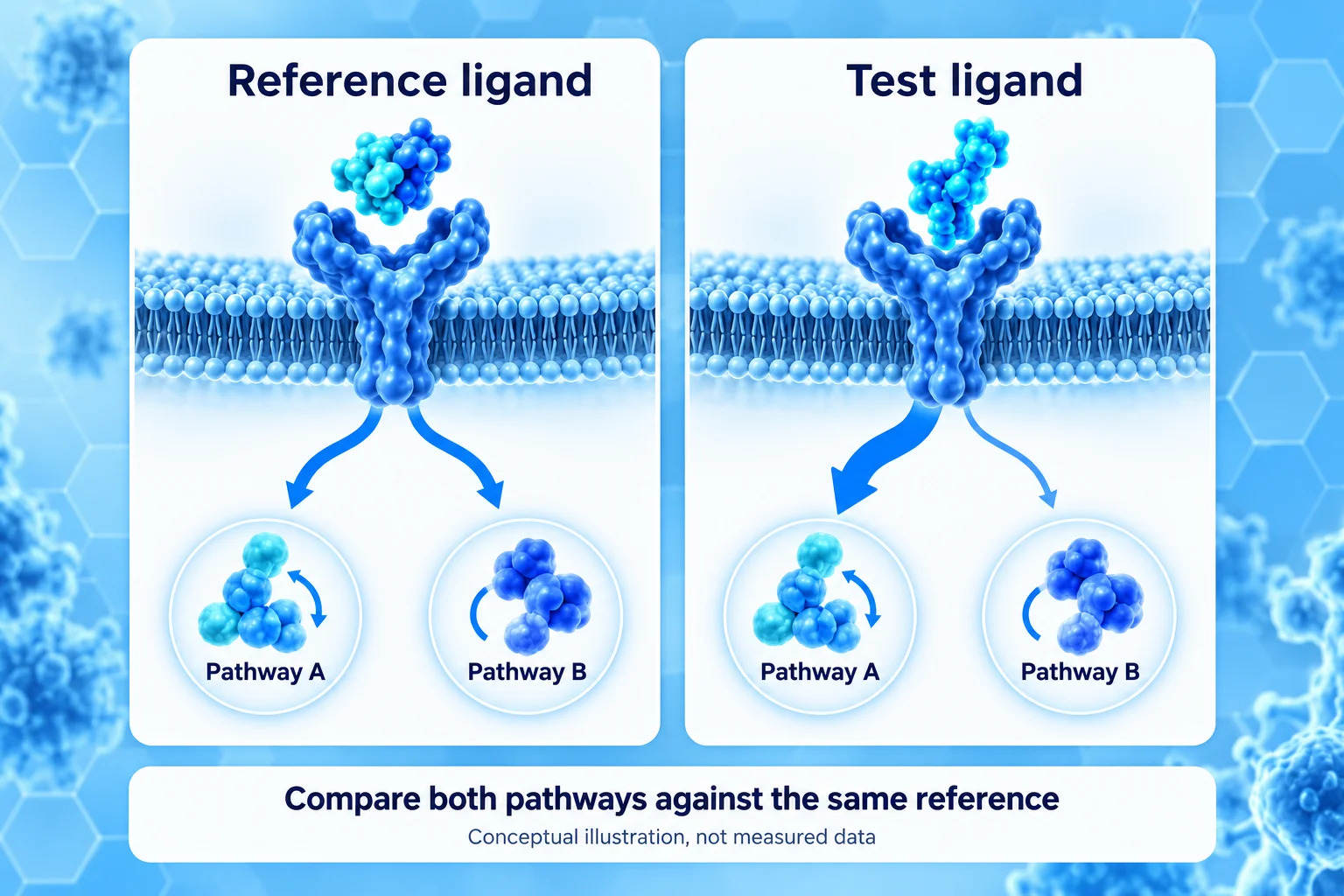
The word biased is relational. A test ligand is compared with a reference ligand across at least two responses associated with the same receptor. Researchers ask whether the test ligand's relative activity differs between those pathways after accounting for the comparison within each assay. Early quantitative work demonstrated why analyzing multiple responses is necessary. Rajagopal and colleagues, 2011.
A reference ligand does not have to generate equal raw signals in both assays. One detector may report light output and another a fluorescence ratio. The reference provides an anchor within each measurement system; it is not a claim that the receptor naturally divides its activity into equal halves.
When reading a headline, expand 'this peptide is biased' into a complete sentence: 'Compared with which ligand, toward which response, relative to which other response, at which receptor?' If those blanks remain empty, the headline has left out the comparison that gives the term its meaning.
G proteins and β-arrestins: readouts, not good and bad teams
Many discussions concern G protein-coupled receptors, or GPCRs. Researchers may compare a G protein-associated response with recruitment of β-arrestin, a protein involved in receptor regulation and signaling. The specific readout matters: measuring accumulation of the messenger cAMP is not identical to measuring direct recruitment of a G protein.
Avoid translating the pathway names into benefits and side effects. A pathway label identifies a part of the experimental story, while a clinical outcome describes what happens to people. Connecting the two requires additional evidence. It also matters whether the experiment examines an immediate response or a sustained one.
In the GLP-1 receptor work discussed below, investigators connected several measurements rather than relying on a single pathway label. That is a useful reading habit: look for the actual endpoint in each figure before interpreting the paper's larger biological argument. Jones and colleagues, 2018.
Bias, potency, partial agonism, and dual agonism are different questions
A crowded comparison chart can put several pharmacology terms beside the same peptide. They should not be treated as interchangeable endorsements. Identify what each column measures before deciding whether the values can answer your question.
For example, a dual agonist acts at two receptor types. That tells you about its target coverage. A signaling-bias comparison asks about the relative responses associated with a particular receptor. A paper can investigate both properties, but evidence for one does not establish the other.
Different terms organize different experimental questions
| Term | Question it answers | What it does not establish |
|---|---|---|
| Affinity | How favorable is binding under the stated conditions? | Which downstream responses will follow |
| Potency | What concentration produces a defined response? | The relative pattern across pathways |
| Partial agonism | How high is the response ceiling relative to a full agonist in this assay? | Whether a pathway preference survives controls |
| Biased agonism | How does relative activity across pathways compare with a reference ligand? | Clinical superiority or fewer adverse effects |
| Dual agonism | Does the ligand activate two receptor types? | Its signaling bias at either receptor |
Why a partial agonist can look selectively active
A strongly amplified assay may show a substantial response to a ligand with low intrinsic efficacy, while a less amplified assay shows little response. That contrast can resemble pathway preference. Experimental work on opioid agonists illustrates why efficacy and assay sensitivity need attention before attributing such a pattern to bias. This is a methodological example, not evidence about every peptide receptor. Gillis and colleagues, 2020.
Use partial vs full agonist peptides to unpack response ceilings, and potency vs efficacy to separate curve position from maximum response. Those distinctions make a bias claim easier to assess.
How to read a bias factor without turning it into a ranking
Some papers fit concentration-response data to an operational model and report a transduction coefficient written as log(τ/KA). They normalize the test ligand against the reference within a pathway, then compare those normalized values between pathways. The resulting double difference, ΔΔlog(τ/KA), can be expressed as a fold bias. This is one analysis framework, with assumptions and uncertainty, rather than a universal property stamped on a molecule. Kenakin and colleagues, 2012.
You do not need to reproduce the calculation to read responsibly. Check which pathway is in the numerator, which ligand defines the reference, and whether the authors report uncertainty. A positive value has no interpretable direction until the paper defines its convention. Poorly resolved curves can also limit what a fitted estimate means.
For a hypothetical headline saying 'tenfold biased,' ask for the missing nouns. Tenfold in what comparison? Against which reference? Using which model? The number is not equivalent to ten times the clinical benefit, ten times the safety, or a tenfold change in a person's dose.
Three reasons the same ligand can look different across experiments
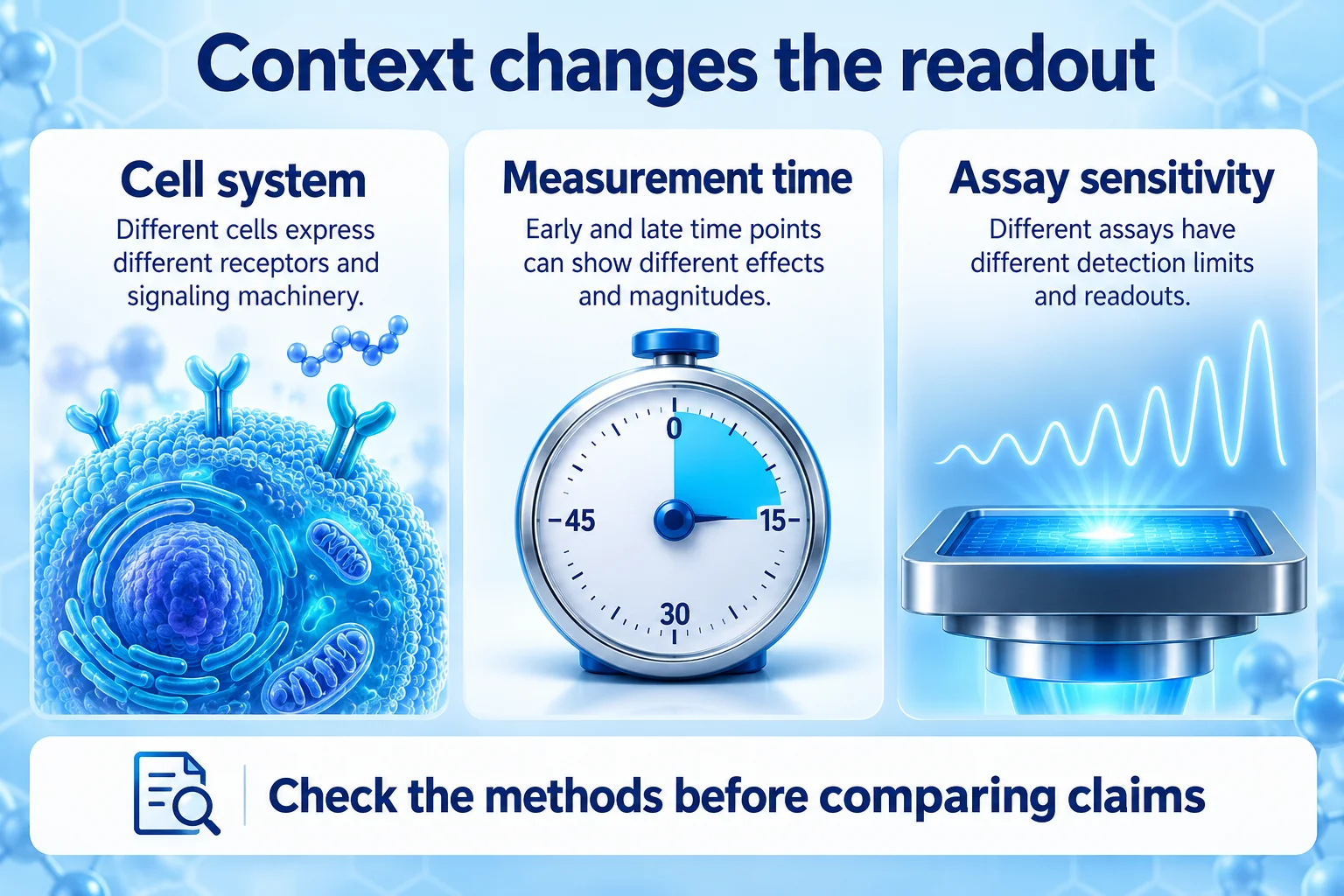
A figure belongs to the conditions that produced it. Before comparing results from different papers, check whether the experiments asked a sufficiently similar question. A shared receptor name alone is not enough to make two measurements equivalent.
1. The cellular setting
Record the cell type and whether the receptor was introduced experimentally or expressed naturally. Also look for information about receptor abundance and the signaling machinery being measured. When these features differ, treat a cross-paper comparison as provisional rather than assuming the cells are interchangeable.
A useful annotation beside a figure is simply 'this result was obtained in this system.' That sentence helps prevent an engineered-cell observation from quietly becoming a statement about every tissue in a human body.
2. The measurement window
Klein Herenbrink and colleagues showed that binding and signaling kinetics could alter apparent bias at the dopamine D2 receptor, including its apparent direction. Their experiment was not a peptide treatment study; it demonstrates why the timing of a measurement belongs in the interpretation. Kinetic-context study, 2016.
Check whether a figure reports a single time point, a peak, or an accumulated response over a period. These are different summaries. A short-lived peak and a persistent lower signal can tell different stories depending on which summary the researchers choose.
3. The measurement method
Look for assay controls, dynamic range, and whether the response is close to the detection limit or ceiling. 'Not detected' should remain tied to the method and conditions. It is a narrower statement than 'this pathway can never respond.'
If one assay is a direct recruitment measurement and another reports an amplified downstream messenger, note that difference before reading the bar heights as comparable quantities. The methods section can matter more than the visual contrast in a promotional graphic.
What GLP-1 receptor studies teach about signaling and trafficking
A 2018 study examined modified exendin peptides and linked their GLP-1 receptor signaling profiles with receptor internalization, recycling, and sustained insulin secretion. The work included cell experiments, human islets, and mouse studies. Its value here is the connection between distinct measurements, rather than a claim that one short signaling assay predicts every outcome. Jones and colleagues, Nature Communications.
A later study examined related glucagon-family receptors. Reduced β-arrestin recruitment was associated with changes in signaling duration and receptor endocytosis, but a longer cAMP signal from biased glucagon analogs did not translate into increased glucose output from hepatocytes. That result is a concrete reminder that a signaling change and a downstream biological outcome are separate findings. Jones and colleagues, Journal of Biological Chemistry.
Keep the evidence categories visible: isolated human islets are human tissue, but they are not a clinical trial in people. Likewise, a mouse outcome and a cellular readout answer different questions. The in vitro vs in vivo guide explains how to keep these distinctions clear.
A worked example: checking a persuasive headline
Imagine a post that says, 'Peptide X activates G proteins but barely recruits arrestin, so it is safer.' This is an invented teaching example, not a description of a real product. The sentence combines an experimental claim with a clinical conclusion, and each part needs its own support.
First, locate the study and identify the receptor, reference ligand, and two assays. Next, check whether full concentration-response data support the claimed pattern or whether the post selected one concentration. Then look for uncertainty and possible measurement limitations. Finally, find the study that directly measured the claimed safety outcome.
If that last study is missing, the defensible summary stops at the experimental finding. You might write, 'The authors observed a different relative signaling profile under their test conditions; this result alone does not establish a safety advantage.' That preserves useful information while removing a conclusion the evidence has not supplied.
A checklist for your next biased-agonism paper
Save these questions alongside the paper rather than trying to remember a single bias number. The answers form a compact description of what was measured and how far the interpretation can travel. Missing details are reasons to consult the methods or supplementary data, not to fill the gaps with assumptions.
- Target: Which receptor was studied, and in which cells or tissue?
- Reference: Which ligand anchors the comparison?
- Responses: Which two or more pathways were measured, and by what methods?
- Conditions: Were concentration ranges, timing, and other relevant conditions comparable?
- Analysis: What model, normalization, uncertainty, and limitations were reported?
- Outcome: Was the claimed biological or clinical advantage measured separately?
Continue through the research-literacy series
Return to affinity vs efficacy for binding versus response, receptor binding kinetics for time-dependent interactions, and how to compare peptide studies for matching experimental questions. The Safety & Guides hub provides broader context for interpreting use-adjacent claims.
Continue with peptide receptor desensitization and internalization to separate changes in responsiveness from receptor movement, recycling, and abundance.
This explainer teaches research interpretation. It does not supply dosing, titration, sourcing, or personal-use protocols. A scientifically interesting signaling profile is a reason to ask better questions about the evidence, not a substitute for the evidence needed to guide clinical decisions.