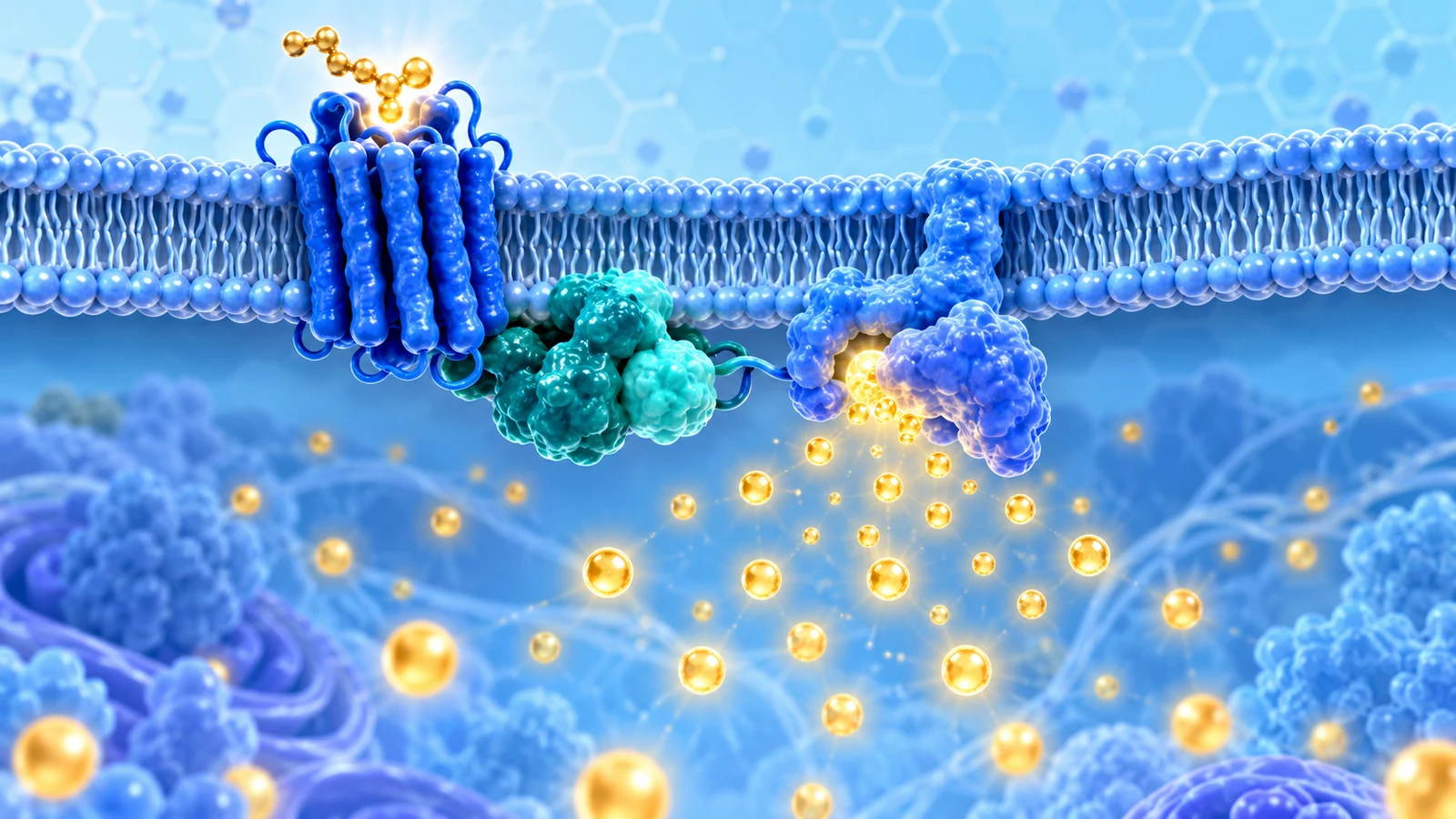

Not every peptide receptor sends its message through a G protein. Natriuretic peptides introduce another route: receptors with their own guanylyl cyclase machinery. Reading these studies means identifying the receptor, separating cGMP from cAMP, and asking whether the experiment measured messenger accumulation, downstream activity, or a cellular function.
A peptide receptor can contain its own messenger-making enzyme
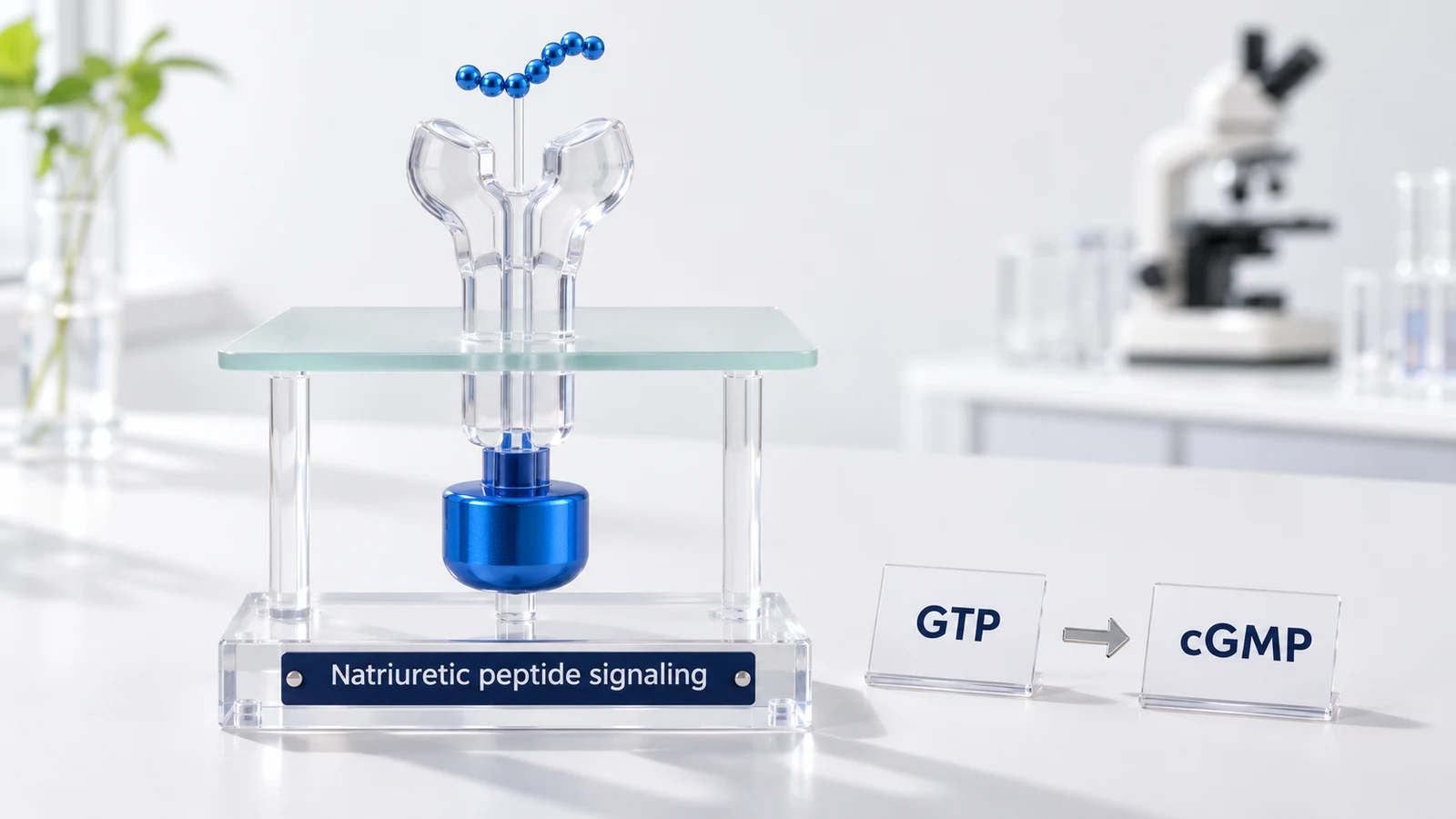
Many peptide signaling diagrams begin with a GPCR, a G protein, and an enzyme downstream. That sequence is useful for the cAMP guide, but it is not a universal receptor design. NPR-A and NPR-B belong to a different class: receptor guanylyl cyclases. Their extracellular regions recognize ligands, while intracellular catalytic regions generate cGMP from GTP.
Chinkers and colleagues cloned and expressed a membrane guanylyl cyclase that also bound atrial natriuretic peptide. The work helped establish a receptor class in which ligand recognition and cyclase activity belong to the same receptor protein. It supplies evidence for that architecture; it does not imply that every protein called a peptide receptor is a guanylyl cyclase. Read the original study.
Start an unfamiliar paper by writing out the receptor name and the measured messenger. A familiar peptide label is not enough to infer the intermediate steps. This explainer sits under the Research & Science hub and follows the guide to phosphodiesterases and messenger breakdown. Its illustrations are physical teaching models, not molecular structures or experimental datasets.
NPR-A, NPR-B, and NPR-C are different experimental questions
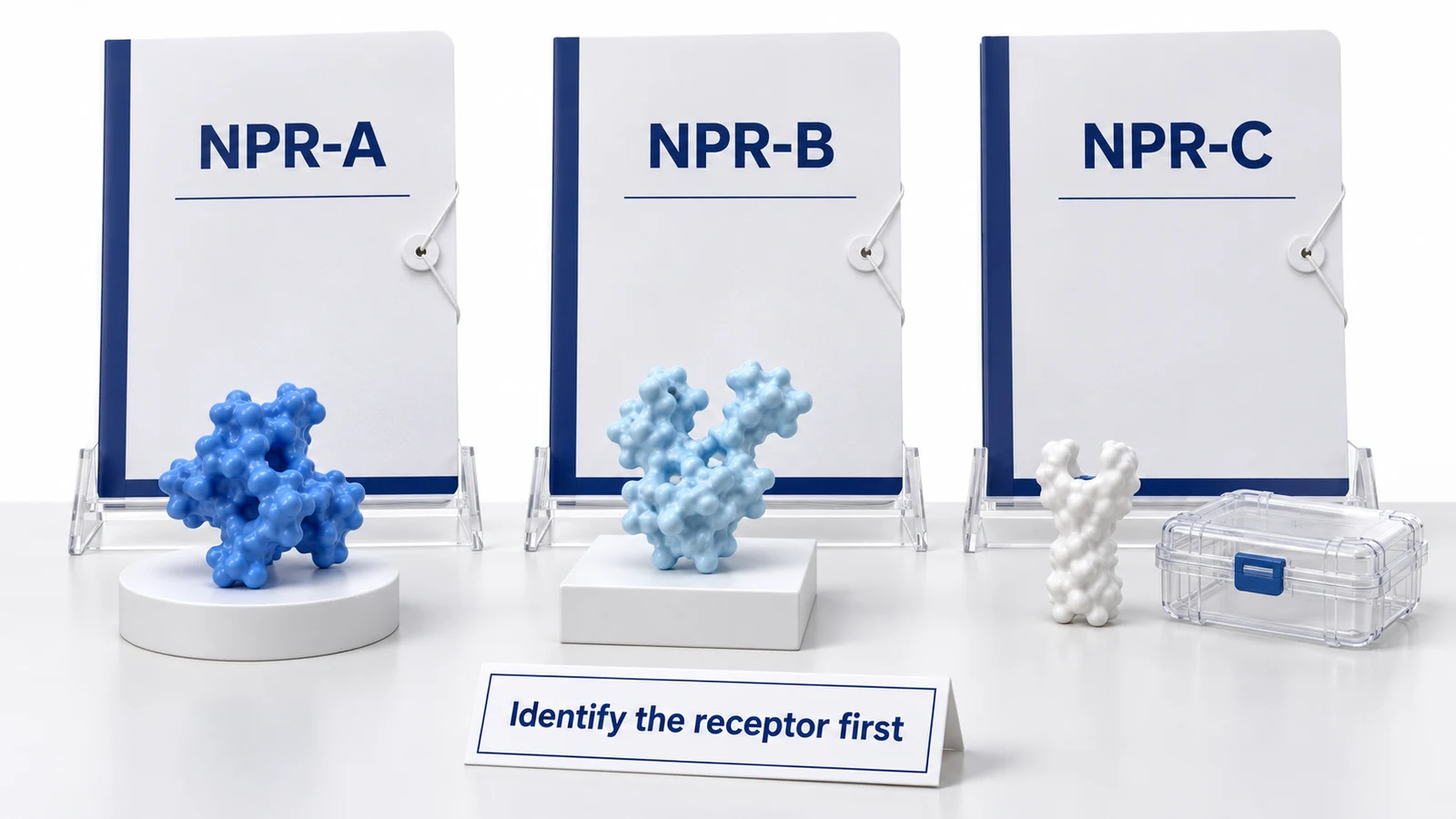
ANP means atrial natriuretic peptide, BNP is commonly called B-type natriuretic peptide, and CNP means C-type natriuretic peptide. The usual signaling map associates ANP and BNP with NPR-A, also called GC-A, and CNP with NPR-B, also called GC-B. These pairings describe receptor pharmacology, not a ranking of the peptides for a person's health.
Koller and colleagues demonstrated selective activation of the human B receptor guanylyl cyclase by CNP in their experimental system. The important reading lesson is that a peptide-family name does not make family members interchangeable at a receptor. A comparison needs the receptor identity and a stated readout. Read the CNP study.
NPR-C belongs in a separate row. It binds natriuretic peptides but does not contain the cyclase catalytic domain of NPR-A or NPR-B. Also avoid confusing NPR-C with GC-C, a different guanylyl cyclase receptor associated with guanylin and uroguanylin. When abbreviations differ across older papers, match the full name, architecture, and ligand rather than relying on a shared letter.
A starting map for reading experiments, not absolute selectivity at every concentration or in every species.
| Receptor | Common names | Main distinction to check |
|---|---|---|
| NPR-A | GC-A; gene NPR1 | Receptor guanylyl cyclase associated with ANP and BNP responses |
| NPR-B | GC-B; gene NPR2 | Receptor guanylyl cyclase associated with CNP responses |
| NPR-C | Clearance receptor; gene NPR3 | Peptide availability and context-dependent signaling; no intrinsic guanylyl cyclase domain |
| GC-C | Gene GUCY2C | A separate receptor guanylyl cyclase; not another name for NPR-C |
Clearance can change a response without making the receptor a cyclase
Clearance concerns how much ligand remains available to act. Messenger production concerns what happens after a signaling receptor is engaged. These processes can affect the same response curve without being the same mechanism. Altering ligand removal could change the apparent duration or size of a response even if the signaling receptor itself has not changed.
Matsukawa and colleagues investigated the natriuretic peptide clearance receptor using genetically altered mice. Their work connected the receptor to local regulation of the natriuretic peptide system. This is a useful reason to include peptide availability in a mechanistic explanation, but a whole-animal genetic alteration is not equivalent to selectively changing one signaling step in an isolated cell. Read the clearance-receptor study.
Clearance is also not the entire NPR-C story. Savoie and colleagues reported inhibition of adenylyl cyclase through an inhibitory G-protein-linked mechanism associated with ANP-C receptors in their preparations. That is a different observation from intrinsic cGMP synthesis. It explains why a paper may connect natriuretic peptides to a lower cAMP result without contradicting the existence of NPR-A and NPR-B cGMP signaling. Read the primary experiment.
Keep the structural and functional labels separate. Evidence that a receptor can engage Gi does not turn it into a conventional seven-transmembrane GPCR. Likewise, calling NPR-C a clearance receptor does not justify assuming that every effect of changing it is purely clearance. The Gi signaling guide explains why an inhibitory readout needs its own controls.
cGMP and cAMP are related messengers, not interchangeable labels
The shared word cyclic can make these messengers look interchangeable. They have different nucleotide bases and different synthetic enzymes. Guanylyl cyclases generate cGMP from GTP; adenylyl cyclases generate cAMP from ATP. A cAMP assay is therefore not automatically a substitute for a cGMP assay, even when both experiments involve a peptide.
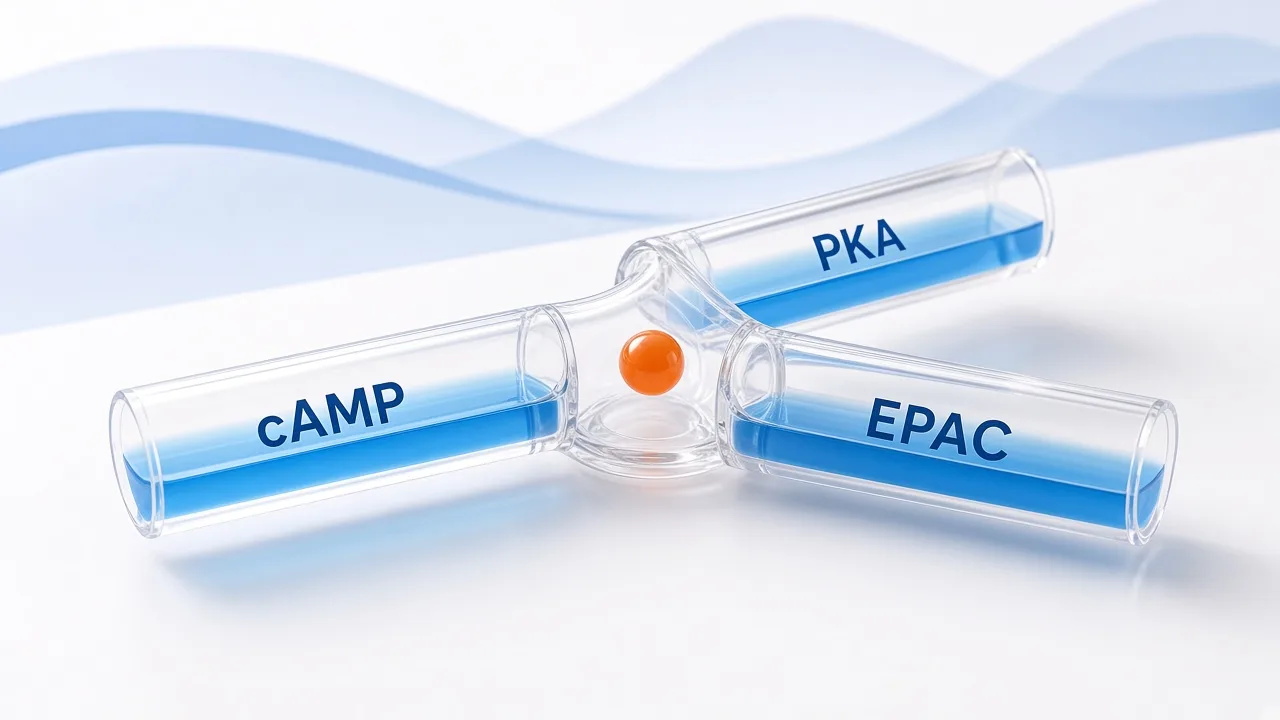
The downstream comparison also needs care. PKA and EPAC are central cAMP effectors discussed in the PKA and EPAC explainer. cGMP can regulate cGMP-dependent protein kinase, commonly called PKG, as well as other targets. Neither messenger should be reduced to one guaranteed cellular outcome. A diagram shows possible connections; the experiment must establish which connections mattered in its model.
A result can support several levels of explanation. A peptide may change measured cGMP, a PKG-directed assay may change, and a later cellular function may change. Observing all three together is informative, but connecting them causally requires interventions and controls. Do not replace those missing experiments with a longer arrow in a pathway diagram.
Similar names do not make the measured quantities equivalent.
| Term | What it refers to | Reading check |
|---|---|---|
| cAMP | Cyclic adenosine monophosphate | Was adenylyl cyclase activity or cAMP breakdown manipulated? |
| cGMP | Cyclic guanosine monophosphate | Which guanylyl cyclase source and PDE conditions were present? |
| PKG activity | A downstream kinase measurement | Was activity measured directly or inferred from messenger? |
| Cellular function | A response of the experimental preparation | Was dependence on the proposed pathway tested? |
The source and location of cGMP can change its meaning
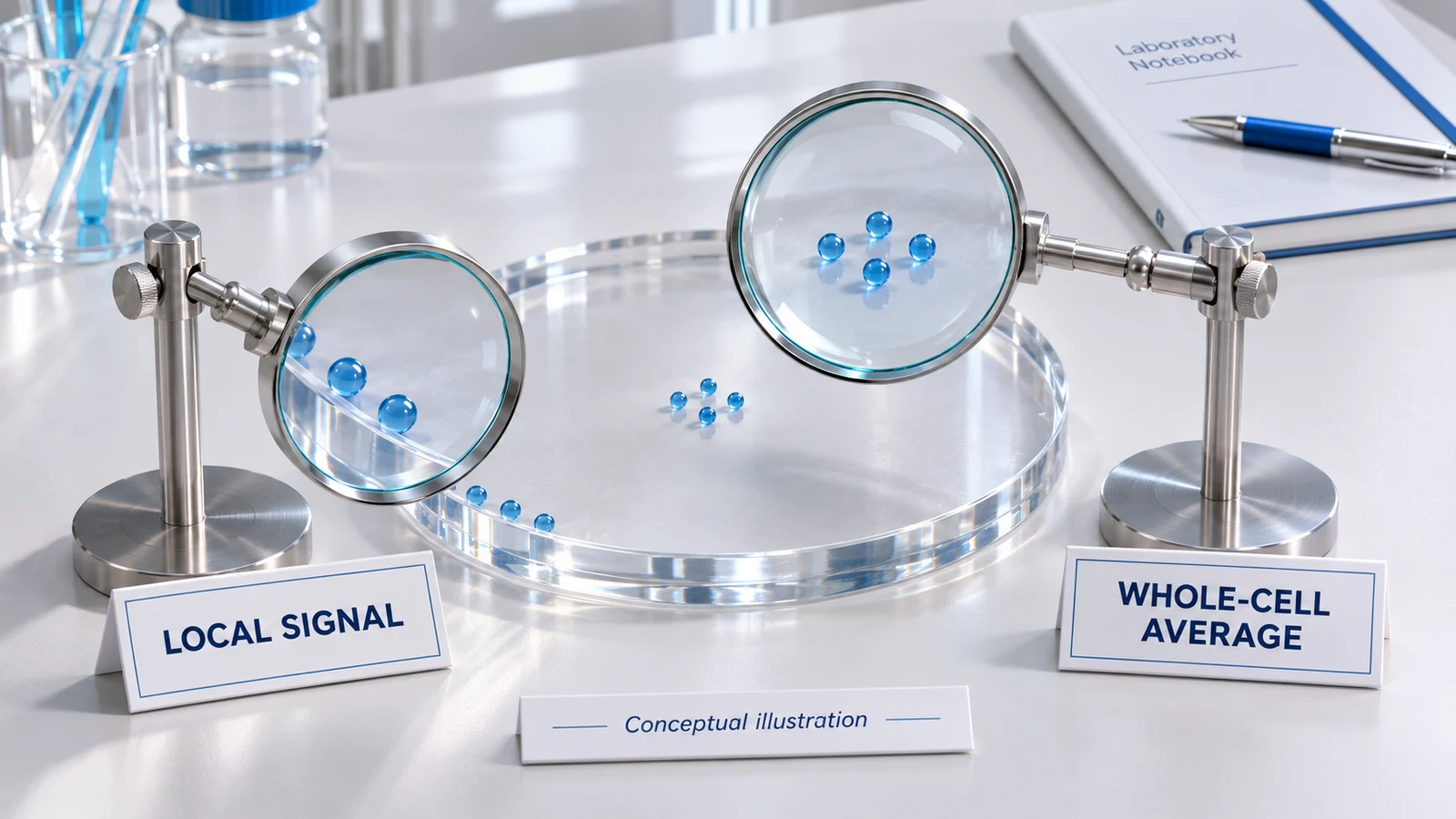
Natriuretic peptide receptors are not the only source of cGMP. Nitric oxide can stimulate a different, soluble guanylyl cyclase system. Both routes can produce the same messenger, but that does not establish identical access to every target. The label soluble also does not guarantee that signaling becomes uniform throughout a cell.
Piggott and colleagues compared natriuretic peptide and nitric oxide-linked cGMP responses in engineered HEK cells and cultured vascular smooth muscle cells. They used membrane-localized cyclic nucleotide-gated channels as reporters alongside measurements of total cGMP. The local reporter and the bulk messenger measurements did not give interchangeable pictures of the responses. Their evidence supported spatial segregation in the tested systems. Read the compartment study.
The method matters to the interpretation. A channel reporter samples messenger accessible to that reporter, whereas a total measurement combines material across the preparation. Neither is automatically the superior assay. They address different questions. The study does not license a universal rule that all peptide-generated cGMP remains at the surface or that all nitric oxide-generated cGMP has the same distribution.
A cGMP sensor is not a PKG activity measurement
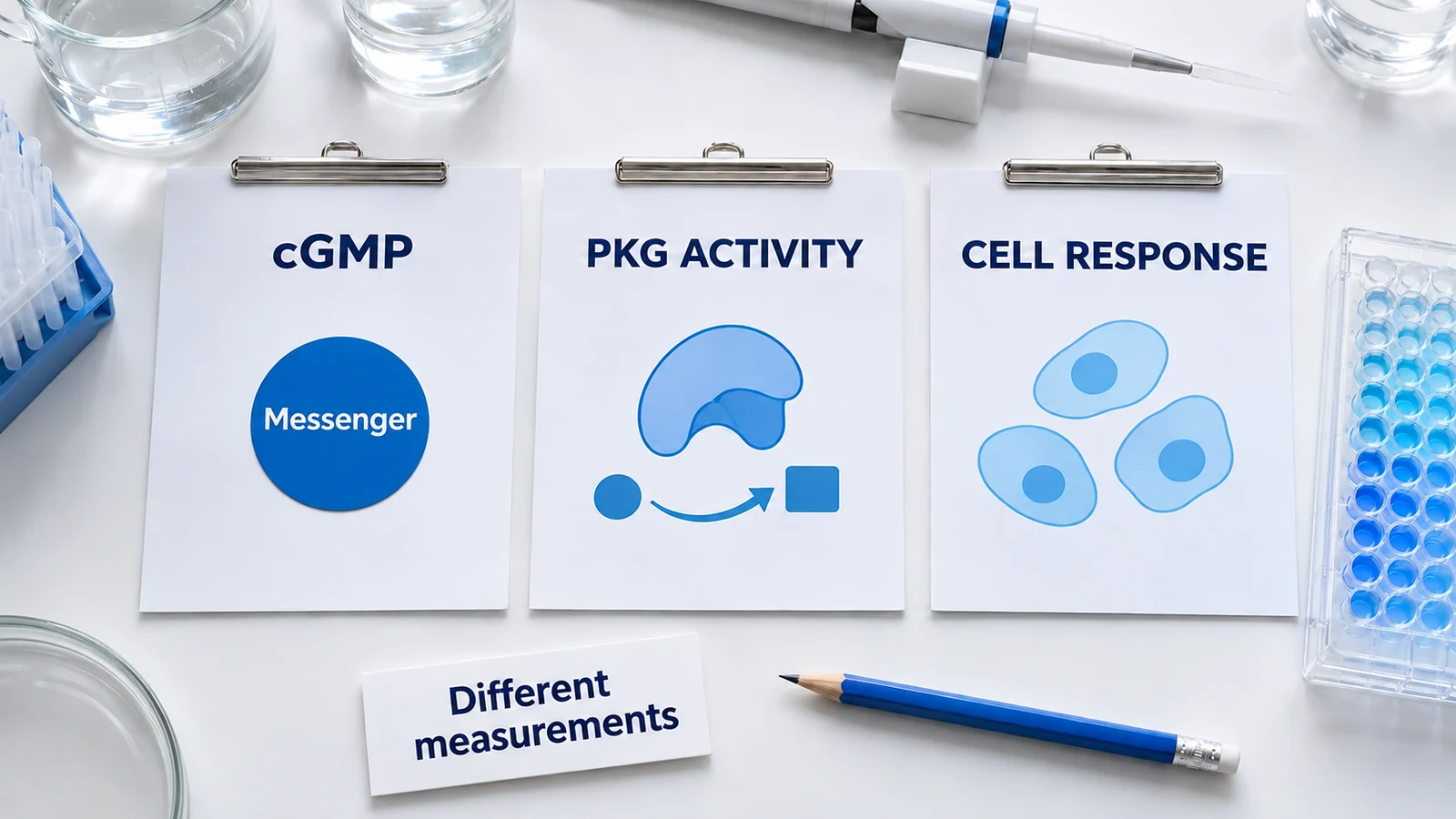
A fluorescent biosensor reports a change in its engineered sensing system. Even if its binding domains came from a kinase, that does not make its fluorescence ratio a measurement of endogenous kinase activity. Read what changes in the sensor, where it is expressed, and what the authors calibrated before translating a trace into a biological claim.
Russwurm and colleagues developed FRET-based cGMP indicators with different affinities and characterized their response properties. This provides a concrete example of why choosing a reporter is part of choosing the experiment. A sensor suitable for one concentration range may not resolve a different range equally well. Read the indicator-development study.
A plateau in a reporter could reflect a biological plateau, limited sensor range, or another measurement constraint. A small trace could reflect little messenger at the sensor, insufficient sensitivity, or a different time course. Suitable controls help distinguish those possibilities. Comparing two published fluorescence ratios without their sensor definitions and reference conditions does not produce a common concentration scale.
PDEs can connect cGMP changes with cAMP changes
The previous article explained that phosphodiesterases shape cyclic nucleotide signals. This matters here because cGMP can regulate PDE-dependent cAMP breakdown as well as participate in its own signaling. The direction of a cAMP change cannot be predicted just by noticing that cGMP increased. The relevant PDEs and their locations need to be identified.
Stangherlin and colleagues used targeted biosensors in living rat cardiac myocytes to examine local cyclic nucleotide responses. They reported opposing cGMP-associated effects on cAMP in different compartments, linked to PDE2 and PDE3. The global cAMP measurement did not capture the same pattern. These findings demonstrate a context-dependent interaction, not a universal instruction that cGMP must raise or lower cAMP in every cell. Read the primary study.
Record whether a PDE inhibitor was present before comparing ligand responses. A larger accumulated signal after reducing breakdown does not by itself identify tighter receptor binding or a new coupling mechanism. It can also change the time window in which a response becomes detectable. The PDE explainer provides the checklist for interpreting those interventions.
An invented example: equal fold changes, different amounts
Suppose two fictional cell preparations are measured with the same calibrated assay and normalized in the same way. Preparation A moves from 2 to 6 arbitrary units; preparation B moves from 8 to 24. Both show a threefold increase. The increases above baseline are 4 and 16 units. Equal fold change and equal absolute change are different statements.
This arithmetic example is invented and does not describe ANP, BNP, CNP, or a published experiment. It illustrates why a graph should identify its baseline, normalization, and units. If the underlying values instead came from different uncalibrated biosensors, even the absolute comparison in this example would not be justified.
Timing adds another question. A single endpoint cannot distinguish a brief large peak from a sustained smaller response that happens to cross the same value at the sampling time. Neither an endpoint nor a fold change establishes receptor affinity, cellular benefit, or a human dose. Keep the conclusion attached to what the measurement actually resolves.
Fictional arithmetic only; not biological or clinical data.
| Preparation | Baseline | Endpoint | Fold change | Increase |
|---|---|---|---|---|
| A | 2 | 6 | 3-fold | +4 |
| B | 8 | 24 | 3-fold | +16 |
Check receptor regulation before making the final claim
Receptor abundance and receptor regulation can affect an assay alongside ligand identity. Koller and colleagues manipulated the kinase-homology regions of NPR-A and NPR-B and found major changes in guanylyl cyclase regulation. This is a reminder that the intracellular regulatory region matters; its name alone is not proof that the receptor operates like a conventional receptor tyrosine kinase. Read the domain study.
A receptor-overexpressing cell line is a defined tool, not an automatic representation of a native tissue. When comparing studies, ask whether expression, baseline messenger, receptor availability, and observation time were comparable. A difference can be scientifically interesting without being attributable entirely to the peptide.
Finish by writing a bounded conclusion: in this preparation, this ligand altered this measured response through a mechanism supported by these experiments. Add the remaining uncertainties explicitly. This keeps a useful signaling result separate from claims about treatment, safety, or product quality that the study did not test. The guide to comparing peptide studies applies the same approach across research topics.
- Identify the full receptor name, species, and expression system.
- Separate receptor guanylyl cyclase activity from other sources of cGMP.
- Record whether the assay measured total messenger, a local sensor, kinase activity, or function.
- Check baseline, normalization, sensor range, and observation time.
- Record PDE conditions and evidence for the proposed receptor or effector contribution.
- Keep findings within the experimental model; use clinical evidence for clinical conclusions.