


Peptide receptor selectivity describes a ligand's relative preference for one receptor over others under defined experimental conditions. That preference may concern binding or a measured functional response. A useful selectivity claim names the receptors compared, the measurement, and the assay context. The word selective alone does not establish exclusive action, tissue targeting, or clinical safety.
Start by naming the comparison
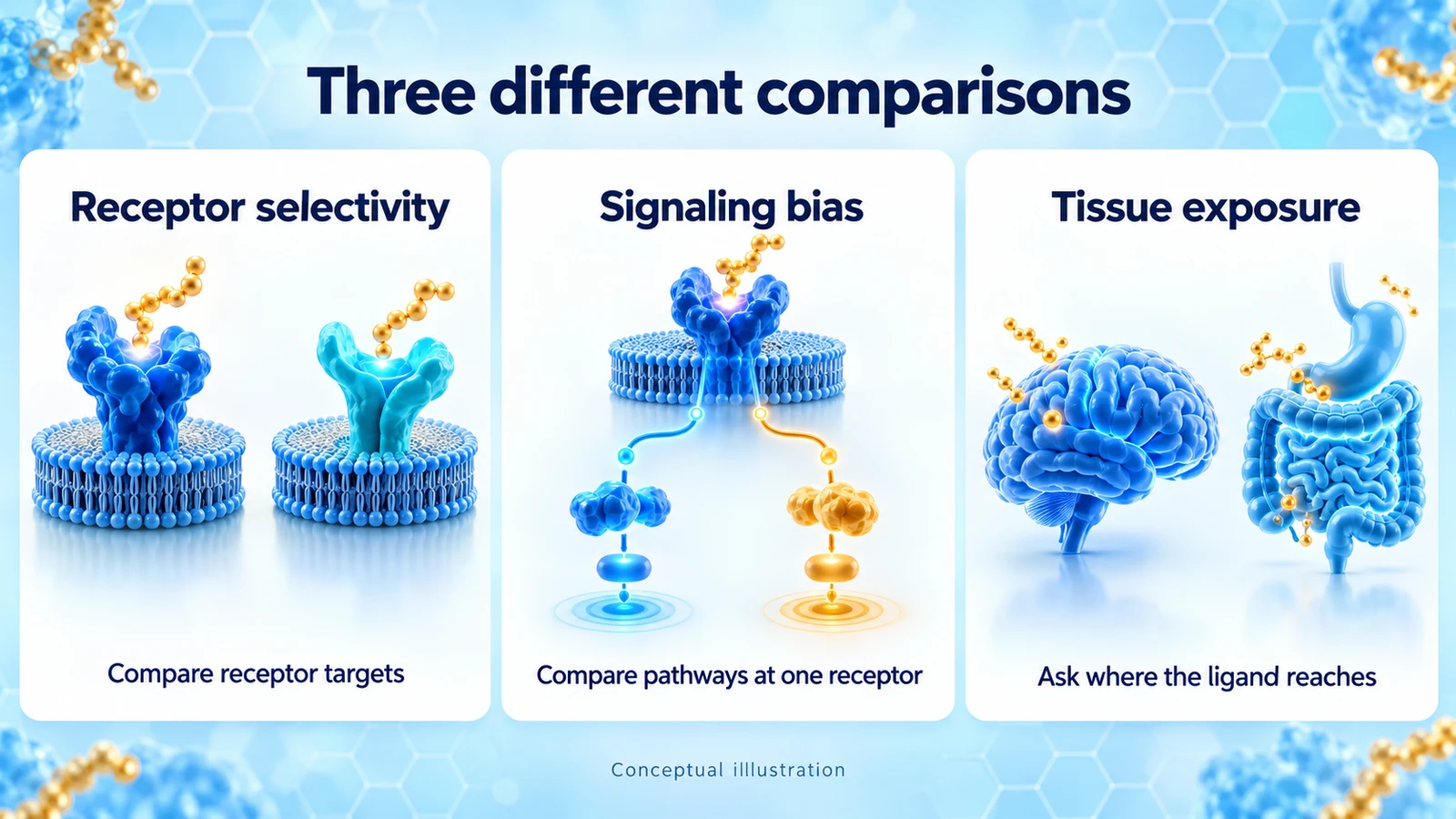
A statement that a peptide is selective is incomplete until it identifies the alternatives. Selective for receptor A over receptor B is a narrower and more testable claim than selective for receptor A. A comparison with two related receptors cannot establish the absence of interactions with every other protein in a cell.
Also identify what the researchers compared. A binding experiment can describe relative affinity. A functional experiment can compare the concentrations needed to produce a defined response, or compare response maxima. Those measurements should remain separate when you summarize the result.
This article continues receptor reserve in peptide research in the Research & Science guide. Reserve explains why response and occupancy can differ; selectivity asks how a ligand behaves across receptor targets. All illustrations here are conceptual.
Three comparisons often compressed into the word selective
| Question | What is compared | What it does not establish alone |
|---|---|---|
| Receptor selectivity | The same ligand at different receptors | Exclusive activity across all possible targets |
| Signaling bias | Different responses through one receptor, relative to a reference ligand | Preference for a different receptor |
| Tissue exposure | Ligand availability in different locations | A receptor-binding preference |
Read selectivity and specificity as claims that need evidence
Selectivity commonly expresses a relative preference. Specificity sometimes implies a more restricted interaction, but authors do not use the words uniformly. Rather than treating either as a guarantee, translate the statement into the underlying observation: which target, compared with which alternatives, using what method?
A peptide's name does not answer that question. A hormone and a receptor may share a name because of their biological history, while related ligands and receptors still have overlapping pharmacology. Likewise, a synthetic analogue may differ from its parent in ways that require fresh characterization.
A useful reading exercise is to replace a broad label with a bounded sentence. For example: the peptide showed higher affinity for receptor A than for the two other receptors tested in this species. That sentence is less sweeping, but it tells another reader exactly what the evidence needs to support. Keep the original authors' definition nearby when terminology is ambiguous.
Binding affinity and functional potency produce different comparisons
Binding studies ask about a ligand's interaction with a receptor under the assay's conditions. Kd describes an equilibrium dissociation constant in the relevant binding model. Ki is an affinity-related constant often estimated from competition experiments. Lower values generally correspond to stronger affinity within a suitable, comparable model.
Functional studies ask what the system does. EC50 describes the concentration associated with half of the fitted maximal response for a stated curve. Emax describes its observed or fitted maximum. A ligand can have a relatively low EC50 yet produce a smaller maximum than a comparator. See potency vs efficacy.
The operational model of agonism formalizes why a functional curve contains contributions from the ligand and the system. Receptor abundance and signal transduction affect observed responses, so an EC50 ratio across receptors is not automatically a ratio of binding affinities. Black and Leff, 1983.
Why an IC50 label needs its assay attached
IC50 is the concentration giving half inhibition of the specified measurement. It is not a universal substitute for Ki. The relationship depends on experimental conditions and the model being applied. The classic Cheng–Prusoff analysis illustrates why inhibition constants and half-inhibitory concentrations must be distinguished. Cheng and Prusoff, 1973.
When a table mixes Ki, Kd, IC50, and EC50, do not divide the entries into one selectivity score. First separate binding from function and identify how each value was obtained. Affinity vs efficacy provides the broader vocabulary.
A selectivity ratio needs a direction and comparable inputs
Consider a deliberately hypothetical binding comparison: Ki is 2 nM at receptor A and 100 nM at receptor B. Dividing Ki at B by Ki at A gives 50. Under that stated convention, the result indicates 50-fold higher affinity for A than B. These are teaching numbers, not measurements for a real peptide.
Reversing the division gives 0.02, which describes the same comparison with the opposite convention. A ratio without its numerator and denominator can therefore be misleading. Check that the units match before calculating: values in micromolar and nanomolar cannot be divided as if they were the same unit.
Now replace Ki with EC50. The arithmetic is unchanged, but the claim becomes a functional potency comparison in the tested systems. It does not become a binding result merely because the ratio looks precise. Include the endpoint, receptor-expression conditions, and response maxima when interpreting that functional comparison.
Hypothetical examples only, not peptide or clinical data
| Inputs | Calculation | Permitted description |
|---|---|---|
| Ki(A) = 2 nM; Ki(B) = 100 nM | 100 / 2 = 50 | 50-fold affinity preference for A under this convention |
| EC50(A) = 2 nM; EC50(B) = 100 nM | 100 / 2 = 50 | 50-fold functional potency difference in these assays |
| A measured; B not tested | No ratio available | Selectivity against B is unknown |
Preserve uncertainty and inequality signs
A fitted constant is an estimate. Before emphasizing a fold difference, look for replicate information, confidence intervals, fit quality, and whether the curves cover the relevant response range. A sharply stated ratio can conceal considerable uncertainty in its inputs.
If a paper reports a value only as greater than its tested limit, any derived comparison may be a bound rather than an exact number. Preserve the greater-than sign and the authors' assumptions. No detected response is not an infinite EC50, and it should not be turned into infinite selectivity.
Oxytocin studies show why receptor subtype and species belong in the claim
The oxytocin/vasopressin system provides a useful example because related peptide ligands interact with a family of receptors. Busnelli and colleagues characterized agonists and antagonists at mouse oxytocin, V1a, and V1b receptors using binding and signaling assays. They identified TGOT as highly selective for the mouse oxytocin receptor in the comparisons they performed. Busnelli and colleagues, 2013.
The species label is part of that result. A compound used as a receptor probe in mice should not inherit a human selectivity profile simply because the receptor names are similar. Nor does demonstrating selectivity against two alternatives amount to screening every possible target.
Muttenthaler and colleagues addressed this translational problem by modifying oxytocin and testing receptor activity across species. Their analogue [Se-Se]-OT-OH retained potency while improving oxytocin-receptor selectivity in the tested comparisons, with the improvement conserved in mice. Muttenthaler and colleagues, 2017.
These studies illustrate a research strategy: measure the relevant receptor family in the relevant species rather than assume that a familiar ligand label is sufficient. They do not justify transferring a cellular selectivity result directly into a claim about behavioral outcomes or personal use.
Multiple receptor targets can be an intentional design
A second receptor interaction is not automatically an unwanted off-target effect. Some peptides are developed to activate more than one receptor. In those cases, the scientific question includes the relative activities at the intended targets and how that profile relates to downstream effects.
Willard and colleagues characterized tirzepatide at GIP and GLP-1 receptors and distinguished its activity across those receptors from its signaling profile within GLP-1R. Their study used defined receptor-expression levels and considered albumin binding when interpreting assay results. Willard and colleagues, 2020.
Coskun and colleagues characterized LY3437943, the molecule subsequently known as retatrutide, at glucagon, GIP, and GLP-1 receptors. The reported in vitro profile included activity at all three receptors with unequal relative activities. The term triple agonist does not, by itself, mean equal potency or equal contribution to every outcome. Coskun and colleagues, 2022.
These are examples of target-profile characterization, not a ranking of treatments. To compare the vocabulary, continue with dual and triple agonist peptide literacy. The number of receptor targets alone cannot establish clinical superiority.
Receptor selectivity and signaling bias ask different questions
Receptor selectivity compares different targets, such as receptor A and receptor B. Signaling bias compares responses associated with one receptor, such as two downstream pathways, while accounting for a reference ligand and the experimental system. A molecule can have both a multi-receptor activity profile and a pathway-dependent signaling profile.
Kenakin and colleagues developed an approach to quantifying agonist bias using operational-model terms and reference comparisons. Their work emphasizes the need to account for system-dependent responses when evaluating pathway preferences. Kenakin and colleagues, 2012. A larger raw signal in one pathway is not sufficient on its own.
When you encounter the phrase functional selectivity, check the author's definition. In bias literature it often refers to pathway preference, while a functional selectivity ratio in a receptor panel may refer to potency differences across targets. Writing out the comparison resolves more confusion than relying on the phrase alone.
The biased agonism explainer covers that analysis in more detail. Keep separate notes for receptor targets, pathway responses, and time-dependent behavior so that evidence for one is not silently used to prove another.
Assay conditions can change the apparent preference
Even carefully measured values can be difficult to compare when the assay conditions differ. A receptor expressed at high abundance in one cell line and at low abundance in another may generate different apparent potency. Different readout windows, coupling machinery, or normalization choices add further context.
Receptor reserve is especially relevant for functional panels. A sensitive, amplified endpoint can conceal differences that appear in another preparation. A matched host cell is useful, but it does not guarantee matched receptor abundance or identical signaling efficiency. Look for what the researchers actually measured or controlled.
Boianelli and colleagues compared GLP-1 receptor assay formats and their relationship to clinical exposure and outcomes. The translation depended on assay setup, including protein conditions and cell system. Boianelli and colleagues, 2024. This supports treating laboratory potency as a context-dependent measurement, not a free-standing clinical conversion.
For a practical comparison, build a small table containing receptor species, expression system, endpoint, exposure time, and medium conditions for each result. If those entries differ, explain the difference beside the ratio. The study-comparison guide develops this approach.
Untested, undetected, and inactive are different statements
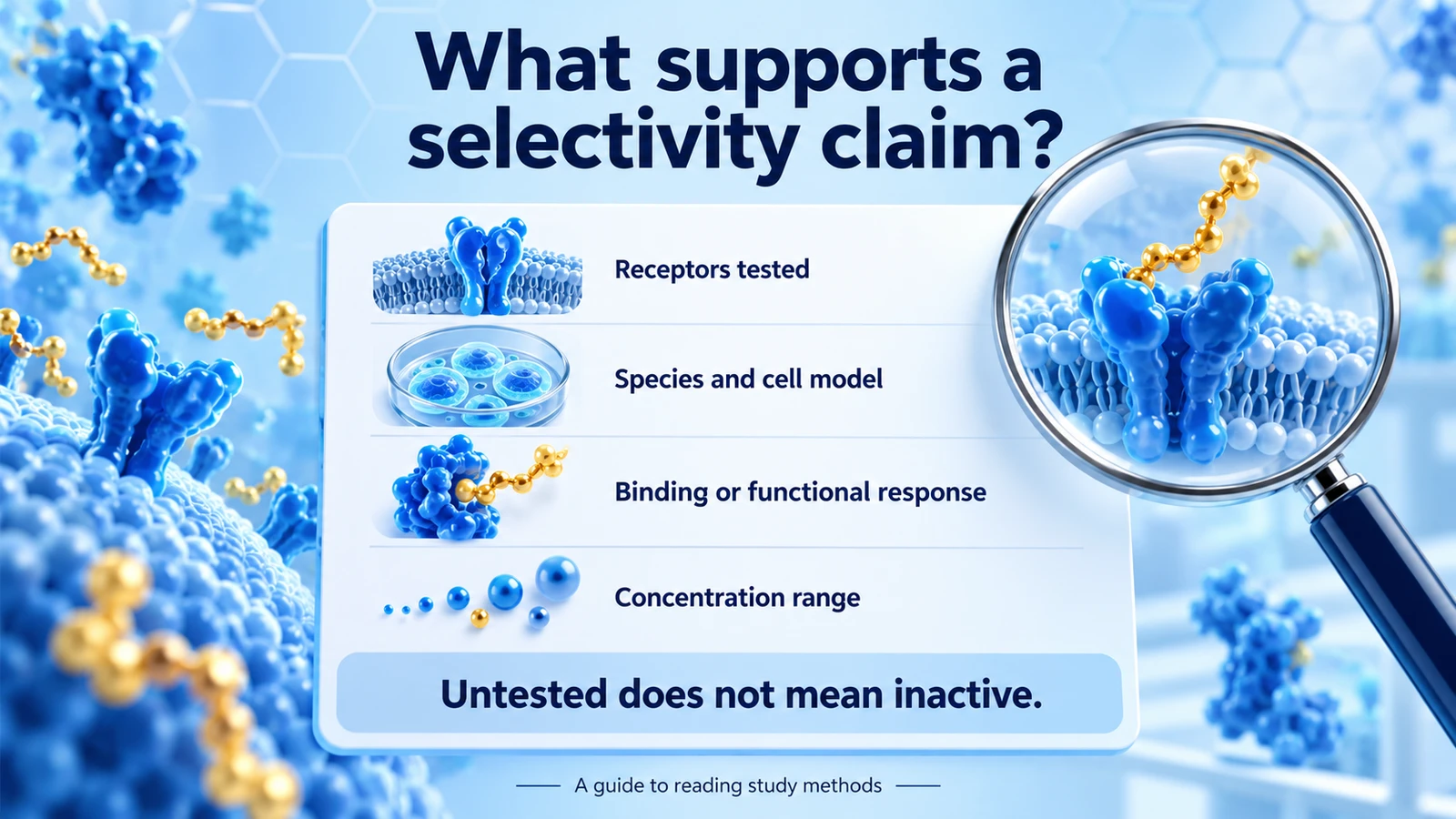
A receptor panel is a defined set of experiments. If receptor C was not included, the panel provides no direct result for C. If C was tested and no response was detected, the conclusion still depends on the measurement's sensitivity, concentration range, and controls.
Also ask which activity was tested. An agonist screen measures stimulation of a selected response. A ligand that binds without stimulating that response may require another experiment to characterize it, including tests of antagonism where appropriate. Binding, activation, and blockade should not be collapsed into a single active/inactive label.
Read the control data before treating a flat trace as a biological conclusion. Did the reference agonist produce the expected response? Was the assay capable of detecting the endpoint? Was there evidence of measurement interference or loss of cell viability? These questions help distinguish a meaningful negative result from an uninformative experiment.
A faithful summary might say: no agonist response was detected at the tested receptor within the reported range. That statement retains the useful observation while leaving unmeasured binding, other pathways, and untested conditions open.
Turn a selectivity claim into a statement another reader can check
Use a compact evidence sentence: in the stated species and cell model, ligand X showed a specified binding or functional preference for receptor A over receptors B and C, within the tested range. Add uncertainty or bounds when the paper reports them. This makes the claim concrete without making it broader than the study.
Keep clinical conclusions in their own evidence category. A receptor-selective ligand can still have effects through its intended target in multiple tissues. Tissue exposure, the duration of exposure, and measured clinical outcomes require their own investigation. Receptor preference alone cannot establish that a product is safer, more effective, or appropriate for a particular person.
This article is for research literacy. For the neighboring concepts, use affinity vs efficacy, receptor reserve, and the Safety & Guides hub. Together, they help keep target claims tied to the actual measurements.
- Name every receptor in the comparison and identify the species.
- Separate binding affinity from functional potency and response maximum.
- Check the ratio's direction, units, uncertainty, and any inequality signs.
- Record receptor expression, assay conditions, and the concentration range.
- Distinguish receptor-target preference from pathway bias and tissue exposure.
- Keep untested targets and undetected responses in separate categories.
- Use clinical evidence, rather than a receptor label, for claims about human outcomes.