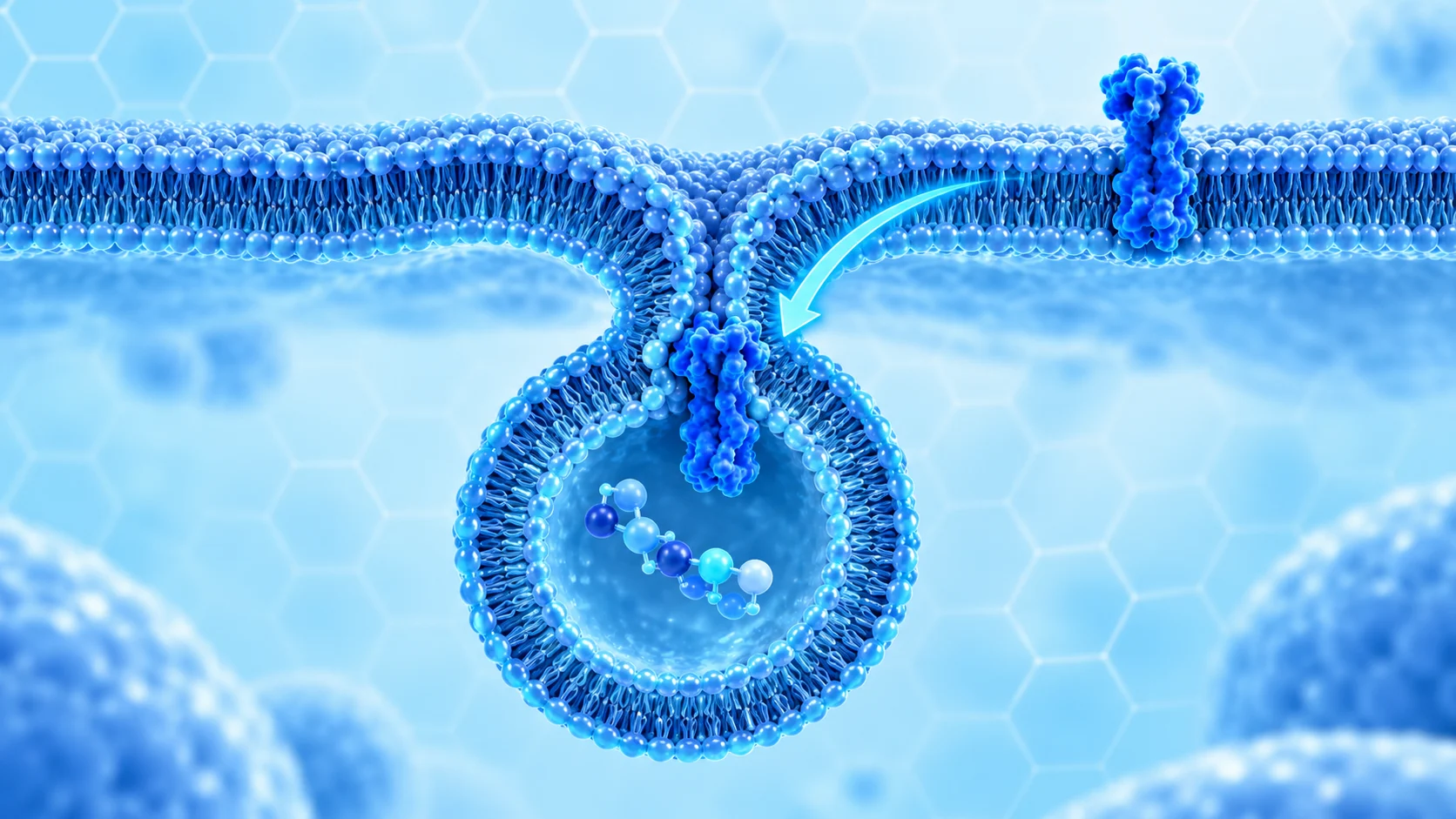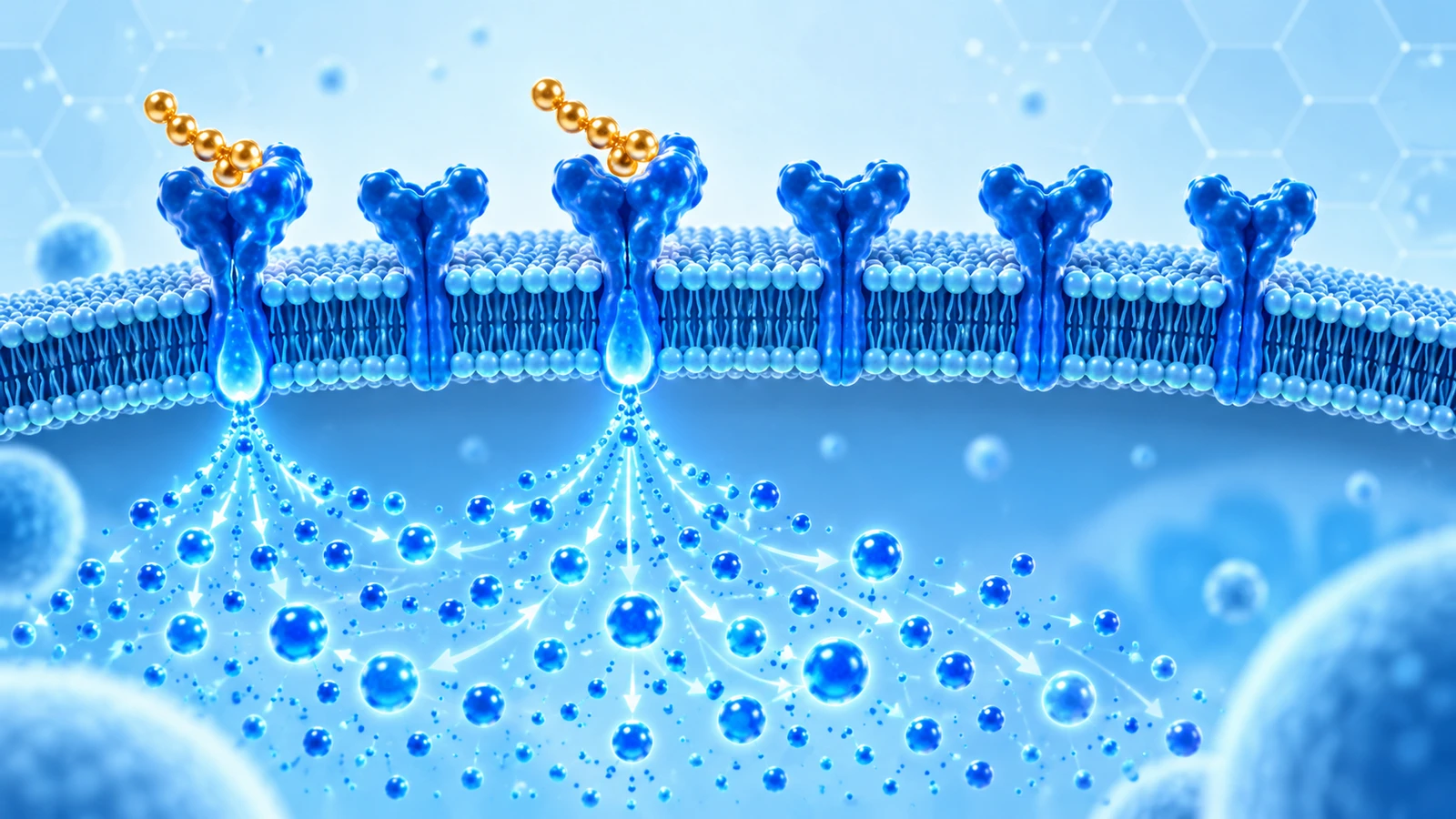

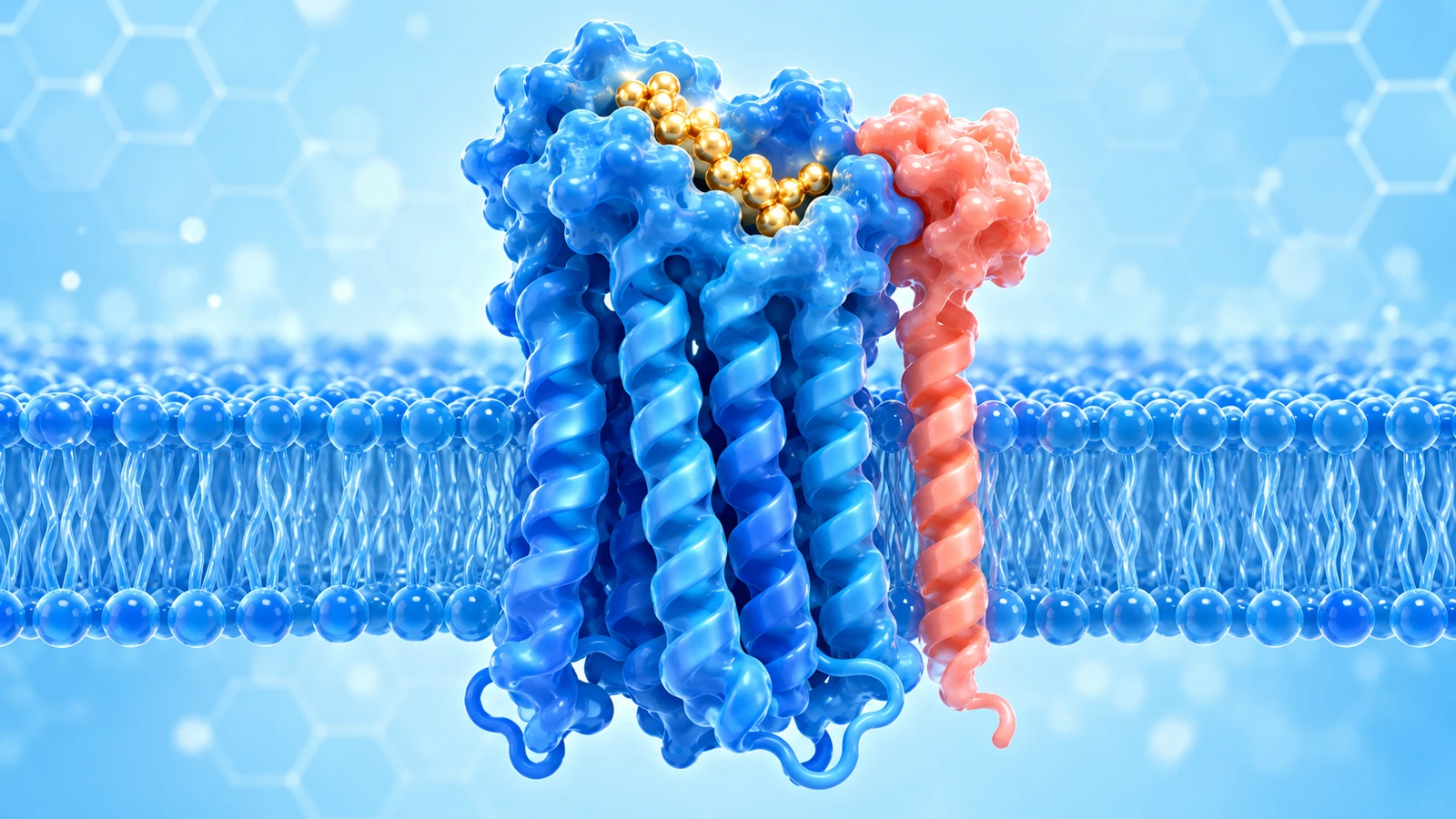
RAMPs, or receptor activity-modifying proteins, are accessory membrane proteins that associate with certain G protein-coupled receptors. They can influence receptor delivery to the cell surface, peptide recognition, signaling, and trafficking. In the calcitonin peptide family, naming the GPCR and its RAMP partner is essential to identifying the receptor complex being studied.
A receptor can depend on a protein partner
For the distinction between accessory proteins and receptor pairs, see peptide receptor dimerization.
Peptide-receptor diagrams often show one ligand meeting one protein. Some important targets are better understood as complexes. A RAMP is a smaller membrane protein with a single membrane-spanning segment, an extracellular region, and a short intracellular tail. Its GPCR partner has the familiar seven-transmembrane architecture. Accessory describes the RAMP's relationship to the GPCR; it does not mean the protein is unimportant.
McLatchie and colleagues demonstrated in 1998 that different RAMP partners changed the transport and pharmacological identity of calcitonin receptor-like receptor. RAMP1 supported a CGRP receptor phenotype, while RAMP2 supported an adrenomedullin receptor phenotype. This established that the same GPCR gene product could participate in different functional receptor complexes. Read the discovery study.
The useful starting question is therefore: which proteins were actually present in the experimental target? A receptor-family name may hide a difference in partner protein that matters for the response. The illustrations in this article show simplified complexes rather than exact molecular structures or measured proportions.
CLR and CTR form different families of RAMP complexes
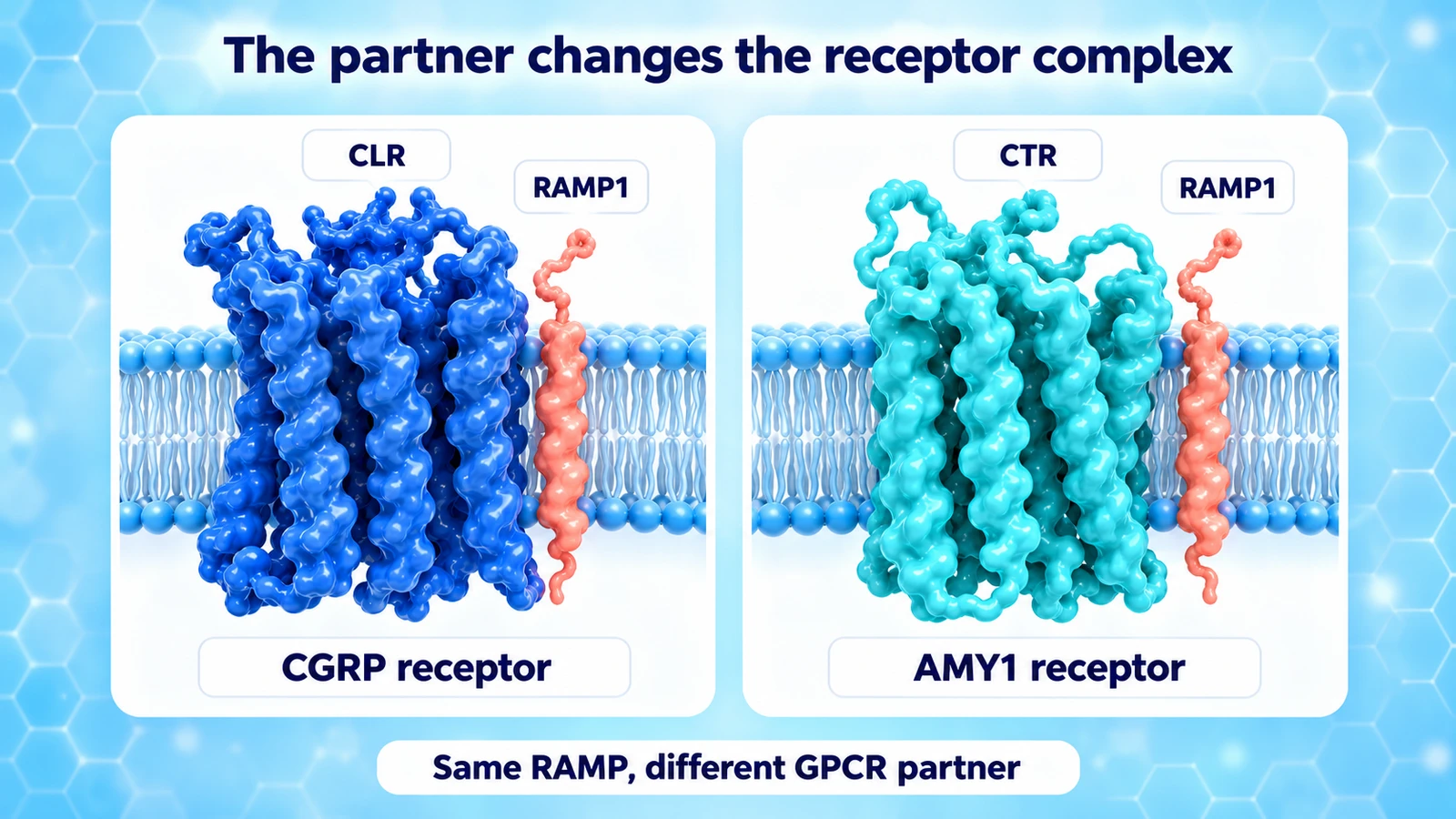
CLR means calcitonin receptor-like receptor; its gene is CALCRL. Older papers may use CRLR for the same protein. CTR means calcitonin receptor, encoded by CALCR. The similar names reflect related biology, but CLR and CTR are distinct GPCRs. RAMP1 paired with one is not the same target as RAMP1 paired with the other.
The table is a composition guide, not a table of exclusive ligand recognition. Receptor names do not mean that only the named peptide can activate the complex. Ligands in this family can show overlapping pharmacology, and experimental conditions affect the apparent preference.
Core GPCR and RAMP composition. Splice variants and other cellular proteins are not shown.
| GPCR | RAMP partner | Receptor name |
|---|---|---|
| CLR (CALCRL) | RAMP1 | Canonical CGRP receptor |
| CLR (CALCRL) | RAMP2 | AM1 adrenomedullin receptor |
| CLR (CALCRL) | RAMP3 | AM2 adrenomedullin receptor |
| CTR (CALCR) | No RAMP required for CTR function | Calcitonin receptor |
| CTR (CALCR) | RAMP1 | AMY1 amylin receptor |
| CTR (CALCR) | RAMP2 | AMY2 amylin receptor |
| CTR (CALCR) | RAMP3 | AMY3 amylin receptor |
AM1 is not AMY1
The extra Y is consequential. AM1 refers to CLR with RAMP2, whereas AMY1 refers to CTR with RAMP1. AMY2 likewise differs from AM2. Some papers also use AM2 as an abbreviation for the peptide adrenomedullin 2, also called intermedin. Check whether the label denotes a ligand or a receptor, then write out the components.
A subtype suffix can add another layer. For example, AMY1(a) specifies a CTR splice-variant context as well as the RAMP partner. When comparing tables from different papers, retain the full receptor designation rather than shortening every entry to amylin receptor.
Amylin receptors are assembled from CTR and a RAMP
Christopoulos and colleagues showed that coexpressing RAMP1 or RAMP3 with a human CTR construct produced amylin-binding receptor phenotypes in their experimental system. The result helped explain why describing the calcitonin receptor gene product alone was insufficient to account for all observed amylin pharmacology. See the 1999 primary study.
Later work by Tilakaratne and colleagues compared CTR isoforms and host cells. The ability of RAMP2 to produce an amylin-binding phenotype depended on those conditions, and other binding characteristics changed too. The practical lesson is specific: a negative result in one expression system cannot be generalized to every CTR-RAMP combination. Read the cell-context study.
This is why a paper's methods may contain information as important as its headline. Look for the CTR species and splice variant, the RAMP used, and the host cell. A study of an unspecified amylin receptor is harder to compare with one that reports all three subtypes under matched conditions.
How this helps with amylin-analogue language
When an article describes an amylin analogue, the receptor label alone does not establish identical activity at every AMY subtype or at CTR without a RAMP. Those are experimental questions. The receptor map provides background for reading the cagrilintide and CagriSema explainer, while keeping molecular mechanism separate from evidence about a particular medicine or trial.
RAMPs can shape recognition without supplying the entire binding site
It is tempting to picture a RAMP as a replacement lock that decides which peptide fits. Structural evidence supports a more connected mechanism. Booe and colleagues examined peptide-bound extracellular domains of CLR-RAMP1 and CLR-RAMP2. The peptide fragments mainly contacted CLR, while RAMP contacts and differences in CLR conformation contributed to recognition. Read the structural study.
Liang and colleagues subsequently determined an active CGRP receptor structure with CGRP and a Gs protein complex. RAMP1 contacted the GPCR across multiple regions and made limited direct contact with the peptide. This connected the partner protein to the architecture of the active receptor, beyond an isolated extracellular binding domain. See the 2018 cryo-EM study.
These observations allow direct peptide contacts and indirect conformational effects to coexist. Calling RAMP action allosteric does not imply that the RAMP never touches a ligand. It also does not make every RAMP a universal positive modulator. The direction and type of effect require a defined receptor, ligand, and comparison. The allosteric modulation guide explains the underlying distinction.
A residue's effect can depend on the partner
Watkins and colleagues found that the consequences of CLR mutations depended on the RAMP and peptide being tested. They assessed functional responses alongside surface-expression measurements and selected binding experiments. This illustrates why a loss of signal should be interpreted with expression and recognition evidence rather than automatically called loss of a direct peptide contact. Read the mutagenesis study.
Amylin structures and subunit dynamics add two different kinds of evidence
Cao and colleagues reported active amylin receptor structures with amylin and calcitonin-based ligands. The amylin-bound AMY complexes shared structural features constrained by their RAMP partners, while calcitonin-bound complexes adopted distinct arrangements. The study showed that different peptide families can activate related receptor complexes through different structural configurations. See the 2022 Science paper.
A structure captures a particular experimental state. It does not establish that every receptor molecule remains permanently paired with the same partner in a living cell. Gostynska and colleagues examined this question directly in a 2025 study, combining biochemical separation, live-cell proximity measurements, and signaling assays. They found different subunit-association behavior across AMY receptors and showed that peptide agonists could shift those interactions. Read the peer-reviewed study.
The two approaches are complementary. Structures help explain the organization of an assembled complex; dynamic measurements examine how populations of components behave under changing conditions. Neither can be replaced by a schematic that simply draws two proteins together.
Surface delivery and receptor recycling are separate effects
A peptide must encounter an accessible receptor to activate it. If a partner changes how much receptor reaches the cell surface, a functional response may change even without a simple improvement in ligand affinity. Total cellular receptor protein and surface-accessible receptor are therefore different measurements.
Events after activation matter as well. Bomberger and colleagues found that RAMP3, together with N-ethylmaleimide-sensitive factor, could redirect internalized CLR complexes toward recycling in their models. The effect involved the RAMP3 tail and was investigated in both engineered cells and rat mesangial cells. The result demonstrates a trafficking role under specified conditions, not a universal rule that all RAMP3-containing receptors always recycle. See the primary report.
Surface delivery, internalization, recycling, and degradation describe different stages of receptor regulation. A larger early response and faster recovery after stimulation need not share the same explanation. The guide to receptor desensitization and internalization explains these distinctions in more detail.
Expression, assembly, and function should be checked separately

A tissue dataset may detect transcripts for a GPCR and a RAMP. That makes a proposed complex worth investigating, but does not establish that both proteins occur in the same cell, reach the same membrane, or assemble in sufficient amounts to explain a response. A mixed tissue sample can contain transcripts contributed by different cell populations.
Protein-level evidence narrows the question, and localization can show whether the components are in compatible places. Association measurements then test physical relationships. Functional experiments ask whether changing the proposed complex changes peptide responses. The strongest argument combines appropriate evidence rather than treating one layer as a substitute for the others.
Different observations support different levels of inference.
| Observation | What it supports | What remains unresolved |
|---|---|---|
| GPCR and RAMP transcripts detected | The tissue or sampled cells express relevant RNA | Protein abundance, same-cell expression, and assembly |
| Proteins at the cell surface | The components are accessible in that location | How much forms the proposed complex |
| Association or proximity evidence | A physical relationship under the assay conditions | Whether it explains the functional response |
| Binding changes | Altered ligand interaction in the tested preparation | All downstream pathways and tissue outcomes |
| Signaling changes after perturbing a component | A functional contribution in that system | Effects of expression changes and other targets |
| Structure of an assembled complex | Molecular organization in a captured state | Population dynamics and clinical consequences |
A hypothetical comparison: same peptide, different receptor preparations
Imagine two reports test the same peptide and call their target an amylin receptor. The first uses one CTR splice variant with RAMP1 in an engineered cell line. The second uses a different CTR variant with RAMP3 in another cell line. The first reports a lower EC50. These are invented study descriptions, not experimental results.
The difference does not establish that RAMP1 universally makes the peptide more potent. The comparisons changed several variables together: subtype composition, receptor sequence, cell background, and possibly receptor abundance and assay timing. EC50 also describes a functional response, not binding affinity by itself.
A narrower conclusion is that the peptide had different measured potencies in the two preparations. To attribute the difference specifically to the RAMP, look for a comparison that holds the other relevant factors consistent and measures surface expression as well as signaling. An apparent difference may then be connected more convincingly to recognition, coupling, or receptor availability.
This is the practical connection to receptor selectivity and receptor reserve: a receptor name is the beginning of the comparison, while the measured system determines how far its result can be generalized.
Four shortcuts that can mislead a reader
First, the same RAMP does not identify the same receptor. CLR-RAMP1 and CTR-RAMP1 differ in their GPCR component. Second, a response to a named peptide does not uniquely identify the complex responsible. Overlapping ligand recognition makes receptor attribution a separate experimental task.
Third, the word modifying does not mean increasing every response. A partner's effects can involve location, recognition, coupling, or trafficking, and those changes may appear differently across measurements. Fourth, a mechanistic receptor result is not a clinical ranking. Tissue exposure, distribution, other targets, and human outcomes remain separate questions.
RAMP biology is useful precisely because it makes those hidden assumptions visible. It helps explain why a result may change between preparations without requiring the peptide itself to have changed. It does not provide a personal-use method for adjusting receptor expression or combining substances.
Keep the scope of each claim clear
This article focuses on well-characterized calcitonin-family receptor complexes. It does not imply that every peptide GPCR requires a RAMP, that a RAMP is an administered peptide drug, or that finding a partner protein predicts a therapeutic outcome. Read a proposed interaction according to the evidence available for that specific pair.
What to record when reading a RAMP study
Write down the complete target as a GPCR plus a partner, then add the species and splice variant. Next, record the ligand and endpoint. This short description prevents AMY1, AM1, and the canonical CGRP receptor from being grouped together merely because their names or components overlap.
Finally, separate what was measured from the mechanism proposed to explain it. A change in surface expression, binding, cAMP, or recycling can each be informative, but they answer different questions. Evidence from more than one of these levels helps connect a molecular observation to a functional explanation.
- Identify CLR versus CTR and the exact RAMP partner.
- Retain receptor species, splice variant, and engineered mutations.
- Record peptide identity, assay endpoint, and timing.
- Check total expression separately from surface localization.
- Look for evidence of assembly and the contribution of each component.
- Distinguish binding affinity from functional potency and maximal response.
- Check whether the result concerns a structural state, subunit dynamics, or trafficking.
- Limit tissue and clinical conclusions to the evidence actually tested.
Continue the receptor-science series
Use how to compare peptide studies for interpreting differences between experiments. The Research & Science hub connects the receptor series, Peptide Basics covers molecular vocabulary, and Safety & Guides addresses the limits of health and product claims.