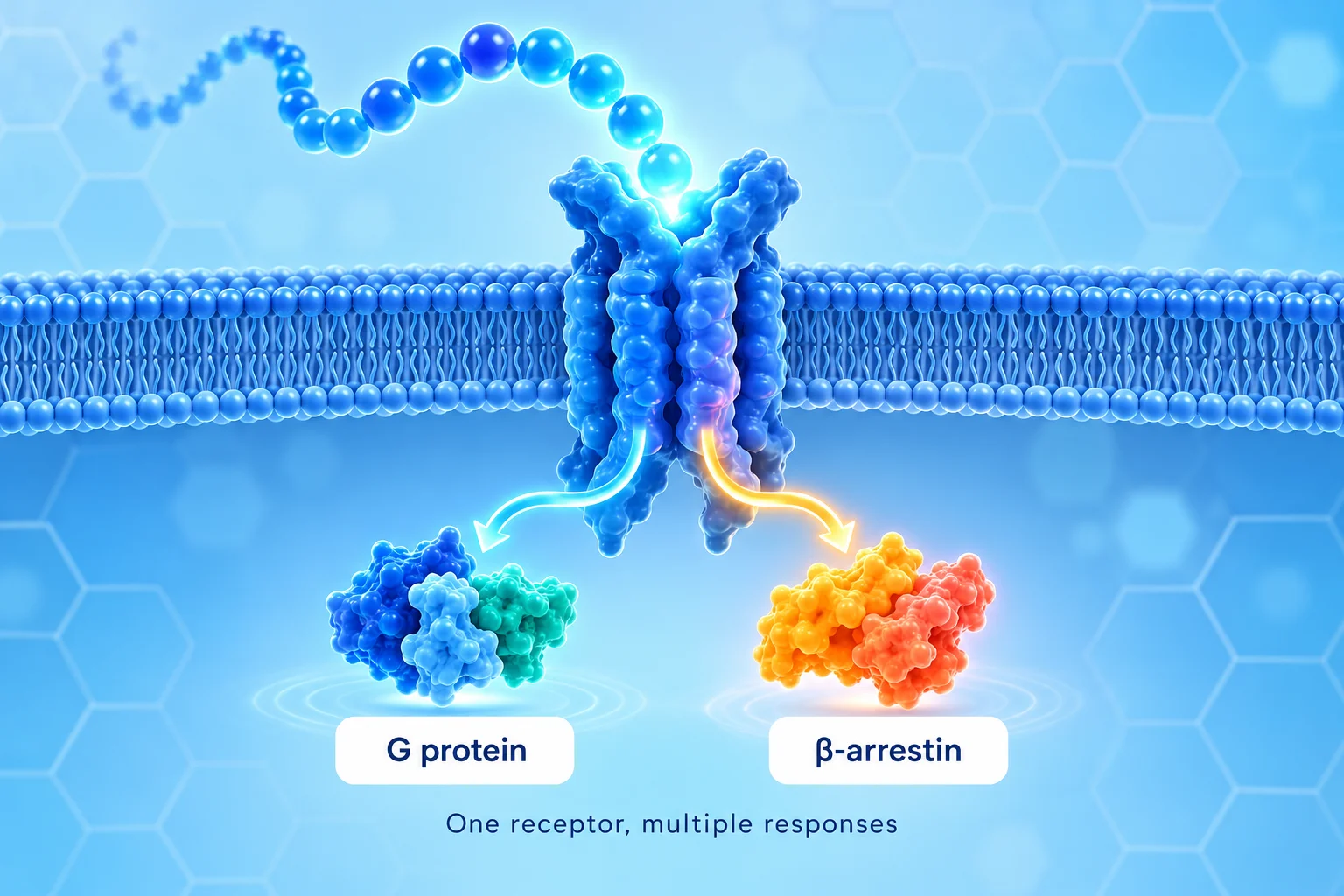


An inverse agonist reduces a receptor's constitutive activity, meaning activity that does not require an activating ligand. A neutral antagonist can block an agonist without changing that constitutive activity in the tested pathway. The distinction depends on the baseline: suppressing an agonist-stimulated response and suppressing ligand-independent receptor activity are different observations.
Receptors can signal without an added agonist
A simple receptor cartoon shows a silent protein waiting for a ligand. That is useful for introducing activation, but it is incomplete. Some receptors can produce measurable activity without an activating ligand. This ligand-independent component is called constitutive activity. Its size depends on the receptor and the experimental system, rather than being a fixed percentage shared by all receptors.
One conceptual model treats a receptor as sampling conformations with different abilities to engage signaling machinery. An agonist favors signaling-competent behavior, whereas an inverse agonist shifts the balance toward less activity in the pathway being observed. This is a teaching model, not a claim that every receptor has only two rigid shapes.
The hero image illustrates that distinction: an unoccupied conceptual receptor produces some basal signaling, and a ligand-bound receptor produces less. The signal beads are illustrative, not measured quantities. For the broader activation vocabulary, start with agonist versus antagonist peptides.
Agonist, neutral antagonist, and inverse agonist
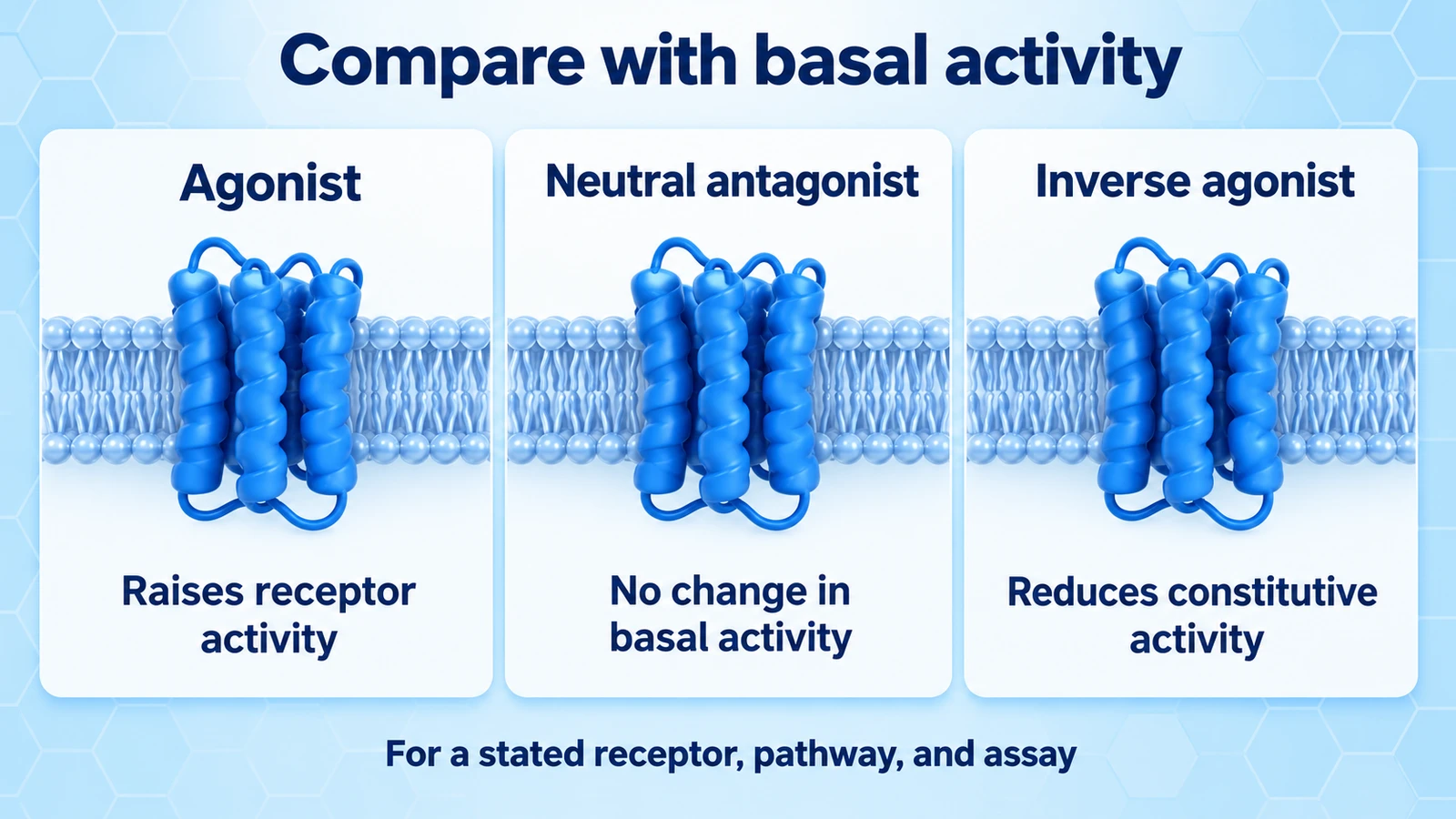
These labels describe functional behavior relative to an appropriate baseline. An agonist increases receptor activity in the specified pathway. A neutral antagonist blocks agonist action while leaving constitutive activity unchanged in that comparison. An inverse agonist reduces constitutive activity and can also antagonize an agonist.
This explains why the older or broader word antagonist does not always settle the mechanism. A paper may establish blockade using an added agonist, yet never examine what the candidate does to the unstimulated receptor. Both a neutral antagonist and an inverse agonist can look inhibitory in that design.
Interpretation assumes an appropriate readout of receptor activity and detectable constitutive signaling.
| Label | Candidate alone relative to constitutive activity | Key comparison |
|---|---|---|
| Agonist | Increases activity | Candidate versus ligand-free receptor baseline |
| Neutral antagonist | No change in constitutive activity | Agonist blockade plus an unchanged baseline |
| Inverse agonist | Reduces constitutive activity | Suppression below the receptor's ligand-free baseline |
| No detected response | No measurable change | Insufficient by itself to assign any of these labels |
The instrument signal may run in the opposite direction
Reduced receptor activity does not always mean a smaller raw number on the instrument. If receptor activation inhibits a measured process, reducing receptor activity can increase that readout. Read the assay's biological meaning and normalization before assigning positive or negative efficacy. The comparison is about receptor-mediated activity, not simply whether a line points up or down.
Basal signal is an observation; constitutive activity is an interpretation
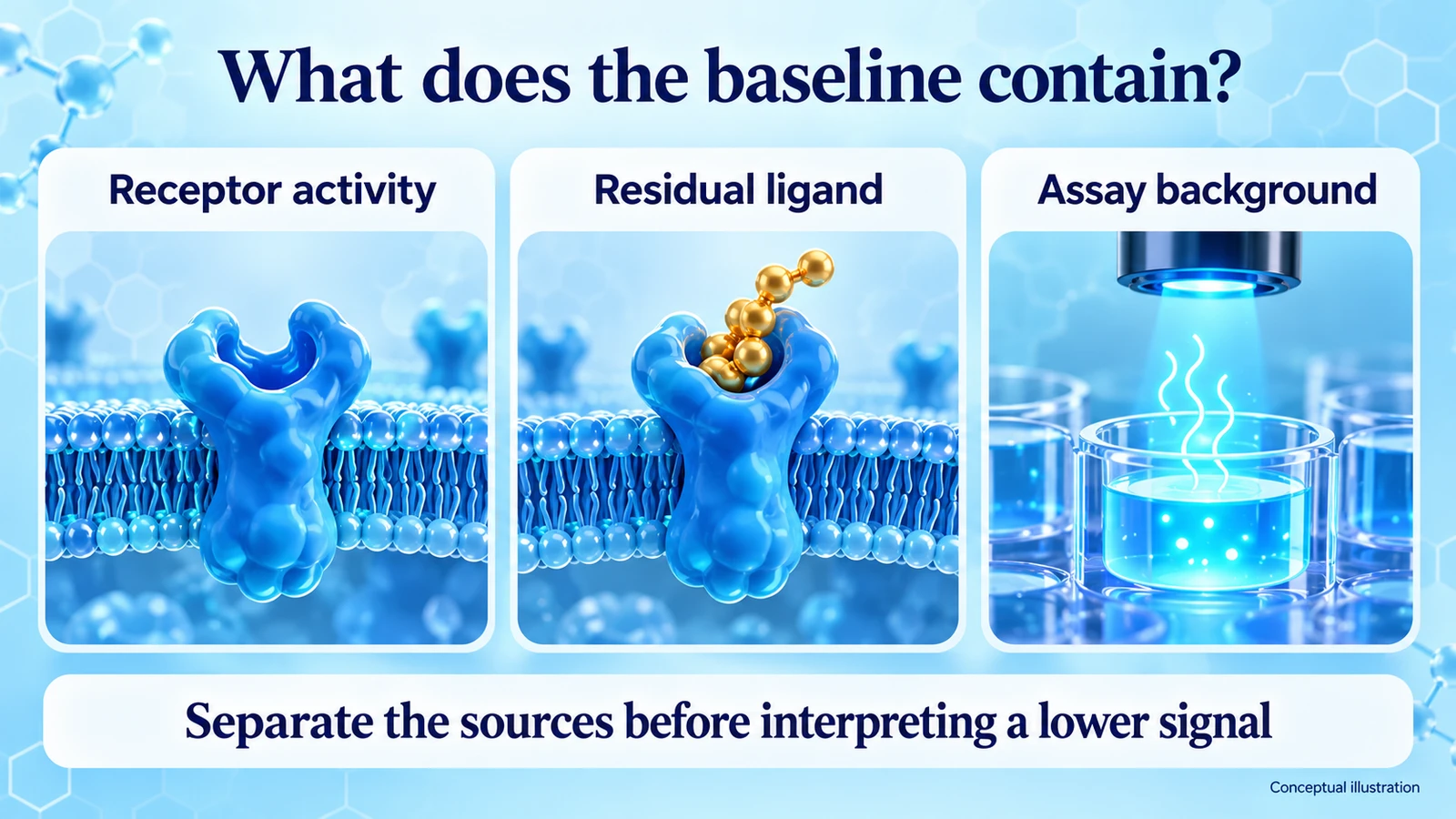
Basal usually means the signal recorded before a specified stimulation or under a vehicle condition. It is an experimental reference, not a guarantee that the receptor is ligand-free. Endogenous agonist released by cells or carried through the preparation can contribute to the measured baseline. A neutral antagonist that blocks this agonist can lower the signal without being an inverse agonist.
The detector also reports a cellular and technical background. A compound might interfere with a reporter, reduce cell viability, or affect a downstream enzyme independently of the receptor. Such changes can mimic suppression of basal receptor activity. Receptor-negative controls and independent readouts help assess those alternatives.
A convincing interpretation therefore connects three observations: a basal component attributable to the receptor, evidence that this component does not require agonist, and a candidate effect consistent with engagement of that receptor. No single low data point answers all three questions.
- Identify what the paper calls basal and which condition defines it.
- Check how residual or cell-derived agonist was considered.
- Look for controls that separate receptor-dependent signal from background.
- Ask whether cell health and direct reporter interference were assessed.
- Compare binding or engagement evidence with the functional finding.
Ghrelin receptor studies made the distinction experimentally visible
Holst and colleagues reported strong ligand-independent signaling from the ghrelin receptor in transfected cells in 2003. A substance P analog reduced that activity toward the level measured in untransfected cells. Its inverse-agonist behavior was distinguishable from its weaker antagonist behavior in agonist-stimulated comparisons. The homologous motilin receptor provided a useful comparison because it responded to its agonist without showing the same basal activity. Read the primary study.
A subsequent study compared ghrelin-family receptors across several signaling readouts and used mutations to alter basal signaling. The findings showed that constitutive activity depends on receptor structure and the pathway measured. They also cautioned against treating one reporter as a complete description of receptor behavior. See the 2004 experiments.
For a reader, the useful question is not whether ghrelin receptors are always active to the same degree. It is what was observed in those cells, at that receptor expression level, through that readout. A cellular demonstration identifies a mechanism; its magnitude cannot simply be assigned to every tissue in a person.
AgRP shows that a peptide can be an inverse agonist
Peptide describes molecular composition, while inverse agonist describes function. Nijenhuis and colleagues found that the AgRP(83–132) fragment suppressed constitutive activity of the human melanocortin-4 receptor in their experimental systems. This extended its characterization beyond antagonism of an added melanocortin agonist. The peptide fragment and receptor identity are part of the finding, not optional details. Read the 2001 report.
Srinivasan and colleagues later examined naturally occurring MC4R variants and identified N-terminal mutations that impaired constitutive activity. Their functional work supported a role for the receptor's own N-terminal region in maintaining basal signaling. These findings linked receptor structure, basal function, and human genetic observations while distinguishing basal activity from the ability to respond to an agonist. See the 2004 study.
An endogenous ligand can therefore have more than one useful pharmacological description. Blocking another ligand and changing ligand-independent activity are separate experimentally testable properties. Neither description alone predicts every signaling pathway or the full physiological outcome.
PTH receptor mutations reveal why the receptor construct matters
Schipani and colleagues identified activating PTH/PTHrP receptor mutations in patients with Jansen's metaphyseal chondrodysplasia and examined their function in cells. Mutant receptors produced higher basal cAMP accumulation than wild-type receptors. The work connected a clinical genetic finding with ligand-independent receptor activation, rather than assuming that abnormal signaling must reflect excess hormone. Read the original clinical and functional study.
Gardella and colleagues used constitutively active mutant PTH/PTHrP receptors to investigate peptide analogs. Certain amino-terminally truncated analogs reduced basal cAMP in the mutant-receptor systems and were characterized as inverse agonists. The study provides a clear peptide-receptor example, but its mutant-receptor context must remain attached to the claim. See the inverse-agonism experiments.
A mutant that raises basal activity can make a negative-efficacy effect easier to detect. It may also alter ligand recognition or signaling in ways that differ from the wild-type receptor. Accordingly, activity at a disease-associated or engineered construct does not automatically establish the same classification, potency, or physiological effect at a normal receptor.
Expression, sensitivity, and pathway change what can be detected
If the ligand-free receptor signal sits close to the assay's background, there may be little measurable room for suppression. An inverse agonist can then appear neutral in that readout. Conversely, a system with many receptors and strong downstream amplification may reveal basal activity that would be harder to detect under another set of conditions.
This is not permission to choose whichever assay gives the desired label. It is a reason to report receptor abundance, baseline separation, uncertainty, and the conditions of the comparison. When studies disagree, ask whether they measured the same pathway using comparable receptor constructs and time windows.
Potency and extent of suppression are also separate. A candidate can reach half of its observed inverse effect at a low concentration while producing only a limited maximal reduction. Terms such as full inverse agonist depend on the available constitutive response and reference used; they do not mean that all signaling everywhere has been eliminated. The related guides to partial versus full agonism and receptor reserve explain why system limits matter.
Molecular changes can alter the direction of efficacy
In ghrelin receptor experiments, Holst and colleagues showed that changes in related peptide ligands and receptor residues could shift behavior between agonism and inverse agonism. This supports treating efficacy as an experimentally established ligand-receptor property. A familiar peptide scaffold or a similar binding affinity does not guarantee the same direction of response. Read the 2007 study.
A worked example: two compounds both block an agonist
Consider invented assay values in which larger numbers reflect greater receptor activity. Receptor-negative cells give 20 units, cells expressing the receptor give 50 units without added agonist, and an agonist raises the response to 100 units. These are hypothetical teaching numbers, not results from a drug study.
Candidate N brings the agonist-stimulated response back to 50 units and leaves the unstimulated response at 50. Candidate I also blocks the agonist, but reduces the unstimulated response to 30. N is consistent with neutral antagonism in this system. I is a candidate inverse agonist, provided the lower signal reflects suppression of constitutive receptor activity and the alternative explanations have been addressed.
Hypothetical readout only. The numbers are not potency estimates or clinical data.
| Condition | Illustrative signal | What it contributes |
|---|---|---|
| Receptor-negative cells | 20 units | Estimate of background in this comparison |
| Receptor present, no added agonist | 50 units | Basal reference requiring further characterization |
| Agonist alone | 100 units | Stimulated reference |
| N alone / N plus agonist | 50 / 50 units | Consistent with neutral antagonism |
| I alone / I plus agonist | 30 / 30 units | Consistent with inverse agonism if controls support it |
Why the background matters
The raw baseline-to-candidate reduction for I is 20 units. The receptor-associated basal component in this simplified example is 30 units above the 20-unit background. Those different denominators produce different percentages. A paper should explain its normalization instead of letting a percentage stand in for the experiment. In real work, variability and the adequacy of the background control also need attention.
If I lowers the signal in receptor-negative cells too, a receptor-independent effect becomes a concern. If the initial 50-unit signal partly reflects residual agonist, blockade could explain some of the drop. The table demonstrates the comparison logic; it does not remove the need for those controls.
Inverse agonism is distinct from allostery, bias, and desensitization
Inverse agonism describes the effect on constitutive activity. Allostery describes an interaction through a site distinct from the endogenous ligand's site. A negative allosteric modulator can reduce an agonist response without reducing constitutive activity. A ligand may have both properties, but evidence for one does not prove the other. See allosteric modulation of peptide receptors.
Signaling bias concerns relative effects across pathways with appropriate comparators. A ligand's inverse behavior in one pathway does not establish the same behavior in all others. Receptor selectivity instead compares different targets. Keep those questions separate using the guides to biased agonism and receptor selectivity.
Desensitization is a change in responsiveness, often following receptor stimulation. A response that declines with time may reflect that adaptation, receptor trafficking, ligand loss, or changes elsewhere in the cell. It is not automatically evidence that the ligand has become an inverse agonist. The unstimulated reference and mechanism remain essential.
Lower basal signaling is not automatically better
Constitutive activity is not a synonym for a defective receptor. Its biological significance depends on the receptor, tissue, and context. Excess basal signaling can be important in some activating mutations, while loss of basal signaling can also be associated with altered function.
Pantel and colleagues described a ghrelin receptor variant in two families with short stature. Functional experiments found impaired constitutive activity with preserved responsiveness to ghrelin, alongside reduced cell-surface expression. The study illustrates why basal activity and agonist responsiveness deserve separate investigation. It does not isolate every effect of the mutation or predict what a pharmacological inverse agonist would do in a different population. Read the human genetic study.
Before translating a receptor result into a health claim, identify the intervention, exposure, tissue, and outcome actually studied. The studies here explain mechanisms and experimental interpretation. They do not establish personal-use combinations, treatment protocols, or a general advantage of suppressing peptide-receptor signaling.
How to assess the next inverse-agonist claim
Start with the sentence: this ligand reduced this receptor-dependent, ligand-independent activity in this system. If the paper does not supply those details, narrow the claim to what it actually measured. A specific observation is more useful than an expansive label.
Then inspect whether the evidence separates the baseline from background and agonist tone, and whether it distinguishes neutral blockade from inverse efficacy. A binding measurement can support receptor engagement, but functional evidence determines the direction of efficacy.
- Name the receptor species, sequence, and any activating mutation.
- Identify the readout and whether higher values mean more or less receptor activity.
- Locate candidate-alone results as well as agonist-blocking results.
- Check the evidence for ligand-independent basal activity.
- Review receptor expression, assay background, and interference controls.
- Keep potency, maximal suppression, and normalization distinct.
- Limit the conclusion to the pathway, system, and outcomes tested.
Continue the receptor-science series
The Research & Science hub connects these receptor concepts. Use how to compare peptide studies to assess differences between experiments, Peptide Basics for molecular vocabulary, and Safety & Guides for the limits of product and health claims.