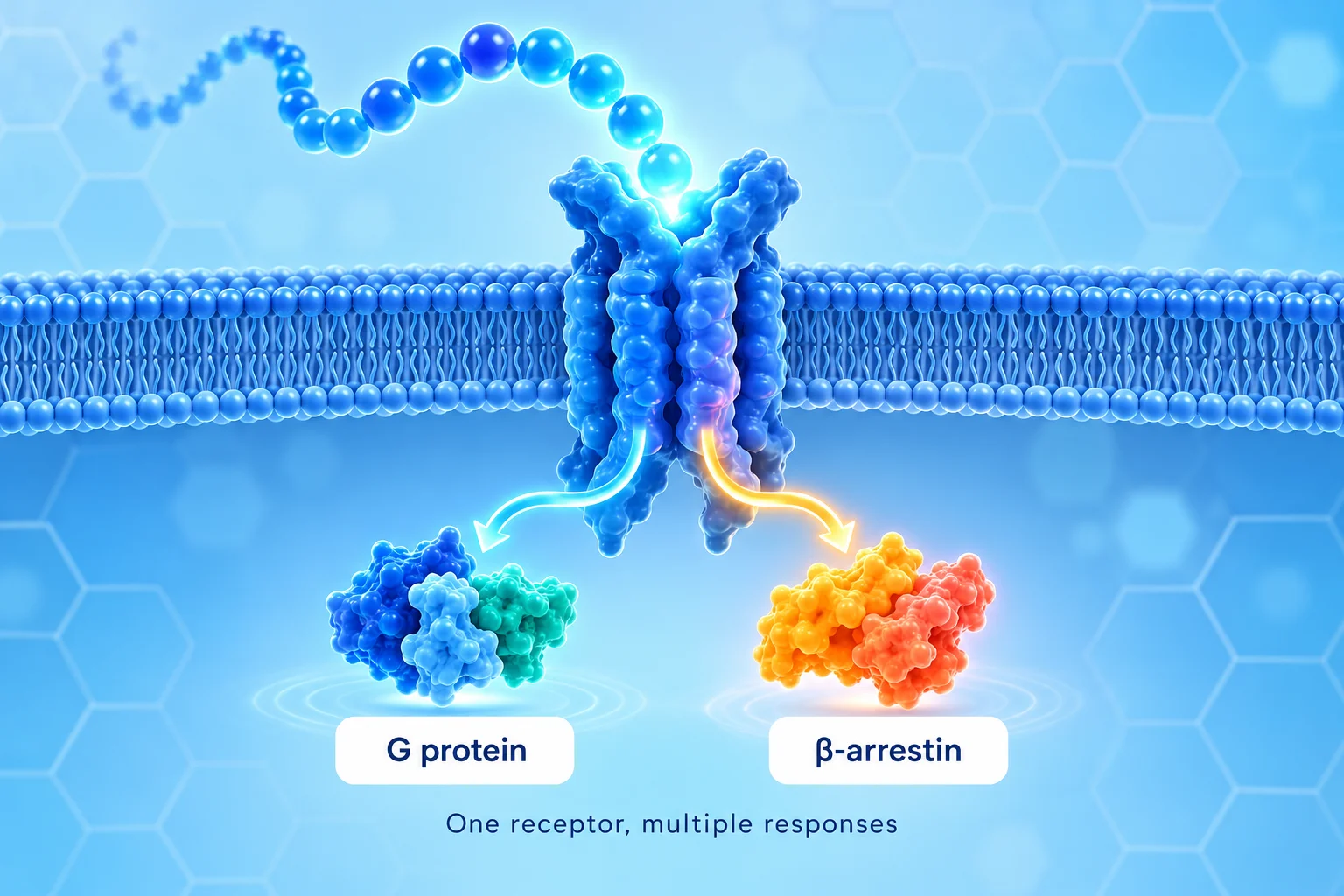


Allosteric modulation occurs when a ligand interacts with a receptor at a site distinct from the endogenous ligand's binding site and changes that ligand's binding or effects. For peptide receptors, the modulator may itself be a nonpeptide molecule. Understanding the claim requires three identities: the receptor, the peptide being tested, and the measured response.
Orthosteric and allosteric describe where an interaction occurs
The orthosteric site is the receptor region used by its endogenous ligand. An allosteric ligand engages a distinct site, allowing an interaction between the two binding events through the receptor. Think of a protein whose conformational preferences can change when another part of it is occupied. The illustration above is a conceptual map of that relationship, not a structure of a particular receptor.
For a peptide receptor, the endogenous ligand may contact an extended surface rather than a single small pocket. A diagram with two neat holes is therefore a teaching simplification. Evidence for a separate interaction site must come from experiments, not from how different the two molecules look.
The distinction also does not tell you whether a molecule is a peptide, a small molecule, an agonist, or an antagonist. Those are separate descriptions. The early GLP-1 receptor work of Knudsen and colleagues identified small molecules with both receptor-activating and allosteric properties, illustrating why chemical class and pharmacological role should be named separately. Read the original study.
PAM, NAM, and neutral modulation need a stated comparison

Positive and negative refer to the direction of modulation, not whether an outcome is beneficial or harmful. A positive allosteric modulator, or PAM, enhances a specified interaction involving the orthosteric ligand. A negative allosteric modulator, or NAM, reduces it. Always look for what was actually measured: ligand binding, cAMP production, calcium signaling, or another endpoint.
A neutral allosteric ligand can occupy a separate site without detectably changing the tested orthosteric interaction. Calling it neutral requires evidence of engagement; a compound that simply produces no response has not thereby been shown to bind an allosteric site. Neutrality in one comparison does not establish inactivity in every possible comparison.
Reducing an agonist's effect is also distinct from reducing ligand-independent receptor activity. The companion guide to inverse agonism and constitutive activity explains the baseline comparisons needed to tell those effects apart.
Terms describe distinct properties and can overlap in one ligand.
| Term | What it describes | What to check |
|---|---|---|
| PAM | Enhancement of a specified orthosteric interaction | Which peptide and which binding or signaling endpoint? |
| NAM | Reduction of a specified orthosteric interaction | Does inhibition reflect receptor modulation or an assay effect? |
| Neutral allosteric ligand | Binding with no detected modulation in the tested comparison | What demonstrates engagement despite no change in the readout? |
| Allosteric agonist | Receptor activation through a distinct site | What happens when the ligand is tested alone? |
| Ago-PAM | Intrinsic agonism plus positive modulation | Are both properties supported by separate comparisons? |
Changing affinity and changing efficacy are different effects
Binding cooperativity describes how occupancy of one site changes binding at the other. Favorable cooperativity can make an orthosteric ligand bind more readily at equilibrium. Efficacy modulation concerns how effectively the ligand-bound receptor produces a response. A modulator may affect either property or both, so a single functional curve usually cannot separate them.
A leftward shift in a concentration-response curve means less orthosteric ligand was needed for the specified response in that experiment. A higher maximum means the assay recorded a larger maximal response. Neither observation alone identifies the binding site. Changes in ligand availability, the reporting system, or cellular state can also alter the curve.
The experimental ceiling matters. If the peptide already reaches the maximum available output, additional efficacy may be difficult to see. Conversely, amplification can make modest receptor activation look nearly maximal downstream. Compare the separate concepts in affinity versus efficacy, potency versus efficacy, and receptor reserve.
A combination response must account for modulator-alone activity
If the candidate activates the receptor by itself, a larger response after adding the peptide does not automatically quantify positive cooperativity. The analysis must distinguish the candidate's own agonism from its effect on the peptide. This is why the peptide-alone, modulator-alone, and combination comparisons answer different questions.
Coopman and colleagues found that compound 2 behaved differently across GLP-1 receptor readouts, including Gs activation and cAMP accumulation. They also reported cell-damaging effects that complicated longer experiments. The paper is a useful reminder to examine both signaling context and assay integrity before treating a larger signal as stronger receptor modulation. See the primary report.
Probe dependence: change the peptide, change the interaction

The probe is the orthosteric ligand used to investigate modulation. Probe dependence means that a modulator's effect can differ when that ligand changes, even if the receptor remains the same. A result obtained with one reference peptide is therefore not a blanket prediction for every agonist that activates that receptor.
Koole and colleagues compared several GLP-1 receptor peptide ligands and signaling readouts. Compound 2 enhanced cAMP responses more strongly with oxyntomodulin than with some GLP-1 forms, while other combinations showed little modulation. The effects also depended on the measured pathway. This is direct evidence that the phrase GLP-1 receptor PAM needs more context than the receptor name alone. Read the 2010 study.
Peptide processing adds another layer. Wootten and colleagues investigated allosteric modulation of endogenous metabolites, including GLP-1(9–36) amide. Their findings showed that a metabolite could respond differently from its parent ligand. The lesson for reading a paper is to retain the complete ligand identity, including sequence boundaries and terminal modifications. It is not evidence that combining substances will improve an outcome in people. See the metabolite study.
Allostery, receptor selectivity, and signaling bias answer different questions
Receptor selectivity compares action across targets. Allostery concerns the relationship between interaction sites on a receptor. Signaling bias compares relative responses through a receptor, with an appropriate reference and analysis. A ligand can have all three properties, but evidence for one does not establish the others.
For example, an allosteric compound could prefer one receptor subtype yet modulate two pathways differently within that receptor. Alternatively, a peptide could show signaling bias while acting through the orthosteric site. The phrase selective signaling should prompt a search for the actual comparison: targets, pathways, or peptide probes.
When a study compares pathways, check whether timing, amplification, and assay sensitivity differ. A larger raw cAMP signal than calcium signal is not a meaningful bias measurement by itself. Continue with peptide receptor selectivity and biased agonism for the corresponding comparison frameworks.
What supports a distinct modulatory site?
Functional results describe what changes. Binding measurements, receptor mutations, chemical engagement studies, and structural work help explain how. Confidence is stronger when independent types of evidence support the same interpretation and plausible assay artifacts have been addressed.
In GLP-1 receptor mutagenesis experiments, Koole and colleagues found that changes in the second extracellular loop affected peptide responses differently from responses to compound 2. That supports differing activation mechanisms, but a mutation is not automatically a map of direct molecular contact. It can also change receptor expression, folding, or communication between regions. Read the 2012 study.
Read each evidence type for the question it can answer.
| Evidence | Useful contribution | Important limit |
|---|---|---|
| Functional concentration-response data | Describes modulation of a measured output | Does not alone locate the interaction site |
| Binding experiments | Tests ligand engagement and binding interactions | Binding changes need not predict every signaling response |
| Receptor mutations | Identifies residues that influence an effect | Changes can affect expression or conformation indirectly |
| Chemical engagement measurements | Can support direct or covalent interaction | Reactivity and other protein targets still require assessment |
| Receptor structure | Locates a ligand in a captured receptor state | One construct and state do not represent all cellular behavior |
A GLP-1 receptor structure illustrates the distinction
Song and colleagues determined structures of the human GLP-1 receptor transmembrane domain with the negative allosteric modulators PF-06372222 and NNC0640. The ligands occupied a pocket outside transmembrane helices V–VII toward the intracellular side and stabilized an inactive conformation. This is a concrete example of modulation at a location distinct from extracellular peptide recognition. See the structural study.
The study's directly observed NAM complexes should be distinguished from its modeling and mutagenesis-based interpretation of positive modulation. More generally, a captured receptor domain is evidence about that construct and state. Connecting it to an intact receptor's responses requires the accompanying functional work.
Not every allosteric interaction is a reversible switch
Simple cartoons often imply that a modulator attaches briefly and then leaves unchanged. Some research compounds behave differently. Nolte and colleagues showed that BETP covalently modified the GLP-1 receptor, with a particular cysteine residue important for its modulatory activity. That chemical mechanism matters when interpreting how exposure time and removal of free compound relate to the observed response. Read the covalent-modification study.
Bueno and colleagues subsequently examined diverse electrophilic compounds and GLP-1 receptor potentiation. Their work included chemical-reactivity measurements and receptor-dependent functional experiments, reinforcing the need to evaluate engagement chemistry alongside a signaling readout. It does not establish that electrophilic reactivity is desirable or safe in a clinical product. See the primary paper.
The general reading lesson is to avoid assuming reversibility, equilibrium behavior, or a common time course merely because two compounds share the label PAM. Mechanism-specific evidence should determine the interpretation.
A hypothetical result: what can the headline actually say?
Imagine a paper reports that candidate M shifts peptide A's cAMP response to the left, has little effect with peptide B, and shows no detectable activity alone in that assay. These are invented observations for interpretation, not experimental data or a proposed combination.
A careful first description is that M increases peptide A's apparent cAMP potency under the tested conditions, with different behavior for peptide B. If engagement at a distinct receptor site is also supported, the findings are consistent with probe-dependent positive allosteric modulation. Without that site evidence, the functional observations remain useful but the mechanism is less certain.
The result does not establish stronger peptide binding unless binding was assessed appropriately. It does not establish positive modulation of calcium or arrestin responses, because those were not part of the example. It does not establish clinical superiority. Those are different questions requiring additional evidence.
Now imagine the experiment used only peptide A. The absence of a peptide B comparison would leave probe dependence unknown, rather than disproven. This distinction between a negative result and a missing comparison is one of the most useful habits when reading allostery claims.
A modulation ceiling is not a clinical safety guarantee
An allosteric effect may approach a ceiling as the relevant interaction becomes saturated in a particular model. That observation can be pharmacologically informative, but it is not a universal cap on every biological effect. Intrinsic agonism, other receptor interactions, reactive chemistry, and different tissue environments may matter outside that experiment.
Likewise, dependence on an endogenous peptide does not automatically preserve normal physiology. Peptide availability varies between tissues and over time, and the modulator may alter more than one aspect of receptor behavior. The measured endpoint also matters: a biochemical signal is not a patient outcome.
The studies discussed here explain mechanisms in receptor, cell, and other experimental systems. They do not provide instructions for combining medicines, supplements, or research chemicals. Clinical benefit and safety require evidence for the specific intervention, population, and outcome. Our Safety & Guides hub covers broader evidence and product-literacy questions.
A practical checklist for the next allostery paper
Write a one-sentence description that names the receptor, orthosteric peptide, candidate modulator, endpoint, and experimental system. Then separate the measured finding from the proposed mechanism. This prevents a broad label such as receptor enhancer from replacing the actual evidence.
- Identify the complete peptide probe, receptor species, and cellular context.
- Check peptide-alone, modulator-alone, and combination results.
- Distinguish binding measurements from functional potency and maximum response.
- Look for comparisons across peptide probes and signaling pathways.
- Ask what supports a separate site and what addresses assay interference.
- Keep direct structures, mutation results, and model-based interpretations distinct.
- Check whether chemical reactivity or time dependence changes the mechanism being claimed.
- State the limits of the experiment before drawing conclusions about clinical outcomes.
Continue the receptor-literacy series
Use agonist versus antagonist terminology for activation and blockade, and how to compare peptide studies for differences between experimental systems. The Research & Science hub connects the series, while Peptide Basics explains the underlying molecular vocabulary.